

Why are prediction market traders suddenly bearish on Nvidia's stock?
Nvidia (NASDAQ: NVDA) stock is still green for 2026, but the trade no longer looks clean from the company that outperformed every other company and country in 2024 and 2025. NND is up about 12% this year, yet they have slipped roughly 3% over the past month.
The gap with the rest of the chip market is hard to ignore. The VanEck Semiconductor ETF (NASDAQ: SMH) has jumped about 84% in 2026 and added 15% in the last month alone. That helped Micron (NASDAQ: MU) and SanDisk (NASDAQ: SNDK) rally nearly 60% each over the past month.
Traders price in weaker demand for Nvidia’s B200 compute
The major stress point here is Nvidia’s B200 GPU. This is Nvidia’s top-end data center chip designed for intensive workload and extensive models’ training. Supposedly, it allows investors to estimate the level of demand by observing the price of computational power leasing because it shows how much people are willing to pay for that access.
The price of B200 compute on May 30 was $6.11 per hour, being the highest in three months, but as of yesterday, it reached the mark of $4.22 per hour.
Kalshi’s market has a contract asks whether the price of Nvidia B200 compute for Q2 ends up above a certain level before June 30. The value is determined by Ornn’s dashboard.
Meanwhile, Polymarket traders give Nvidia only 3% odds of hitting $236, 20% odds of hitting $220, and 35% odds of hitting $216 by June 26. The heavier bets sit lower, with traders pricing a 62% chance of Nvidia crashing to $204 and a 40% chance of falling to $200. At Monday’s close, Nvidia was worth $208.78, down 1.20% in twenty-four hours.
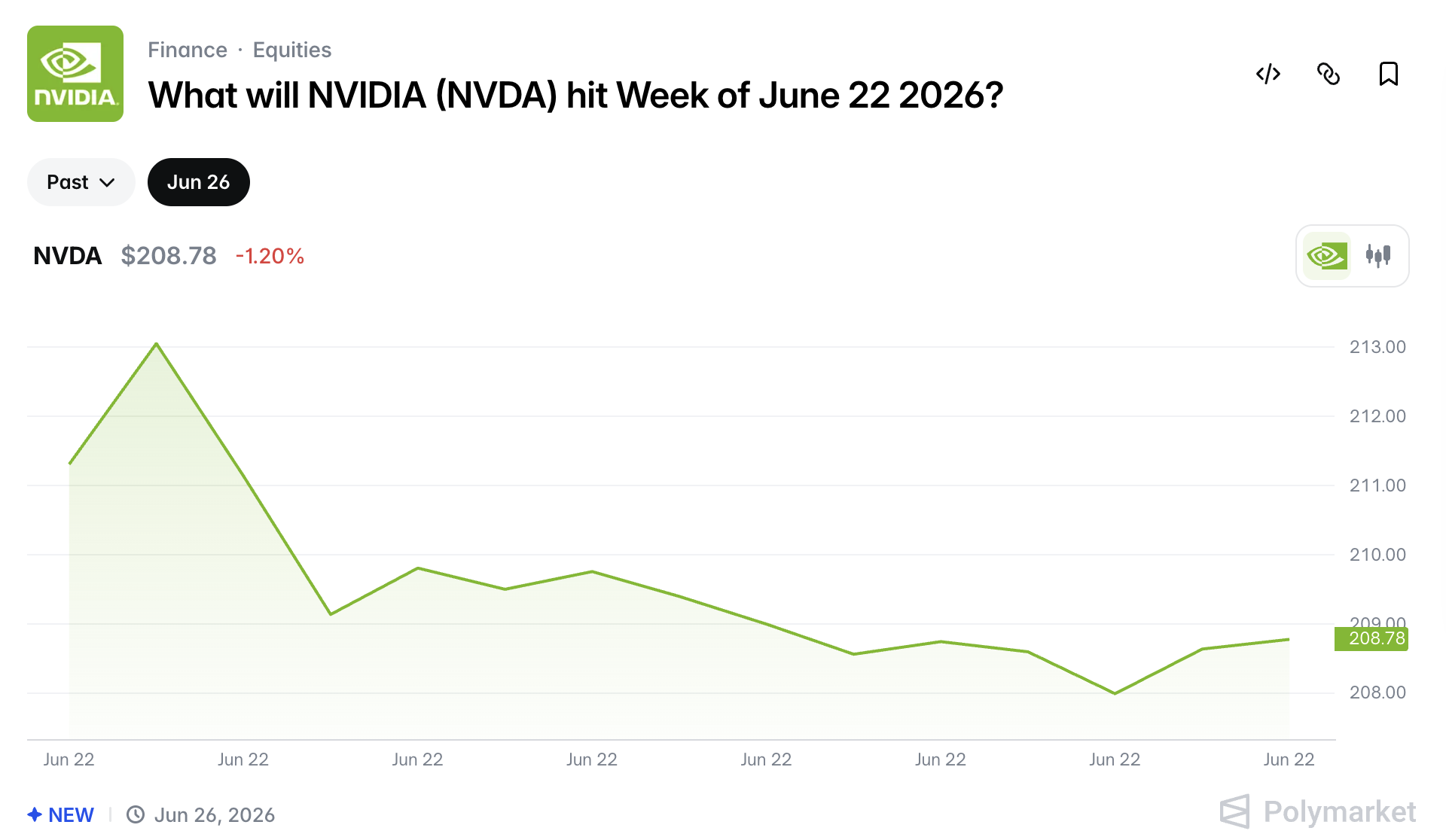 Source: Polymarket
Nvidia is currently trading at 0.5% under its 20-day simple moving average of $211.79. At the same time, the stock is still 0.7% higher than its 50-day simple moving average of $209.31. Therefore, Nvidia shares continue to hold near short-term support levels despite recent pullbacks.
The longer chart continues to look more bullish. Nvidia shares trade at 7.6% above its 100-day simple moving average of $195.77 and about 10.9% higher than its 200-day simple moving average of $189.90. Besides, the 20-day simple moving average continues to be above the 50-day one.
However, when NVDA rises above the MACD signal line, buying interest might become more positive, but once it drops below the line, the price of the stock may remain confined within a narrow range. NVDA resistance lies at $217.00 while its support lies at $209.00.
Analysts keep Buy ratings while chip money rotates elsewhere
The next major date for Nvidia is its expected earnings release on Aug. 26, 2026. Wall Street expects earnings per share of $2.06, compared with $1.04 in the same quarter last year. Revenue is expected to reach $91.70 billion, up from $46.74 billion a year earlier.
Nvidia trades at about 32.3 times trailing earnings. Analysts still carry a Buy consensus on the stock, with an average price target of $323.83. China Renaissance started coverage on June 5 with a Buy rating and a $319 target. Needham repeated its Buy rating on June 2 and kept its $270 target. DA Davidson kept its Buy rating on June 1 with a $300 target.
Meanwhile, in the US stock market on Monday, the S&P 500 index fell by 0.37% to 7,472.79 at close, the Nasdaq Composite dropped by 1.32% to 26,166.60, and the Dow gained 148.01 points, or 0.29%, helped by a nearly 4% rise in Caterpillar (NYSE: CAT).
Chip stock Micron (NASDAQ: MU) rose almost 7% before its quarterly report, which is due Wednesday after the close. Advanced Micro Devices (NASDAQ: AMD) too gained more than 2%, and Intel (NASDAQ: INTC) climbed 5%, continuing what is proving to be a bull run.
Oil also added to the market noise. Brent turned lower Monday after Qatar and Pakistan said U.S. and Iranian officials had agreed on a roadmap for a final deal within 60 days. Prices later traded near session lows after the U.S. Treasury Department allowed Iranian oil sales for 60 days.
August Brent crude fell 3.31% to $77.90 a barrel. July West Texas Intermediate crude lost 2.32% and closed at $74.82.
If you're reading this, you’re already ahead. Stay there with our newsletter.


You May Also Like
Fed’s Shift to Quieter Guidance: The ‘Warsh Era’ Begins, Says BNY

Best Crypto to Buy With $750? Experts Compare Pepecoin (PEPE) and New Protocols

What is ‘GoreBox’, the video game temporarily banned by the CICC?



