SpaceX’s post-IPO rally has evolved beyond a simple first-day demand story. After pricing its shares at $135, opening near $150, and quickly surging past the $200 threshold, the market is now entering a critical testing phase. The most significant shift is the entry of derivatives: the emergence of record first-day options activity has transformed SpaceX from a standard IPO momentum play into a complex, volatility-driven price-discovery narrative. In this new regime, round-number psychological levels, dealer hedging, and implied volatility often dictate short-term price action as much as the company’s long-term aerospace ambitions.SpaceX’s post-IPO rally has evolved beyond a simple first-day demand story. After pricing its shares at $135, opening near $150, and quickly surging past the $200 threshold, the market is now entering a critical testing phase. The most significant shift is the entry of derivatives: the emergence of record first-day options activity has transformed SpaceX from a standard IPO momentum play into a complex, volatility-driven price-discovery narrative. In this new regime, round-number psychological levels, dealer hedging, and implied volatility often dictate short-term price action as much as the company’s long-term aerospace ambitions.

SpaceX Options Surge: Turning IPO Momentum Into a Volatility Test

2026/06/17 16:40
4 min read
For feedback or concerns regarding this content, please contact us at [email protected]
News Brief
SpaceX’s post-IPO rally has evolved beyond a simple first-day demand story. After pricing its shares at $135, opening near $150, and quickly surging past the $200 threshold, the market is now entering a critical testing phase. The most significant shift is the entry of derivatives: the emergence of record first-day options activity has transformed SpaceX from a standard IPO momentum play into a complex, volatility-driven price-discovery narrative. In this new regime, round-number psychological levels, dealer hedging, and implied volatility often dictate short-term price action as much as the company’s long-term aerospace ambitions.

Options Trading: The New Engine of Volatility

The most important signal for traders right now isn't the latest corporate headline; it is the rapid maturation of the options market.

Before options were available, SpaceX’s price discovery was driven primarily by equity demand—IPO allocations, institutional positioning, and scarcity value. Now, the stock has gained a second engine. With active calls and puts, dealer hedging can amplify intraday volatility, particularly around psychological round numbers like $200, $225, or $250.

Because SpaceX currently lacks a long-term earnings history as a public entity or a stabilized options surface, this derivative activity reflects market uncertainty as much as it does directional conviction. SpaceX is increasingly being priced not just as a rocket manufacturer or a satellite internet provider, but as a high-octane volatility product. Consequently, in the short term, the stock’s movement is arguably more sensitive to technical flow than to fundamentals.

The $200 Level as a Price-Discovery Benchmark

The $200 area has become the definitive line in the sand for the market. Following a post-IPO rally above $200, the stock has absorbed a massive valuation reset in a matter of days.

This does not necessarily signal the end of the rally; rather, it shifts the burden of proof. Below $200, the market remains divided on whether the initial surge was an overshoot. Above $200, buyers are signaling a willingness to pay a premium for scarcity and growth optionality. Investors are watching closely: if the stock holds this level with sustained volume, the bullish narrative remains intact. If it faces repeated rejection, the sentiment could quickly shift from "institutional accumulation" to "exhaustion of the initial IPO enthusiasm."

AST SpaceMobile and the Event-Beta Channel

The current market environment offers interesting cross-currents, specifically regarding the BlueBird 8–10 mission. While this launch highlights SpaceX’s high-cadence execution, it provides a different strategic read-through for satellite players like AST SpaceMobile (ASTS).

For SpaceX, the mission reinforces its role as an operating machine—managing commercial launches, NASA contracts, and satellite deployments simultaneously. For ASTS, however, the successful deployment of these satellites provides direct business-model validation. This makes ASTS a cleaner "high-beta" sympathy play, while SpaceX remains the broader liquidity and momentum vehicle. For those looking to hedge or diversify their exposure in this sector, tracking the evolution of the broader space ecosystem—including instruments like the SPCXSTOCK_USDT futures market—can provide a more comprehensive view of how liquidity is flowing through these related assets.

Dragon Return: Execution Density vs. Equity Catalyst

The CRS-34 Dragon return serves as a reminder of SpaceX’s "execution density," though it should not be mistaken for a primary equity catalyst.

While operational success is the baseline expectation for SpaceX, the market’s reaction is often asymmetric: a perfect mission supports the existing premium, but a single technical snag could trigger an outsized negative reaction. In a market already pricing in near-perfection, routine success protects the valuation, but it rarely acts as a catalyst for a new leg higher.

The Risk of "Good News" Saturation

The biggest risk for SpaceX at this stage is that the bar for positive sentiment has been set extremely high. When a stock experiences such a rapid IPO repricing, the market moves quickly from the "scarcity" phase to the "momentum" phase, and finally into the "validation" phase.

SpaceX is entering that third stage at an accelerated pace. The arrival of liquid options can either extend momentum through dealer hedging or accelerate a decline through premium decay if the stock stalls. Investors must recognize that the market is no longer asking whether SpaceX is a great company—it is asking whether the current price leaves any room for error.

Conclusion

SpaceX remains the most compelling post-IPO story in the current market, but the trade has become more fragile. The narrative has shifted from pure IPO scarcity into a complex volatility-pricing game.

The path forward depends on three factors: whether the $200 support zone holds, whether options demand continues to fuel sustainable volume rather than just inflating premiums, and how related event-driven catalysts like the ASTS mission impact sector sentiment. Investors are clearly hungry for exposure, but they are now seeking that exposure through a complex mix of leveraged, hedged, and event-driven channels. Above $200, the market remains in "growth mode," but failure to hold this key level could mark the first true test of SpaceX’s public-market premium.

Articles written by the MEXC News editorial team are for general informational purposes only and do not constitute financial, investment, or trading advice. Crypto markets are highly volatile, please conduct your own research and independently verify information before making financial decisions. Produced in accordance with our Editorial Policy, MEXC assumes no liability for losses incurred from reliance on this content. To report copyright or third-party rights infringement, please contact [email protected].

You May Also Like

Tokenized Stock Trading: How the SEC's 5-Year Trial Works
Tokenized Stock Trading: How the SEC's 5-Year Trial Works

The U.S. Securities and Exchange Commission has created a five-year regulatory pathway for limited onchain trading of tokenized U.S. equities, marking one of the clearest attempts yet to bring blockchain-native market structure into the National Market System. On September 17, 2026, the SEC issued its “Innovation Exemption,” granting temporary and conditional relief to qualifying Tokenized Securities Venues, or TSVs, that use permissioned automated market makers and liquidity pools to facilitate tokenized stock trading. The relief also covers certain liquidity providers that would otherwise potentially fall within the Exchange Act definition of a dealer
Share
MEXC NEWS2026/09/22 13:42
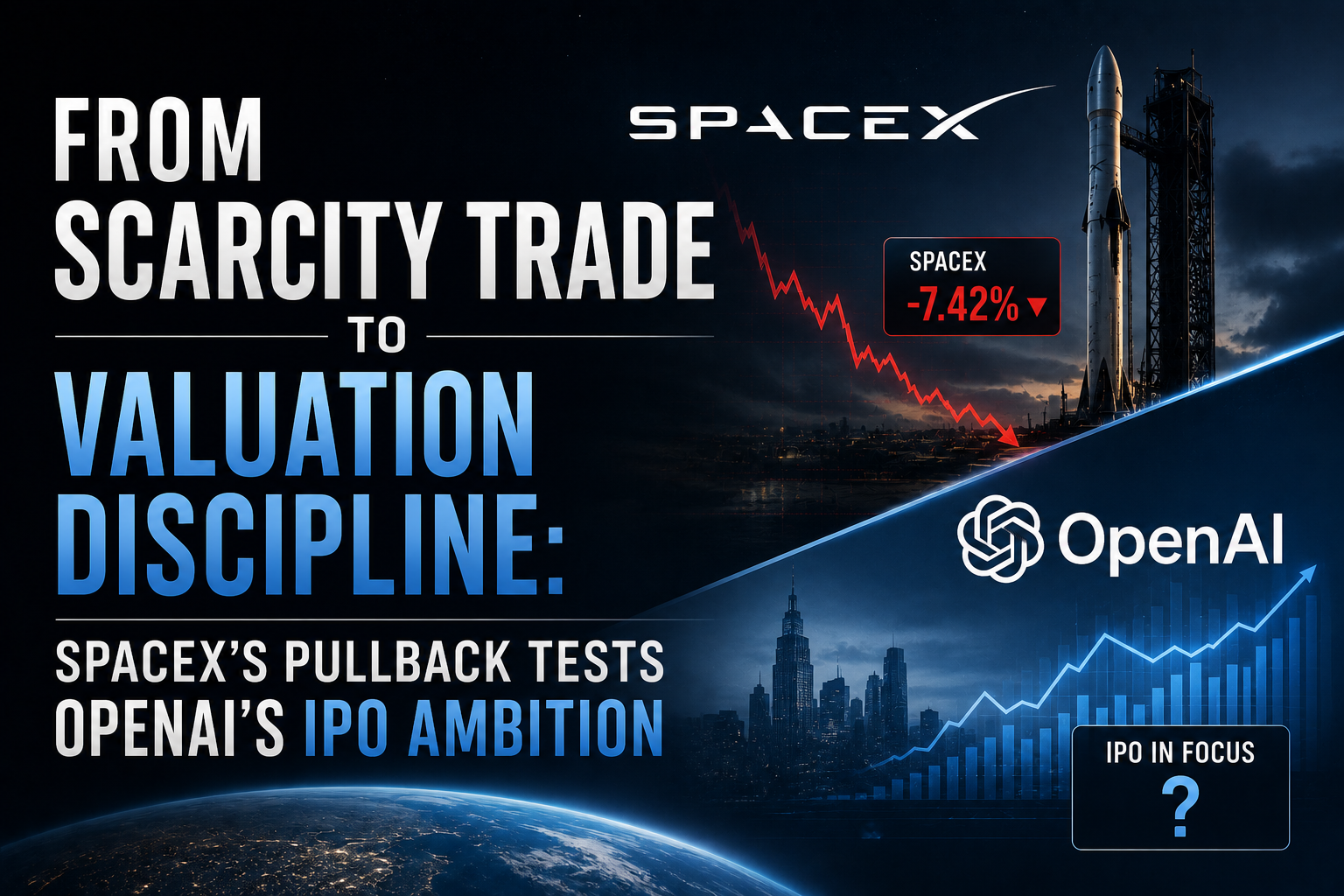
From Scarcity Trade to Valuation Discipline: SpaceX’s Pullback Tests OpenAI’s IPO Ambition

From Scarcity Trade to Valuation Discipline: SpaceX’s Pullback Tests OpenAI’s IPO Ambition

OpenAI is reportedly leaning toward delaying its IPO until 2027, but the sharper market signal is coming from SpaceX. SpaceX closed down 16.4% at $154.60 on June 22, down 31.5% from its $225.64 intraday high, though still 14.5% above its $135 IPO price. That move turned SpaceX from a clean scarcity-driven IPO success into the first major public-market stress test for the AI-adjacent mega-listing cycle. OpenAI’s issue is not demand, but price. Reuters, citing The New York Times, reported that OpenAI is considering waiting until 2027 to preserve a valuation target of up to $1 trillion, while advisers have framed the choice as either waiting for that valuation or going public sooner at a lower target. Prediction markets are already reflecting that caution. Polymarket’s OpenAI IPO market recently showed roughly one-in-four odds for an OpenAI IPO by Dec. 31, 2026, signaling that traders no longer see a near-term listing as the clear base case. For crypto traders, that makes AI pre-IPO exposure less of a one-way scarcity trade and more of a valuation-discipline trade tied to public-market benchmarks.
Share
MEXC NEWS2026/06/29 16:38
Bitcoin-Backed Borrowing: How Circle Unlocks USDC

Bitcoin-Backed Borrowing: How Circle Unlocks USDC

Circle has launched Digital Asset-Backed Borrowing for eligible Circle Mint LLC customers, creating an integrated institutional workflow that allows Bitcoin holders to access USDC liquidity without first selling their BTC. Launched on September 21, 2026, the service allows eligible customers to deposit BTC, mint Circle Wrapped Bitcoin (cirBTC), move that tokenized collateral through a wallet they control into supported third-party lending markets, and receive borrowed USDC directly in Circle Mint. The workflow is available across Arc and Ethereum, with Morpho-supported markets included at launch
Share
MEXC NEWS2026/09/22 13:44