TLDR Vitalik Buterin believes low-risk DeFi could serve as Ethereum’s stable revenue source, similar to how Google Search funds Google’s other ventures He sees low-risk protocols like stablecoin lending as a way to balance profit generation with Ethereum’s founding values Current stablecoin lending yields around 5% for blue-chip assets, providing reliable returns without high speculation [...] The post Why Vitalik Thinks Low-Risk DeFi Could Be Ethereum’s Secret Weapon appeared first on CoinCentral.TLDR Vitalik Buterin believes low-risk DeFi could serve as Ethereum’s stable revenue source, similar to how Google Search funds Google’s other ventures He sees low-risk protocols like stablecoin lending as a way to balance profit generation with Ethereum’s founding values Current stablecoin lending yields around 5% for blue-chip assets, providing reliable returns without high speculation [...] The post Why Vitalik Thinks Low-Risk DeFi Could Be Ethereum’s Secret Weapon appeared first on CoinCentral.

Why Vitalik Thinks Low-Risk DeFi Could Be Ethereum’s Secret Weapon

2025/09/22 15:14
3 min read

TLDR

  • Vitalik Buterin believes low-risk DeFi could serve as Ethereum’s stable revenue source, similar to how Google Search funds Google’s other ventures
  • He sees low-risk protocols like stablecoin lending as a way to balance profit generation with Ethereum’s founding values
  • Current stablecoin lending yields around 5% for blue-chip assets, providing reliable returns without high speculation
  • Ethereum’s DeFi ecosystem has rebounded with total value locked crossing $100 billion for the first time since early 2022
  • Buterin also promotes basket currencies and flatcoins as alternatives to dollar-denominated financial tools

Ethereum co-founder Vitalik Buterin has outlined a vision where low-risk decentralized finance protocols could become the network’s primary revenue driver. He compares this model to Google Search, which generates steady ad revenue that funds the company’s broader ecosystem.

In a recent blog post, Buterin argued that Ethereum needs a stable income source that doesn’t compromise its founding principles. The current ecosystem faces a split between high-fee speculative products and value-aligned applications that struggle financially.

Low-risk DeFi protocols offer a middle ground. These include basic financial services like payments, savings accounts, and collateralized lending that have matured since DeFi’s volatile early days.

Buterin points to Aave’s lending rates as a concrete example. Blue-chip stablecoins like USDT and USDC currently yield around 5% through these platforms. Higher-risk assets offer returns exceeding 10%.

The Ethereum founder believes these returns represent a reliable base layer of income. Unlike speculative trading or NFT markets, low-risk lending aligns with the network’s decentralized values while generating consistent fees.

DeFi Market Shows Recovery Signs

Ethereum’s DeFi ecosystem has shown recent strength. Total value locked across protocols has crossed $100 billion for the first time since early 2022.
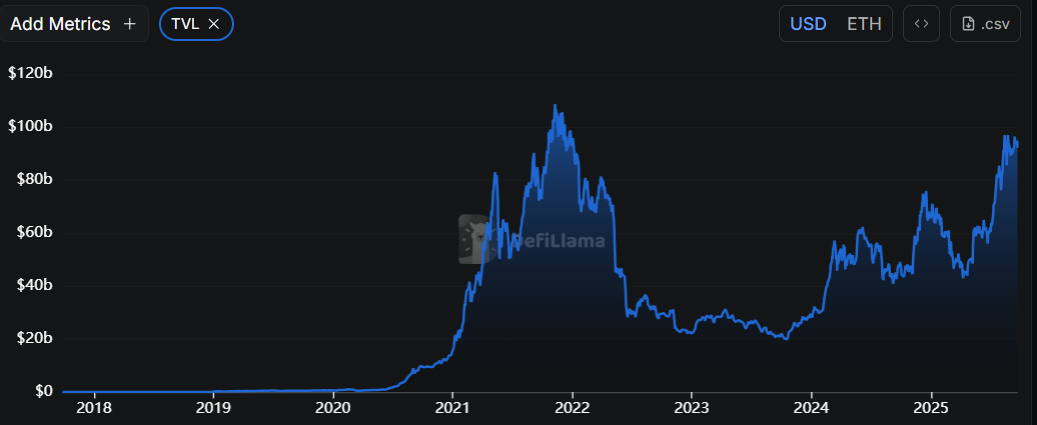
Source: DefiLlama

This recovery comes after TVL lagged during the 2022-2023 bear market. Recent regulatory developments, including the Digital Asset Market Clarity Act, have helped revive institutional interest.

A survey from the DeFi Education Fund found that over 40% of Americans would consider using DeFi under stronger regulatory frameworks. This suggests potential for mainstream adoption of low-risk protocols.

Buterin contrasts Ethereum’s approach with Google’s advertising-dependent model. While Google provides valuable open-source tools like Chromium, its reliance on ads compromises user privacy.

Ethereum’s decentralized design could align financial performance with ethical outcomes. The network can generate revenue without sacrificing user data or control.

Revenue Challenges Persist

Despite the optimistic outlook, Ethereum faces current revenue challenges. On-chain revenue dropped 44% in August to $14.1 million, down from $25.6 million in July.

Network fees also fell 20% month-over-month. The Dencun upgrade, which reduced layer-2 transaction costs, has cut into Ethereum’s base-layer revenue long-term.

Some analysts describe August’s figures as among the weakest since early 2021. Critics worry that shrinking fee revenue could threaten ETH’s value proposition.

However, supporters argue Ethereum is evolving into a foundational layer for global finance. Lower costs could fuel broader adoption of DeFi services.

Buterin also promoted basket currencies and flatcoins as part of this stable foundation. These digital assets peg to consumer price indices or multiple fiat currencies rather than single dollar-denominated tools.

The Ethereum co-founder envisions future innovations like reputation-based lending and prediction markets. These would build on the stable base of low-risk protocols.

Ethereum’s DeFi total value locked currently stands above $100 billion, marking its highest level since early 2022.

The post Why Vitalik Thinks Low-Risk DeFi Could Be Ethereum’s Secret Weapon appeared first on CoinCentral.

Market Opportunity
DeFi Logo
DeFi Price(DEFI)
$0.000325
$0.000325$0.000325
-1.21%
USD
DeFi (DEFI) Live Price Chart
Disclaimer: The articles reposted on this site are sourced from public platforms and are provided for informational purposes only. They do not necessarily reflect the views of MEXC. All rights remain with the original authors. If you believe any content infringes on third-party rights, please contact [email protected] for removal. MEXC makes no guarantees regarding the accuracy, completeness, or timeliness of the content and is not responsible for any actions taken based on the information provided. The content does not constitute financial, legal, or other professional advice, nor should it be considered a recommendation or endorsement by MEXC.

You May Also Like

XRP Confirms Downtrend After $1.50 Breakdown, with $1.15 in Focus

XRP Confirms Downtrend After $1.50 Breakdown, with $1.15 in Focus

XRP price is currently trading near $1.44 on Sunday, February 8, after dipping to $1.21 earlier in the week. The price has been declining from its high near $1.
Share
Tronweekly2026/02/08 21:17
Will Bitcoin Crash Again After Trump Insider Whale Dumps 6,599 BTC?

Will Bitcoin Crash Again After Trump Insider Whale Dumps 6,599 BTC?

Trump insider Garrett Jin moves 6,599 BTC to Binance, raising concerns about more Bitcoin sell pressure as market sentiment weakens. Bitcoin has seen a turbulent
Share
LiveBitcoinNews2026/02/08 21:30
China’s Ban on Nvidia Chips for State Firms Sends Stock Tumbling

China’s Ban on Nvidia Chips for State Firms Sends Stock Tumbling

The post China’s Ban on Nvidia Chips for State Firms Sends Stock Tumbling appeared on BitcoinEthereumNews.com. Cyberspace Administration of China (CAC) has instructed big companies to stop purchasing and cancel existing orders for Nvidia’s RTX Pro 6000D chip The ban is part of China’s ongoing effort to reduce dependency on US-made AI hardware, especially after restrictive US export rules After the news, Nvidia shares dropped in premarket trading by about 1.5% Cyberspace Administration of China (CAC) has instructed big companies like Alibaba and ByteDance to stop purchasing and cancel existing orders for Nvidia’s RTX Pro 6000D chip. The ban is part of China’s ongoing effort to reduce dependency on US-made AI hardware, especially after restrictive US export rules. The RTX Pro 6000D was tailored for China to comply with some export rules, but now the regulator says even that chip is off-limits. After the news, Nvidia shares dropped in premarket trading (around 1.5%), reflecting investors’ concerns about reduced demand in one of the biggest markets. This isn’t the first time China has done something like this. For instance, in August, the country urged firms not to use Nvidia’s H20 chip due to potential security issues and the need to comply with international export control regulations. Meanwhile, Alibaba and Baidu have begun using domestically produced AI chips more heavily, which shows that China is seriously investing in building its own chip-making capacity. Additionally, a few days ago, Chinese regulators opened an antitrust review into Nvidia’s Mellanox acquisition, suggesting the company may have broken some of the promises it made to get the 2020 deal passed. From AI to blockchain and the possible effects of China’s ban The banning of Nvidia chips represents a rather notable escalation in the technological rivalry between the United States and China. Beyond tariffs or export bans, China is now proactively telling its firms to avoid even “compliant” US chips and instead shift…
Share
BitcoinEthereumNews2025/09/18 07:46