

Michael Saylor fires back after Cramer blames him for Bitcoin crash
Bitcoin has fallen to nearly $59,000 after dropping more than 20% in a week, prompting Michael Saylor to respond publicly after CNBC host Jim Cramer blamed him for the cryptocurrency’s latest selloff.
- Michael Saylor pushed back after Jim Cramer blamed him for Bitcoin’s slide below $60,000 following Strategy’s sale of 32 BTC.
- CryptoQuant and Citigroup argued that ETF outflows and whale selling have had a much larger impact on Bitcoin than Strategy’s transaction.
- Grayscale, Peter Schiff, and Charles Schwab analysts focused on Strategy’s funding model and Bitcoin’s longer-term bear market trend.
Posting on X as Bitcoin (BTC) slid below the $60,000 level, Jim Cramer wrote that “Saylor murdered Bitcoin,” pointing to Strategy’s recent Bitcoin sale and the market’s sharp decline. The comment came after Bitcoin suffered over $450 million in long liquidations and reached its lowest level in almost two years.
Responding shortly afterward, Strategy Executive Chairman Michael Saylor dismissed the accusation, writing that the decline was “just a flesh wound.”
Strategy disclosed earlier this week that it sold 32 BTC after trading opened on Monday. Although the transaction represented only a tiny fraction of the company’s Bitcoin holdings, the move attracted attention because Saylor has spent years publicly advocating a buy-and-hold approach toward the asset. Bitcoin and Strategy shares both came under pressure following the disclosure.
As reported earlier by crypto.news, Cramer argued that the sale altered investor perceptions of Bitcoin’s previous rally. According to his remarks, many traders had viewed Strategy’s aggressive accumulation program as an important source of support for the market.
He described the company as a key factor behind Bitcoin’s rise, while stopping short of calling the situation market manipulation.
ETF outflows have drawn scrutiny from analysts
Several market observers pushed back against the idea that Strategy’s sale was responsible for Bitcoin’s decline.
CryptoQuant CEO Ki Young Ju argued that focusing on Saylor overlooks much larger selling activity from long-term Bitcoin holders.
Ju added that Bitcoin would likely be trading at lower levels today without purchases from Strategy and spot Bitcoin ETFs.
While Ju rejected claims that Saylor caused the downturn, he said he remained open to evidence-based analysis challenging his view. In his assessment, blaming Strategy for Bitcoin’s collapse was unsupported by available market data.
Citigroup analysts reached a similar conclusion in a recent note. According to the bank, investors may be paying too much attention to Strategy’s sale while overlooking persistent withdrawals from U.S. spot Bitcoin exchange-traded funds.
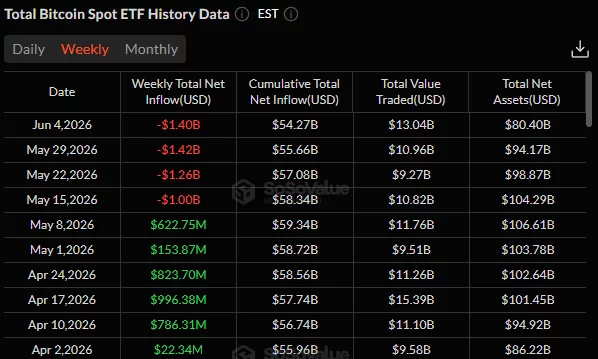
Data from SoSoValue showed spot Bitcoin ETFs recorded $2.43 billion in net outflows during May. Another $1.40 billion left the funds during the first three days of June. Citigroup said ETF demand remains one of the most important drivers of Bitcoin prices and suggested those outflows have had a much larger impact on market performance.
Concerns remain around Strategy’s funding model
Elsewhere, some analysts focused less on the sale itself and more on what it could signal about Strategy’s future.
Economist Peter Schiff argued that Strategy’s Bitcoin treasury model depends heavily on its ability to continue raising capital through equity markets. According to Schiff, the company could face increasing pressure if MSTR shares lose their premium and make future fundraising more difficult.
A separate report from Grayscale Research also highlighted potential funding challenges. Grayscale said declining prices for MSTR and STRC shares could make it harder for Strategy to expand its Bitcoin holdings. The firm added that if STRC trades below its intended level, Strategy may need to increase dividend payments, raising cash obligations and potentially increasing the likelihood of future Bitcoin sales.
Despite those concerns, Grayscale said a reduction in Bitcoin concentrated on highly leveraged corporate balance sheets could benefit the market over time by spreading ownership across more treasury companies.
Meanwhile, Charles Schwab Director of Digital Currencies Research and Strategy Jim Ferraioli argued that the market may be searching for a simple explanation for a trend that began months ago.
According to Ferraioli, Bitcoin has been in a bear market since October 2025, when it reached nearly $126,000 before entering a prolonged decline.
Ferraioli said Bitcoin’s weakness stems primarily from the loss of momentum that previously attracted capital into the asset. Because Strategy’s sale occurred near the end of an eight-month downtrend, he argued it is difficult to identify the transaction as the main cause of Bitcoin’s latest losses.


추천 콘텐츠

Zcash price plunges 50% amid bug fallout and Hayes selloff, can whales reverse the trend?

Could Solana Be The Best Spot Trading Market Globally? This Crypto Pundit Thinks So

Beyond Inflation and the RBA: The Real Forces Driving the Australian Dollar Lower


인기 뉴스
더보기
