Ripple expands enterprise services in Brazil, pursuing regulatory approval and a VASP license as RLUSD gains traction among institutions.Ripple expands enterprise services in Brazil, pursuing regulatory approval and a VASP license as RLUSD gains traction among institutions.

Ripple Expands Brazil Push as RLUSD Gains Institutional Use
For feedback or concerns regarding this content, please contact us at [email protected]
Cb 458729 Ripple Expands Brazil Push As Rlusd Gains Institutional Use

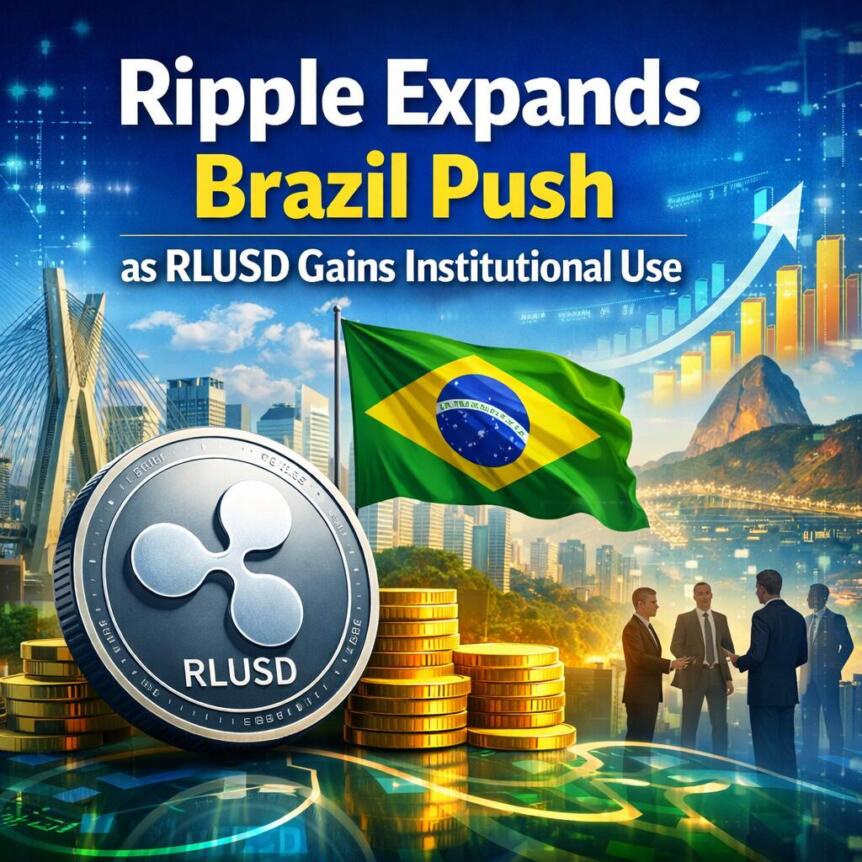
Ripple has expanded its financial infrastructure in Brazil, targeting deeper institutional adoption and regulatory approval. The company introduced payments, custody, and treasury tools for local institutions. Meanwhile, it plans to secure a Virtual Asset Service Provider license under Brazil’s evolving digital asset framework.

Ripple Expands Enterprise Services in Brazil

Ripple has launched a full enterprise platform tailored for Brazil’s financial institutions. The rollout includes cross-border payments, custody solutions, and treasury management tools. Moreover, the company added prime brokerage features to extend services beyond basic payment rails.

The expansion aligns with Brazil’s structured regulatory push for digital assets and financial innovation. Ripple continues to focus on compliance while scaling operations in regulated markets. Therefore, the planned VASP license application supports its long-term presence in the country.

Brazil offers a mature financial ecosystem, which attracts global fintech firms seeking growth opportunities. Ripple has maintained a regional focus due to increasing demand for efficient settlement systems. Consequently, the company positions its infrastructure as a solution for modern financial operations.

Institutional Adoption and RLUSD Growth

Ripple Payments now operates across more than 60 markets and has processed over $100 billion globally. The platform enables faster settlement using both fiat currencies and stablecoins. Additionally, several Brazilian institutions actively use the network for payments and liquidity management.

Banco Genial uses Ripple’s system for same-day U.S. dollar disbursements and plans to integrate RLUSD into payment flows. Braza Bank supports U.S. dollar transfers and issued its BBRL stablecoin on the XRP Ledger. Meanwhile, Nomad manages treasury flows between Brazil and the United States using Ripple infrastructure.

Other firms continue to adopt Ripple’s tools for various financial operations across the region. Azify supports currency exchange into major global currencies using the Ripple system. Similarly, Attrus and Frente Corretora use the platform for cross-border payments and foreign exchange settlements.

RLUSD adoption continues to rise across Latin America, supported by institutional demand for liquidity solutions. The stablecoin has surpassed a $1.5 billion market capitalization. Furthermore, regulators in the United States oversee RLUSD through established financial authorities.

Ripple Custody has also expanded into Brazil, offering secure digital asset storage for institutions. The platform integrates compliance tools and supports staking across multiple proof-of-stake networks. As a result, firms such as CRX and Justoken now use custody services for tokenized asset operations.

CRX has settled nearly $100 million on-chain using Ripple Custody and XRPL infrastructure. Meanwhile, Justoken has tokenized over $1.7 billion in assets and plans regional expansion. This growth reflects increasing institutional reliance on blockchain-based financial systems.

RLUSD now trades on platforms such as Mercado Bitcoin, Foxbit, and Ripio across Brazil. Additionally, several financial institutions support the stablecoin for treasury and settlement use cases. This integration strengthens Ripple’s broader payments ecosystem across Latin America.

This article was originally published as Ripple Expands Brazil Push as RLUSD Gains Institutional Use on Crypto Breaking News – your trusted source for crypto news, Bitcoin news, and blockchain updates.

Disclaimer: The articles reposted on this site are sourced from public platforms and are provided for informational purposes only. They do not necessarily reflect the views of MEXC. All rights remain with the original authors. If you believe any content infringes on third-party rights, please contact [email protected] for removal. MEXC makes no guarantees regarding the accuracy, completeness, or timeliness of the content and is not responsible for any actions taken based on the information provided. The content does not constitute financial, legal, or other professional advice, nor should it be considered a recommendation or endorsement by MEXC.

You May Also Like

Franklin Templeton CEO Dismisses 50bps Rate Cut Ahead FOMC

Franklin Templeton CEO Dismisses 50bps Rate Cut Ahead FOMC

The post Franklin Templeton CEO Dismisses 50bps Rate Cut Ahead FOMC appeared on BitcoinEthereumNews.com. Franklin Templeton CEO Jenny Johnson has weighed in on whether the Federal Reserve should make a 25 basis points (bps) Fed rate cut or 50 bps cut. This comes ahead of the Fed decision today at today’s FOMC meeting, with the market pricing in a 25 bps cut. Bitcoin and the broader crypto market are currently trading flat ahead of the rate cut decision. Franklin Templeton CEO Weighs In On Potential FOMC Decision In a CNBC interview, Jenny Johnson said that she expects the Fed to make a 25 bps cut today instead of a 50 bps cut. She acknowledged the jobs data, which suggested that the labor market is weakening. However, she noted that this data is backward-looking, indicating that it doesn’t show the current state of the economy. She alluded to the wage growth, which she remarked is an indication of a robust labor market. She added that retail sales are up and that consumers are still spending, despite inflation being sticky at 3%, which makes a case for why the FOMC should opt against a 50-basis-point Fed rate cut. In line with this, the Franklin Templeton CEO said that she would go with a 25 bps rate cut if she were Jerome Powell. She remarked that the Fed still has the October and December FOMC meetings to make further cuts if the incoming data warrants it. Johnson also asserted that the data show a robust economy. However, she noted that there can’t be an argument for no Fed rate cut since Powell already signaled at Jackson Hole that they were likely to lower interest rates at this meeting due to concerns over a weakening labor market. Notably, her comment comes as experts argue for both sides on why the Fed should make a 25 bps cut or…
Share
BitcoinEthereumNews2025/09/18 00:36
Cashing In On University Patents Means Giving Up On Our Innovation Future
Cashing In On University Patents Means Giving Up On Our Innovation Future

The post Cashing In On University Patents Means Giving Up On Our Innovation Future appeared on BitcoinEthereumNews.com. “It’s a raid on American innovation that would deliver pennies to the Treasury while kneecapping the very engine of our economic and medical progress,” writes Pipes. Getty Images Washington is addicted to taxing success. Now, Commerce Secretary Howard Lutnick is floating a plan to skim half the patent earnings from inventions developed at universities with federal funding. It’s being sold as a way to shore up programs like Social Security. In reality, it’s a raid on American innovation that would deliver pennies to the Treasury while kneecapping the very engine of our economic and medical progress. Yes, taxpayer dollars support early-stage research. But the real payoff comes later—in the jobs created, cures discovered, and industries launched when universities and private industry turn those discoveries into real products. By comparison, the sums at stake in patent licensing are trivial. Universities collectively earn only about $3.6 billion annually in patent income—less than the federal government spends on Social Security in a single day. Even confiscating half would barely register against a $6 trillion federal budget. And yet the damage from such a policy would be anything but trivial. The true return on taxpayer investment isn’t in licensing checks sent to Washington, but in the downstream economic activity that federally supported research unleashes. Thanks to the bipartisan Bayh-Dole Act of 1980, universities and private industry have powerful incentives to translate early-stage discoveries into real-world products. Before Bayh-Dole, the government hoarded patents from federally funded research, and fewer than 5% were ever licensed. Once universities could own and license their own inventions, innovation exploded. The result has been one of the best returns on investment in government history. Since 1996, university research has added nearly $2 trillion to U.S. industrial output, supported 6.5 million jobs, and launched more than 19,000 startups. Those companies pay…
Share
BitcoinEthereumNews2025/09/18 03:26
Fed Makes First Rate Cut of the Year, Lowers Rates by 25 Bps

Fed Makes First Rate Cut of the Year, Lowers Rates by 25 Bps

The post Fed Makes First Rate Cut of the Year, Lowers Rates by 25 Bps appeared on BitcoinEthereumNews.com. The Federal Reserve has made its first Fed rate cut this year following today’s FOMC meeting, lowering interest rates by 25 basis points (bps). This comes in line with expectations, while the crypto market awaits Fed Chair Jerome Powell’s speech for guidance on the committee’s stance moving forward. FOMC Makes First Fed Rate Cut This Year With 25 Bps Cut In a press release, the committee announced that it has decided to lower the target range for the federal funds rate by 25 bps from between 4.25% and 4.5% to 4% and 4.25%. This comes in line with expectations as market participants were pricing in a 25 bps cut, as against a 50 bps cut. This marks the first Fed rate cut this year, with the last cut before this coming last year in December. Notably, the Fed also made the first cut last year in September, although it was a 50 bps cut back then. All Fed officials voted in favor of a 25 bps cut except Stephen Miran, who dissented in favor of a 50 bps cut. This rate cut decision comes amid concerns that the labor market may be softening, with recent U.S. jobs data pointing to a weak labor market. The committee noted in the release that job gains have slowed, and that the unemployment rate has edged up but remains low. They added that inflation has moved up and remains somewhat elevated. Fed Chair Jerome Powell had also already signaled at the Jackson Hole Conference that they were likely to lower interest rates with the downside risk in the labor market rising. The committee reiterated this in the release that downside risks to employment have risen. Before the Fed rate cut decision, experts weighed in on whether the FOMC should make a 25 bps cut or…
Share
BitcoinEthereumNews2025/09/18 04:36
