A decline in ERC-20 stablecoin supply is often interpreted as liquidity exiting the cryptocurrency market. However, on-chain data from CryptoQuant shows a differentA decline in ERC-20 stablecoin supply is often interpreted as liquidity exiting the cryptocurrency market. However, on-chain data from CryptoQuant shows a different

Stablecoin Liquidity Is Shifting Networks, Not Leaving Crypto

2026/01/29 07:23
3 min read
For feedback or concerns regarding this content, please contact us at [email protected]

A decline in ERC-20 stablecoin supply is often interpreted as liquidity exiting the cryptocurrency market.

However, on-chain data from CryptoQuant shows a different dynamic unfolding in January 2026. Rather than leaving the system, stablecoin liquidity appears to be rotating across blockchain networks.

Stablecoin Supply Moves: January 19–20, 2026

On January 19 and 20, a clear divergence emerged between Ethereum and Tron stablecoin supplies.
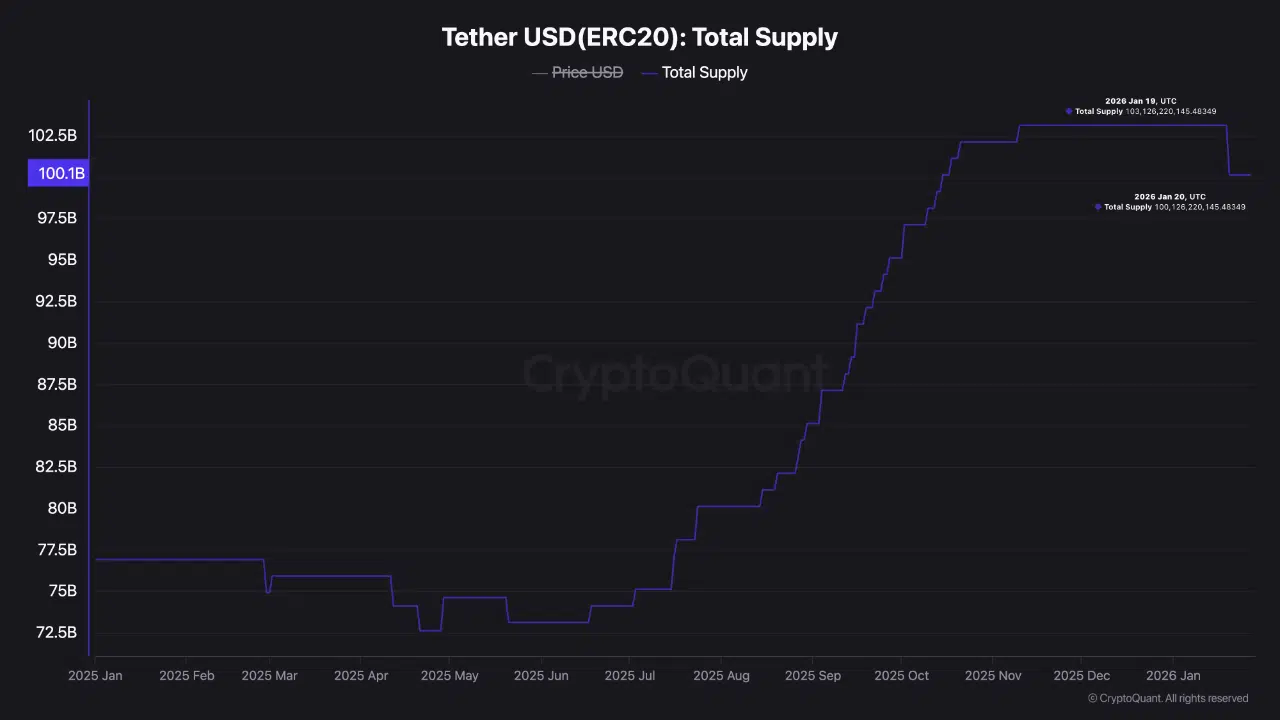
On the Tron network, USDT supply increased sharply. Total TRC-20 USDT rose from 82,434,679,540 on January 19 to 83,434,679,540 on January 20, marking a net increase of $1 billion in a single day. This expansion was driven by a direct mint on Tron.

At the same time, Ethereum experienced a notable contraction in stablecoin balances. ERC-20 USDT supply declined by approximately $3.0 billion, while ERC-20 USDC fell by around $3.55 billion. Combined, this represents roughly $6.5 billion in stablecoins removed from Ethereum-based circulation.

The timing is critical. The increase in TRC-20 USDT followed immediately after the contraction on Ethereum, suggesting a coordinated liquidity shift rather than an isolated redemption event.

What the Flow Data Indicates

This pattern does not resemble a broad exit from crypto into fiat. Instead, it reflects a redistribution of liquidity across networks and use cases.

USDT is primarily used for derivatives trading, OTC settlement, and short-term tactical positioning. Because of this role, it frequently migrates to lower-cost networks where transaction efficiency is higher. Tron has increasingly served as a preferred rail for these functions.

USDC, by contrast, is more closely tied to spot market activity and on-chain settlement. As a result, changes in ERC-20 USDC supply tend to act as a clearer signal for spot demand conditions, particularly on Ethereum.

When both USDT and USDC decline on Ethereum while USDT simultaneously expands on Tron, the most straightforward interpretation is that liquidity is changing rails, not disappearing.

OKX Launches Stablecoin Card in Europe as MiCA Takes Effect

Market Implications

The data suggests that liquidity remains inside the crypto ecosystem, but its positioning has become more defensive. Demand for Ethereum-based settlement appears to be softening, while capital preference shifts toward derivatives-oriented and parked liquidity environments.

From a market perspective, falling ERC-20 stablecoin supply carries specific implications. It is bearish for Ethereum on-chain activity, neutral to bearish for spot-driven risk appetite, and not evidence of capital exiting crypto entirely.

Rather than signaling capitulation, the stablecoin flows point to structural reallocation, a rotation within crypto infrastructure driven by cost efficiency and evolving use cases.

The post Stablecoin Liquidity Is Shifting Networks, Not Leaving Crypto appeared first on ETHNews.

Disclaimer: The articles reposted on this site are sourced from public platforms and are provided for informational purposes only. They do not necessarily reflect the views of MEXC. All rights remain with the original authors. If you believe any content infringes on third-party rights, please contact [email protected] for removal. MEXC makes no guarantees regarding the accuracy, completeness, or timeliness of the content and is not responsible for any actions taken based on the information provided. The content does not constitute financial, legal, or other professional advice, nor should it be considered a recommendation or endorsement by MEXC.

You May Also Like

Leonardo AI Unveils Comprehensive Image Editing Suite with Six Model Options

Leonardo AI Unveils Comprehensive Image Editing Suite with Six Model Options

Leonardo AI releases detailed guide to AI image editing featuring Nano Banana, GPT Image 1.5, and Flux models as competition heats up with Adobe, Google, and Canva
Share
BlockChain News2026/03/19 12:39
RBA warns high and rising risk of severe shock to world economy amid Iran war

RBA warns high and rising risk of severe shock to world economy amid Iran war

The post RBA warns high and rising risk of severe shock to world economy amid Iran war appeared on BitcoinEthereumNews.com. The Reserve Bank of Australia (RBA)
Share
BitcoinEthereumNews2026/03/19 11:49
Headwind Helps Best Wallet Token

Headwind Helps Best Wallet Token

The post Headwind Helps Best Wallet Token appeared on BitcoinEthereumNews.com. Google has announced the launch of a new open-source protocol called Agent Payments Protocol (AP2) in partnership with Coinbase, the Ethereum Foundation, and 60 other organizations. This allows AI agents to make payments on behalf of users using various methods such as real-time bank transfers, credit and debit cards, and, most importantly, stablecoins. Let’s explore in detail what this could mean for the broader cryptocurrency markets, and also highlight a presale crypto (Best Wallet Token) that could explode as a result of this development. Google’s Push for Stablecoins Agent Payments Protocol (AP2) uses digital contracts known as ‘Intent Mandates’ and ‘Verifiable Credentials’ to ensure that AI agents undertake only those payments authorized by the user. Mandates, by the way, are cryptographically signed, tamper-proof digital contracts that act as verifiable proof of a user’s instruction. For example, let’s say you instruct an AI agent to never spend more than $200 in a single transaction. This instruction is written into an Intent Mandate, which serves as a digital contract. Now, whenever the AI agent tries to make a payment, it must present this mandate as proof of authorization, which will then be verified via the AP2 protocol. Alongside this, Google has also launched the A2A x402 extension to accelerate support for the Web3 ecosystem. This production-ready solution enables agent-based crypto payments and will help reshape the growth of cryptocurrency integration within the AP2 protocol. Google’s inclusion of stablecoins in AP2 is a massive vote of confidence in dollar-pegged cryptocurrencies and a huge step toward making them a mainstream payment option. This widens stablecoin usage beyond trading and speculation, positioning them at the center of the consumption economy. The recent enactment of the GENIUS Act in the U.S. gives stablecoins more structure and legal support. Imagine paying for things like data crawls, per-task…
Share
BitcoinEthereumNews2025/09/18 01:27