

Yagy Secures 18 Multi-year Enterprise Contracts as FoodTech Infrastructure Expands
Yagy Secures 18 Multi-year Enterprise Contracts as India’s FoodTech Market Moves Toward Daily Consumption Infrastructure: The Shift Beyond Food Delivery
India’s food technology ecosystem is entering a new strategic phase, and Yagy Secures 18 Multi-year Enterprise Contracts may represent one of the clearest indicators of that transition.
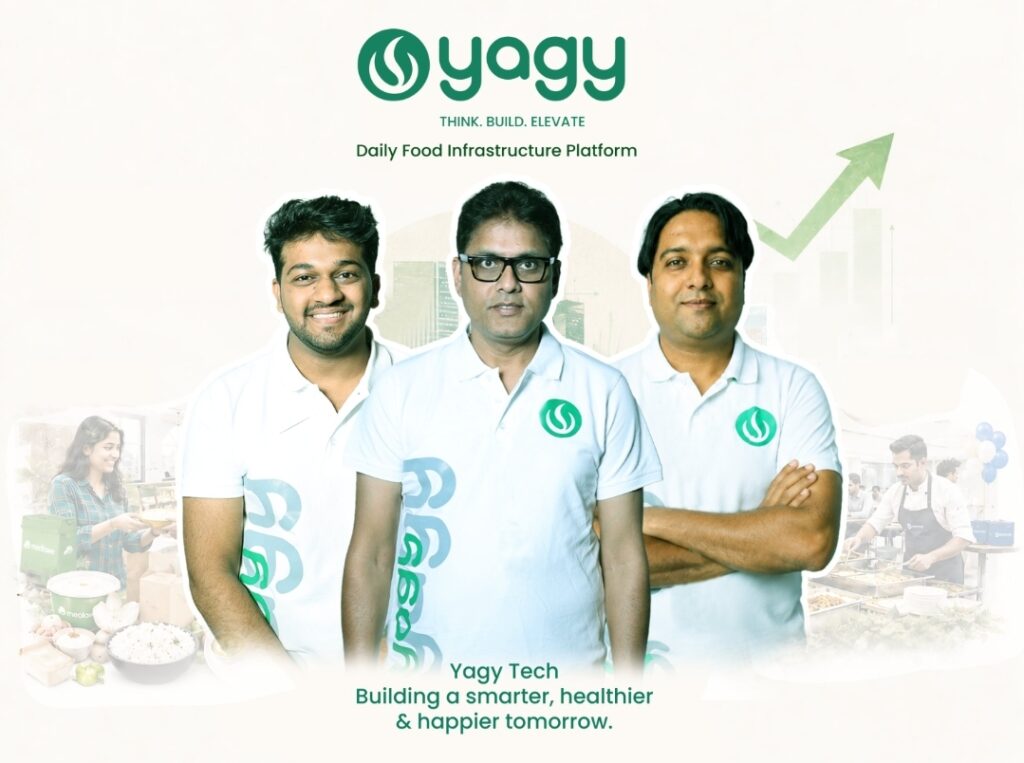
yagytech.com, the Pune-based company behind Mealawe and DeskDyne, announced that it has signed 18 multi-year enterprise agreements carrying an estimated annualized revenue potential of ₹100–150 crore at full activation.
The contracts span sectors including quick commerce, IT services, education, co-working, and institutional dining environments. While the announcement itself is commercially significant, the deeper implication lies in what Yagy is attempting to build: an integrated daily food infrastructure platform connecting home meals, workplace dining, institutional consumption, and operational food networks through a shared backbone.
This becomes critical when food consumption behavior is increasingly fragmented across environments while customer expectations continue to center around consistency, reliability, and recurring convenience.
Why Yagy Secures 18 Multi-year Enterprise Contracts Signals a Structural Shift
Historically, India’s food economy evolved through disconnected operating models.
Food delivery platforms optimized cravings and instant fulfillment. Grocery platforms optimized ingredient procurement. Corporate cafeteria vendors optimized isolated office environments. Institutional meal providers operated independently from consumer dining systems.
What nobody fully connected was the recurring nature of food consumption itself.
Speaking on the announcement, Rupesh Kumar, Founder & CEO, Yagy Tech Pvt Ltd, said:
That statement reveals the company’s core strategic thesis.
Rather than viewing workplace dining, home meals, and institutional food as separate markets, Yagy treats them as recurring monetization layers surrounding the same daily demand pool.
Strategically, this indicates a shift from category-based food businesses toward infrastructure-based food ecosystems.
The distinction matters because infrastructure ownership generally produces:
- Better operational utilization
- More predictable recurring demand
- Lower acquisition volatility
- Stronger enterprise retention
- Higher ecosystem defensibility
This is where the shift occurs. Food technology may increasingly become an infrastructure orchestration problem rather than a marketplace aggregation problem.
Infrastructure Competition Is Replacing Marketplace Competition
At the surface level, Yagy operates in the broader FoodTech sector alongside companies such as Zomato and Swiggy.
But the competitive architecture is fundamentally different.
Traditional delivery marketplaces optimize:
- Restaurant discovery
- Ordering convenience
- Logistics speed
- Promotional retention
Yagy’s model instead focuses on:
- Recurring meal infrastructure
- Enterprise demand predictability
- Shared kitchen utilization
- Cross-environment food continuity
- Operational orchestration
At a structural level, the company appears to be positioning itself between enterprise dining systems, operational SaaS infrastructure, and recurring food logistics networks.
This becomes important because recurring consumption infrastructure tends to create stronger operational leverage than transactional ordering systems.
The deeper implication is that future winners in FoodTech may not necessarily be the companies with the largest consumer traffic. They may instead be the companies controlling the most efficient recurring food infrastructure.
The Technology Backbone Behind the Expansion
Technology is central to how Yagy intends to scale this model.
The company has developed its stack internally while adopting AI-assisted software development to accelerate deployment and reduce engineering overhead.
Operationally, this translates to tighter synchronization between:
- Enterprise dining systems
- Meal demand forecasting
- Kitchen orchestration
- Logistics coordination
- Institutional consumption management
- Analytics-driven operational planning
Yagy is also a member of the NVIDIA Inception Program, holds two granted patents, and is pursuing ISO 27001 certification.
Speaking further on the company’s approach, Rupesh Kumar said:
At a systems level, the company is effectively building a persistent operational layer capable of serving multiple consumption environments simultaneously.
This matters because operational fragmentation remains one of India’s largest food-sector inefficiencies.
Why the Customer Experience Layer Matters
From a CX standpoint, Yagy’s model is attempting to solve continuity rather than convenience alone.
Most food experiences today remain disconnected:
- Separate vendors
- Separate loyalty systems
- Separate interfaces
- Separate quality standards
- Separate operational processes
Customers experience food as a fragmented ecosystem despite consuming meals repeatedly throughout the day.
Yagy’s infrastructure-led approach introduces the possibility of unified recurring meal experiences across home, workplace, and institutional settings.
For customers, that could eventually translate to:
- Better consistency
- Lower decision fatigue
- More reliable meal quality
- Personalized recurring experiences
- Unified operational reliability
For enterprises, the benefits extend into:
- Better employee dining experiences
- Centralized food operations
- Improved utilization efficiency
- Better consumption analytics
- Standardized operational governance
At a structural level, the company is moving food CX away from episodic transactions and toward habit infrastructure.
That distinction is strategically significant because recurring behavioral ecosystems typically create stronger retention and operational efficiency dynamics.
The Operational Challenge Ahead
The opportunity is substantial, but so is the execution challenge.
Scaling recurring food infrastructure across 21 cities requires operational precision across:
- Supply chains
- Vendor networks
- Enterprise onboarding
- Meal standardization
- Kitchen coordination
- Logistics synchronization
This becomes especially difficult in India where regional consumption preferences, operational variability, and supply chain inconsistencies remain highly localized.
The company’s current bridge round reflects the capital intensity associated with activating enterprise demand at scale.
Still, the enterprise contract structure provides an important strategic advantage: predictable recurring demand.
Unlike consumer-only ordering ecosystems where demand volatility can fluctuate dramatically, multi-year enterprise agreements create operational stability that improves planning efficiency and infrastructure utilization.
Why the Industry Should Watch Closely
The broader FoodTech ecosystem should pay attention because Yagy’s model reflects a wider industry transition.
The next phase of food technology may increasingly revolve around:
- Infrastructure efficiency
- Recurring consumption ecosystems
- Enterprise integration
- Shared operational networks
- AI-assisted orchestration
- Utilization optimization
This changes the nature of competition itself.
Instead of competing only for consumer attention, companies may begin competing for operational control of recurring consumption environments.
That evolution has implications across:
- Enterprise dining
- Smart workplaces
- Institutional infrastructure
- Kitchen automation
- Meal analytics
- Workforce experience systems
At a CX level, the shift also aligns with growing expectations around consistency, convenience, and integrated daily experiences.
Final Takeaway
Ultimately, Yagy Secures 18 Multi-year Enterprise Contracts is significant not simply because of the revenue potential involved, but because it reflects a broader evolution in how food ecosystems are being restructured.
The company is betting that the future of FoodTech will not be defined solely by ordering interfaces or delivery speed.
Instead, the future may belong to companies capable of orchestrating the invisible infrastructure behind recurring daily consumption itself.
If that thesis proves correct, the competitive center of gravity in India’s food economy could shift from marketplace aggregation toward integrated operational food infrastructure.
The post Yagy Secures 18 Multi-year Enterprise Contracts as FoodTech Infrastructure Expands appeared first on CX Quest.


You May Also Like

One Of Frank Sinatra’s Most Famous Albums Is Back In The Spotlight

Not a loophole: Singapore AI export controls let China tap US AI legally

LIST: Bayanihan initiatives amid soaring oil prices



