Crude Oil Prices Climb Following Military Confrontation in Strait of Hormuz
TLDR
- Brent crude futures climbed 0.5% to reach $100.51 per barrel on Friday; WTI advanced 0.4% to $95.19
- Military confrontation occurred between U.S. and Iranian forces in the Strait of Hormuz on Thursday
- President Trump characterized the incident as a “trifle” while affirming the cease-fire continues
- Washington is exploring the possibility of resuming “Project Freedom” naval escort operations
- Despite Friday’s gains, crude remains lower for the week, falling from approximately $108 Brent at the week’s start
Crude oil futures advanced on Friday morning following a military confrontation between United States and Iranian forces in the strategically vital Strait of Hormuz, adding strain to the already delicate cease-fire agreement between the nations.
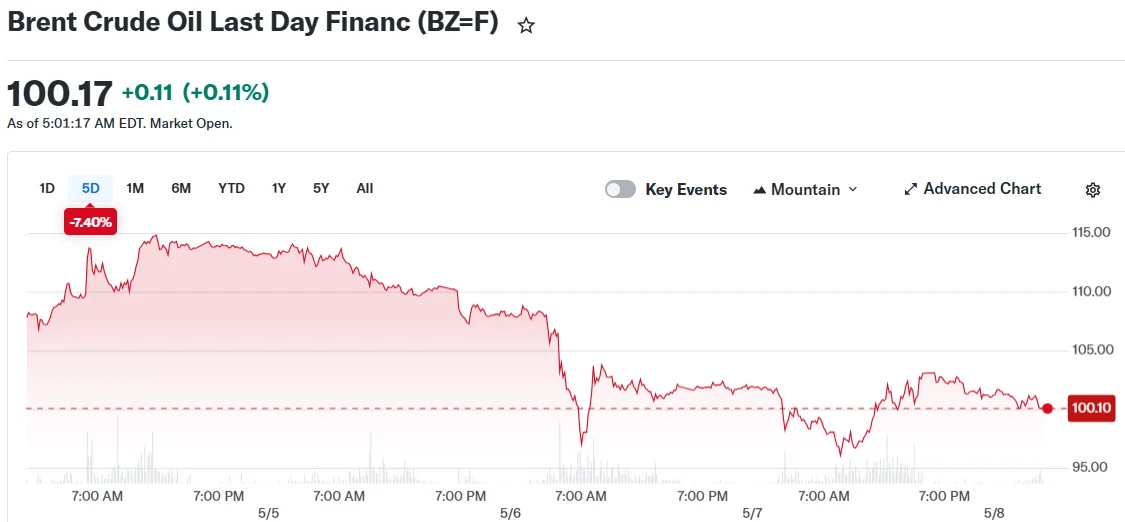 Brent Crude Oil Last Day Financ (BZ=F)
Brent crude futures traded 0.5% higher at $100.51 per barrel during early European market hours. West Texas Intermediate futures increased 0.4% to reach $95.19 per barrel.
During earlier trading activity, both benchmark contracts had surged more than 2%. Brent momentarily exceeded $102 per barrel in Asian market sessions before paring back those advances.
Notwithstanding Friday’s upward movement, oil continues to show significant weekly declines. Brent commenced Monday’s trading near $108 per barrel, with WTI positioned close to $100. This trajectory places Brent on track for approximately $7 in weekly losses.
The Strait of Hormuz represents one of the planet’s most crucial oil transportation corridors. Approximately 20% of global oil supplies typically transit through this strategic waterway.
What Happened in the Strait
Iranian forces initiated attacks using missiles, unmanned aerial vehicles, and small watercraft targeting American naval vessels positioned near the Strait of Hormuz, based on a U.S. Central Command statement reported by the Wall Street Journal.
U.S. military personnel successfully intercepted the incoming threats and conducted retaliatory strikes against Iranian military installations responsible for launching the attacks, according to the official statement.
President Trump minimized the significance of the confrontation on Truth Social Thursday, describing it as a “trifle.”
Trump additionally affirmed that the cease-fire arrangement remains operative notwithstanding the military engagement.
Hormuz Escort Plans and Peace Talks
The Trump administration is evaluating the potential resumption of “Project Freedom,” a military operation designed to provide protective escorts for commercial shipping vessels navigating through the Strait of Hormuz, according to Wall Street Journal reporting.
The Strait has become essentially inaccessible to routine maritime traffic, Saxo Bank analysts indicated on Friday. They characterized the trading week as showing an “almost $20 trading range as Middle East headlines swung sentiment between optimism and frustration.”
Financial markets continue monitoring developments regarding a potential resumption of direct diplomatic negotiations between Washington and Tehran.
ING analyst Francesco Pesole noted in a research communication that expectations exist for a potential agreement before a scheduled U.S.-China summit on May 14-15, though he cautioned that “risks are clearly very binary.”
Pesole observed that market optimism is “fading again” in the aftermath of the military confrontations and the possible reinstatement of American escort operations.
Saxo Bank analysts emphasized that the fundamental challenge persists: “The Strait of Hormuz remains effectively closed, with renewed clashes between U.S. and Iranian forces lowering the prospect of a near-term reopening.”
As of early European trading Friday, Brent crude for July delivery had advanced 0.6% to $100.67 per barrel. WTI futures for June delivery climbed 0.4% to $95.16 per barrel.
The post Crude Oil Prices Climb Following Military Confrontation in Strait of Hormuz appeared first on Blockonomi.


You May Also Like

Metaplanet buys 5,075 Bitcoin in Q1 to become 3rd-largest treasury
Oil Prices Rise After U.S. and Iran Exchange Fire Near Strait of Hormuz