Saylor Says Bitcoin Could Win Big If AI Destroys Traditional Moats
Michael Saylor says Bitcoin could emerge as one of the biggest winners if artificial intelligence compresses corporate “terminal value” and forces markets to stop paying up for long-dated growth. His argument came in response to Chamath Palihapitiya’s latest thought experiment, which framed AI not simply as a productivity engine, but as a force that could undermine the basic assumptions behind modern equity valuation.
Palihapitiya’s core thesis was stark. If AI makes disruption faster, cheaper, and more relentless, investors may no longer be willing to underwrite cash flows far into the future. In that world, equities would stop being valued as long-duration assets and instead trade closer to what they generate right now.
“The entire architecture of modern capital markets rests on a single, rarely examined assumption: that competitive advantages compound over time. Moats persist. Brands endure. Network effects defend,” Palihapitiya wrote. “Strip that assumption away, and you aren’t just repricing some stocks, you would be dismantling the philosophical foundation of how capital has been allocated for a century.”
He then pushed that logic through a valuation framework built around disruption risk. Using a US 10-year yield of roughly 4.5% as a starting point and an equity risk premium of 4% to 5%, Palihapitiya argued that a stable, durable business might justify a 10x to 12x free cash flow multiple. But once AI-driven obsolescence becomes a serious annual risk, those multiples fall fast. At a 20% annual disruption probability, he estimated fair value at about 3.9x FCF. At 30%, it drops to 2.8x. Even 10% only gets to roughly 6.5x.
That matters because, in his telling, markets have done this before. He pointed to newspapers after digital advertising, retailers facing Amazon, oil majors during the energy transition, and even New York taxi medallions after Uber. In each case, the market was not denying the existence of current cash flows. It was repricing how long those cash flows could realistically last.
Palihapitiya extended that argument to the broader market. With the S&P 500 valued at around $58 trillion and corporate free cash flow near $2.8 trillion annually, he argued that repricing the index at 5x FCF would imply a market value of about $14 trillion, or a 75% drawdown. Even a less severe compression would radically change how capital gets allocated.
Bitcoin Could Surge as AI Destroys Traditional Moats
Saylor’s response was brief and reiterated his previous public stance. “If AI compresses terminal value and makes every moat temporary, capital will rotate to assets with no disruption risk,” he wrote. “Bitcoin is Digital Capital – scarce, neutral, and impervious to AI disruption. $BTC should be the primary beneficiary of this shift.”
That exchange quickly turned to a familiar fault line in Bitcoin debates: quantum risk. Palihapitiya answered that Bitcoin “would need to be quantum resistant by then,” prompting Saylor to push back. “Your AI thesis assumes the digital world is quantum-resistant. If quantum breaks cryptography, it breaks AI, cloud infrastructure, banks, and the internet—not just Bitcoin. The entire stack upgrades together.”
Palihapitiya was unconvinced. “No. A store of value has to be 100% hacking resistant. It’s an existential feature,” he wrote. “For other industries it will be important but less binary/existential.”
Others in crypto added nuance. BitGo CEO Mike Belshe said both sides were partially right, arguing that Bitcoin is likely the “low-hanging fruit” for quantum attackers even if other systems would also be affected. He added: “It’s just too easy relative to other efforts. Similarly, Bitcoin also has the easiest job to be Quantum Resistant – it’s a clean solve technically, suffering only from lack of governance and decisiveness. The banking solution(s) to Quantum will be much harder with a much longer tail of work, but at least the centralized decision making is easier.”
Helius Labs CEO Mert Mumtaz made a similar distinction from another angle: “Those systems can detect, mitigate, and fix against a quantum threat infinitely faster than bitcoin in a non-messy way. That is the cost of decentralization. An EC2 machine getting hacked (won’t happen anyway) is nowhere near the severity of your entire financial getting drained.”
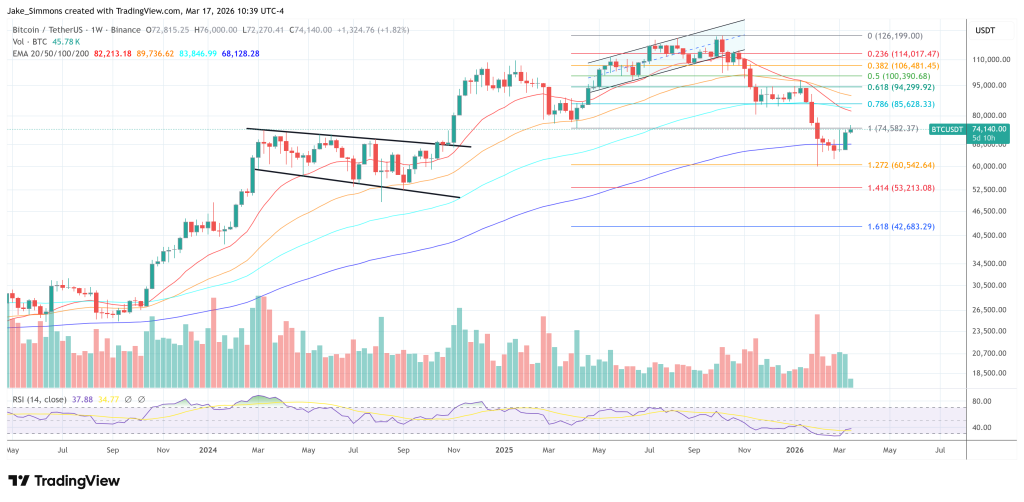
At press time, Bitcoin traded at $74,140.
You May Also Like

Disney Pockets $2.2 Billion For Filming Outside America

XRP vs Chainlink 2026: Ghost Chain Accusation, Ripple CTO Response, and the Full Debate Explained