The post Why Gold and Silver Prices Crashed Today and How It Dragged Bitcoin Lower appeared first on Coinpedia Fintech News Today, gold and silver prices crashedThe post Why Gold and Silver Prices Crashed Today and How It Dragged Bitcoin Lower appeared first on Coinpedia Fintech News Today, gold and silver prices crashed

Why Gold and Silver Prices Crashed Today and How It Dragged Bitcoin Lower

why gold and silver prices crashed today

The post Why Gold and Silver Prices Crashed Today and How It Dragged Bitcoin Lower appeared first on Coinpedia Fintech News

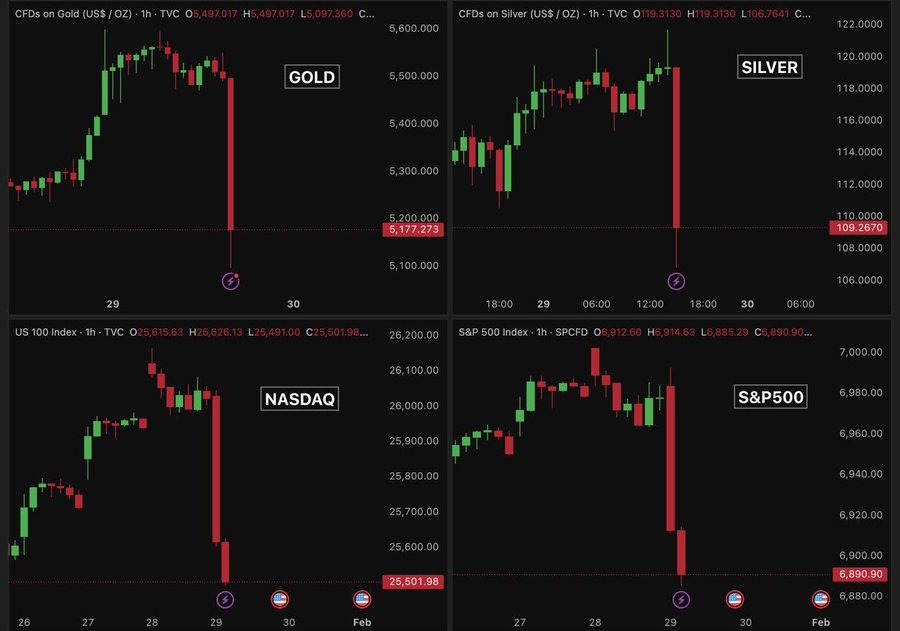
Today, gold and silver prices crashed nearly 10%, wiping out over $3 trillion in value, an amount equal to the entire crypto market cap. The sudden fall quickly spread to crypto, pulling Bitcoin down nearly 7% as leveraged positions were wiped out.

What began as a sharp sell-off in metals soon turned into a broader risk-off move, catching many traders by surprise.

Gold Prices Crash After Record Rally

According to market data, gold prices dropped from near $5,625 to around $5,100, while silver fell from over $121 to nearly $106. This sharp move erased an estimated $3.4 trillion in notional value, marking one of the fastest reversals in precious metals history.

The fall was not triggered by fresh geopolitical news or policy changes. Instead, markets were hit by heavy profit-taking. 
Gold silver bitcoin price drop

Gold has surged nearly 90% in the past year, while silver climbed more than 270%, driven by central bank buying, geopolitical fears, and strong industrial demand.

Another key factor was excessive leverage. Futures markets were crowded with traders using 50x to 100x leverage. Once prices dipped slightly, margin calls kicked in, forcing liquidations and creating a chain reaction of selling.

  • Also Read :
  •   Why Are Bitcoin, XRP, and Ethereum Prices Falling Today?
  •   ,

Bitcoin Drops 7% as Crypto Liquidations Spike

The chaos did not stop with gold & silver. The crypto market saw a sharp sell-off as Bitcoin fell nearly 7%, dropping from around $89,000 to below $82,000. Large-cap cryptocurrencies like ETH, XRP, BNB, SOL, and ADA also dropped between 6% and 10% in a single day.

According to CoinGlass, the crypto market recorded $1.68 billion in liquidations over the past 24 hours. Around 267,000 traders were forced out of positions, with long liquidations accounting for nearly 93% of the total.
At the same time, on 29 January, Bitcoin ETFs recorded heavy outflows of about $817 million, led by BlackRock, Fidelity, and Grayscale. Bitcoin ETFs have now seen outflows for eight straight days, except on January 26, when a small inflow of $6.8 million was recorded.  

Stocks and Crypto-Linked Firms Also Hit

The sell-off also hit equitie market too. Microsoft shares dropped about 10–11% after weak cloud growth guidance and a downgrade, pulling major indexes lower. The S&P 500 erased $780 billion, while the Nasdaq lost $760 billion intraday.

Crypto-related stocks such as Strategy, Metaplanet, and Bitmine fell between 15% and 20%, reflecting the broader risk reset.

Never Miss a Beat in the Crypto World!

Stay ahead with breaking news, expert analysis, and real-time updates on the latest trends in Bitcoin, altcoins, DeFi, NFTs, and more.

bell icon Subscribe to News

FAQs

How did the gold and silver crash impact the crypto market?

The metals sell-off sparked a broader risk-off move, forcing leveraged traders to unwind positions and pushing Bitcoin and altcoins sharply lower.

What could determine whether markets stabilize or fall further next?

Stability depends on whether liquidation pressure eases and leverage resets. Upcoming macro data, ETF flows, and futures positioning will be key indicators to watch.

How might this affect investor behavior in the coming weeks?

Many investors may reduce leverage, rotate into cash, or favor less volatile assets. Risk appetite typically stays cautious until price action and liquidity normalize.

Disclaimer: The articles reposted on this site are sourced from public platforms and are provided for informational purposes only. They do not necessarily reflect the views of MEXC. All rights remain with the original authors. If you believe any content infringes on third-party rights, please contact [email protected] for removal. MEXC makes no guarantees regarding the accuracy, completeness, or timeliness of the content and is not responsible for any actions taken based on the information provided. The content does not constitute financial, legal, or other professional advice, nor should it be considered a recommendation or endorsement by MEXC.

You May Also Like

qLabs Fires First Shot in Quantum Crypto Race — Can Coinbase Catch Up?

qLabs Fires First Shot in Quantum Crypto Race — Can Coinbase Catch Up?

The rapid progress of quantum computing is forcing the cryptocurrency industry to confront the problem that has long been treated as theoretical. Blockchains th
Share
CryptoNews2026/01/30 22:53
The Anatomy of a Self-Made Billionaire’s Mindset: How Gurhan Kiziloz Reached a $1.7B Net Worth

The Anatomy of a Self-Made Billionaire’s Mindset: How Gurhan Kiziloz Reached a $1.7B Net Worth

There are many paths to wealth in the modern economy, but the one Gurhan Kiziloz took stands out for a simple reason: he built everything himself. By 2026, the
Share
Coinstats2026/01/30 23:07
Aave DAO to Shut Down 50% of L2s While Doubling Down on GHO

Aave DAO to Shut Down 50% of L2s While Doubling Down on GHO

The post Aave DAO to Shut Down 50% of L2s While Doubling Down on GHO appeared on BitcoinEthereumNews.com. Aave DAO is gearing up for a significant overhaul by shutting down over 50% of underperforming L2 instances. It is also restructuring its governance framework and deploying over $100 million to boost GHO. This could be a pivotal moment that propels Aave back to the forefront of on-chain lending or sparks unprecedented controversy within the DeFi community. Sponsored Sponsored ACI Proposes Shutting Down 50% of L2s The “State of the Union” report by the Aave Chan Initiative (ACI) paints a candid picture. After a turbulent period in the DeFi market and internal challenges, Aave (AAVE) now leads in key metrics: TVL, revenue, market share, and borrowing volume. Aave’s annual revenue of $130 million surpasses the combined cash reserves of its competitors. Tokenomics improvements and the AAVE token buyback program have also contributed to the ecosystem’s growth. Aave global metrics. Source: Aave However, the ACI’s report also highlights several pain points. First, regarding the Layer-2 (L2) strategy. While Aave’s L2 strategy was once a key driver of success, it is no longer fit for purpose. Over half of Aave’s instances on L2s and alt-L1s are not economically viable. Based on year-to-date data, over 86.6% of Aave’s revenue comes from the mainnet, indicating that everything else is a side quest. On this basis, ACI proposes closing underperforming networks. The DAO should invest in key networks with significant differentiators. Second, ACI is pushing for a complete overhaul of the “friendly fork” framework, as most have been unimpressive regarding TVL and revenue. In some cases, attackers have exploited them to Aave’s detriment, as seen with Spark. Sponsored Sponsored “The friendly fork model had a good intention but bad execution where the DAO was too friendly towards these forks, allowing the DAO only little upside,” the report states. Third, the instance model, once a smart…
Share
BitcoinEthereumNews2025/09/18 02:28