The industry is realizing that Bitcoin was deliberately designed to prioritize simple, deterministic validation over complex on-chain execution. This design choiceThe industry is realizing that Bitcoin was deliberately designed to prioritize simple, deterministic validation over complex on-chain execution. This design choice

Why Bitcoin Prioritizes Simple Validation Over Complex Execution

2026/01/01 02:00

The industry is realizing that Bitcoin was deliberately designed to prioritize simple, deterministic validation over complex on-chain execution. This design choice minimizes resource requirements, preserves decentralization, and reduces systemic risk even if it means pushing complex logic, programmability, and heavy computation to higher layers or external systems.

How Bitcoin Avoids Complex State Transitions

The fundamental limitation of Bitcoin is its inability to run heavy verification logic at a low cost, a core constraint that every BitVM-based bridge must navigate. According to the GOAT Network post on X, to address these issues, they are introducing a BitVM2 design that will ensure disputes are affordable enough to be executed under real fee conditions. The security mechanism is addressed through optimistic verification using garbled circuits (GC).

This operator, which is set to launch soon, publishes the garbled-circuit artifacts off-chain, while committing only the relevant labels on-chain. If the computation is correct, no on-chain action will be required. Meanwhile, if something is wrong, a challenger does not need to replay an expensive computation on-chain. 

Instead, they produce a minimal fraud-proof to reveal the output “0” label that contradicts the operator’s claimed result. At that point, the on-chain step is about demonstrating a contradiction, which will reduce the cost of disputes and change the economics of security. 

A practical detail in BitVM designs is that the garbled circuit size matters, and pairing heavy verification can cause bloated circuits. To avoid this, BitVM2 integrates a designated-verifier SNARK, which reduces verifier complexity so that the garbled circuits remain within realistic size limits. For end users, the implication is that the cheaper, more reliable depute paths make it harder for the bridge to stall when the fees spike. 

Public Companies Are Becoming Bitcoin’s Strongest Buyers

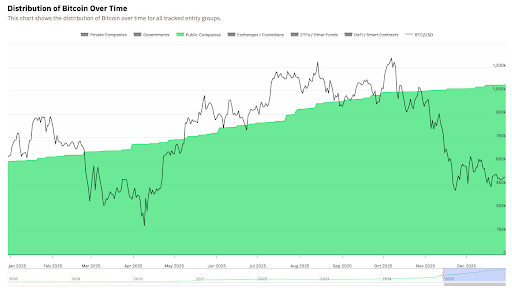
While several projects are being introduced to improve the efficiency of Bitcoin, seasoned crypto expert and the founder of the Wealth Mastery Newspaper, Lark Davis, has revealed that many public companies are aggressively accumulating BTC. Currently, public companies collectively hold 1.09 million BTC, representing 5.1% of the total BTC supply, which is a new all-time high.

However, the latest major aggressive purchases have come from MicroStrategy and Metaplanet. Strategy just announced another 1,200 BTC purchase, pushing its total holdings to 672,000 BTC. Asia-based firm Metaplanet also bought an additional 4,200 BTC in December, bringing its total holdings to 35,000 BTC.
Bitcoin

Davis pointed out that other recent purchases have come from Cango Inc., Bitdeer Technologies, and Anap Holdings. While retail investors are demonstrating weakening sentiment, public companies or institutional investors continue to stack regardless of the ongoing market.

Bitcoin
Market Opportunity
Core DAO Logo
Core DAO Price(CORE)
$0.0971
$0.0971$0.0971
+1.14%
USD
Core DAO (CORE) Live Price Chart
Disclaimer: The articles reposted on this site are sourced from public platforms and are provided for informational purposes only. They do not necessarily reflect the views of MEXC. All rights remain with the original authors. If you believe any content infringes on third-party rights, please contact [email protected] for removal. MEXC makes no guarantees regarding the accuracy, completeness, or timeliness of the content and is not responsible for any actions taken based on the information provided. The content does not constitute financial, legal, or other professional advice, nor should it be considered a recommendation or endorsement by MEXC.

You May Also Like

The Channel Factories We’ve Been Waiting For

The Channel Factories We’ve Been Waiting For

The post The Channel Factories We’ve Been Waiting For appeared on BitcoinEthereumNews.com. Visions of future technology are often prescient about the broad strokes while flubbing the details. The tablets in “2001: A Space Odyssey” do indeed look like iPads, but you never see the astronauts paying for subscriptions or wasting hours on Candy Crush.  Channel factories are one vision that arose early in the history of the Lightning Network to address some challenges that Lightning has faced from the beginning. Despite having grown to become Bitcoin’s most successful layer-2 scaling solution, with instant and low-fee payments, Lightning’s scale is limited by its reliance on payment channels. Although Lightning shifts most transactions off-chain, each payment channel still requires an on-chain transaction to open and (usually) another to close. As adoption grows, pressure on the blockchain grows with it. The need for a more scalable approach to managing channels is clear. Channel factories were supposed to meet this need, but where are they? In 2025, subnetworks are emerging that revive the impetus of channel factories with some new details that vastly increase their potential. They are natively interoperable with Lightning and achieve greater scale by allowing a group of participants to open a shared multisig UTXO and create multiple bilateral channels, which reduces the number of on-chain transactions and improves capital efficiency. Achieving greater scale by reducing complexity, Ark and Spark perform the same function as traditional channel factories with new designs and additional capabilities based on shared UTXOs.  Channel Factories 101 Channel factories have been around since the inception of Lightning. A factory is a multiparty contract where multiple users (not just two, as in a Dryja-Poon channel) cooperatively lock funds in a single multisig UTXO. They can open, close and update channels off-chain without updating the blockchain for each operation. Only when participants leave or the factory dissolves is an on-chain transaction…
Share
BitcoinEthereumNews2025/09/18 00:09
XRP Escrow Amendment Gains Momentum, Set for February 2026 Activation

XRP Escrow Amendment Gains Momentum, Set for February 2026 Activation

TLDR The XRP Ledger’s Token Escrow amendment has gained 82.35% consensus and is set for activation on February 12, 2026. This amendment allows users to escrow a
Share
Coincentral2026/01/31 01:00
ZKP’s 300x Potential Takes Center Stage as XRP Price Shifts and Algorand News Turns Cautious

ZKP’s 300x Potential Takes Center Stage as XRP Price Shifts and Algorand News Turns Cautious

ZKP takes focus as XRP price tests a macro shift and Algorand news signals caution, reshaping views on structure and the best crypto to buy.
Share
Blockchainreporter2026/01/31 01:00