CLARITY Act faces new pressure from Ohio Senate race
The battle for the open Senate seat for the state of Ohio could impact the chances of the CLARITY Act, the crypto-friendly legislation that has been in the works since last year, finally landing this year, according to Galaxy Digital’s Alex Thorn.
The race is tightly contested, with Republican incumbent Jon Husted set to potentially face off with former Democratic Senator Sherrod Brown, who’s expected to win his party’s nomination.
If Democrats succeed, the CLARITY Act will likely face a far rougher path.
Why is Sherrod Brown bad for the CLARITY Act?
According to Galaxy Digital’s Alex Thorn, if Democrats take the Senate and Brown wins Ohio, he could reclaim the Banking Committee chairmanship, a position he held from 2021 to 2025.
If Democrats take the Senate but Brown loses, Sen. Elizabeth Warren would be next in line to lead the panel. Thorn sees both outcomes as hostile territory for digital-asset legislation.
Brown earned an “F” rating from Stand With Crypto, which labeled him “strongly against crypto” based on 17 public statements and his vote against the SAB 121 resolution in May 2024.
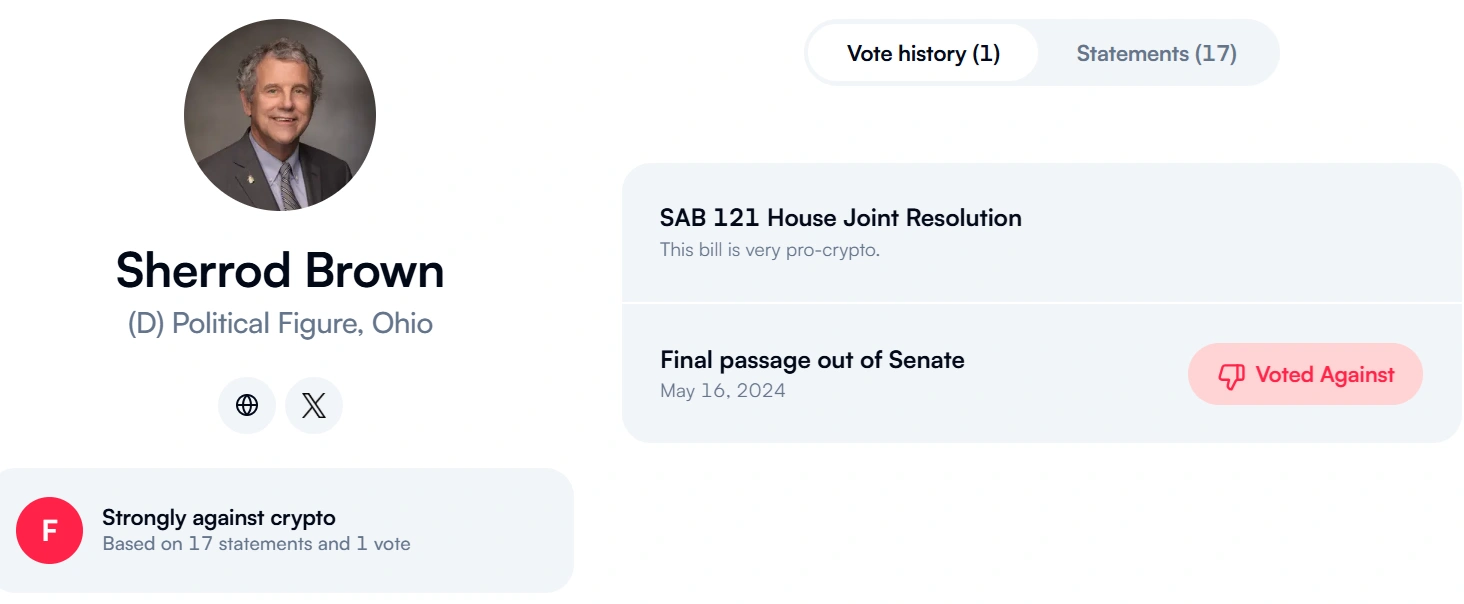 Democrat candidate Sherrod Brown’s recent comments have not improved his crypto rating. Source: Stand With Crypto.
As banking chair during the Biden administration, he blocked industry-backed bills from advancing, a record that Sen. Tim Scott, his Republican successor atop the committee, credited directly to the crypto industry’s spending.
“Thank you, to all of y’all, for getting rid of Sherrod Brown,” Scott reportedly told attendees at a Wyoming blockchain conference in August 2025, according to the Associated Press.
How did Crypto groups lead to Senator Brown losing?
Pro-crypto groups spent more than $40 million to unseat Brown in 2024, more than four times their outlay in any other Senate contest that cycle, and it worked. Brown narrowly lost to Republican Bernie Moreno, 46% to 50%.
However, like all political cycles, elections are back again, and Brown is back. This time, he has the financial edge. He raised $10.1 million in the first quarter of 2026, compared with Husted’s $2.9 million, and carries $16.5 million cash on hand to Husted’s $8.2 million, according to Politico’s review of FEC filings.
Senate Leadership Fund, the top Republican super PAC, has committed $79 million to defend the seat.
The crypto industry is mobilizing again, with the Sentinel Action Fund super PAC having already spent $8 million opposing Brown. Fairshake, which led the 2024 campaign against him, held upward of $170 million in cash as of February, per the Washington Examiner.
Coinbase CEO Brian Armstrong told the reporters, “We saw what happened in the last administration. We’re never gonna let that happen again.”
What is Brown’s current stance on crypto?
With his time away from the Senate, Brown has adjusted his tone but has not specified new policy positions. His campaign told reporters last August that he “recognizes that cryptocurrency is a part of America’s economy” and would work to ensure it “expands opportunity and lifts up Ohioans.”
In April, Brown’s campaign repeated the same talking points when pressed on whether his views had changed.
Husted, who was appointed to fill JD Vance’s vacated seat when Vance became vice president, has positioned himself as pro-crypto. Contributions from executives at Andreessen Horowitz, Solana Labs, and others totaling $49,000 have flowed to his campaign, according to Follow the Crypto.
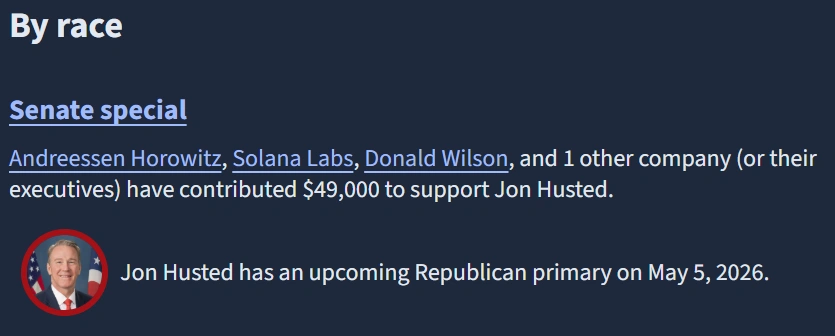 Jon Husted has support from crypto stakeholders. Source: Follow the Crypto.
The clock on CLARITY
Senior Trump administration officials have urged Congress to pass the CLARITY Act to establish a broader regulatory framework for digital assets, building on the GENIUS Act stablecoin law enacted last year.
But the window may be narrow. Ohio’s primary on Tuesday, May 6, sets the stage for a November special election whose outcome could determine the Banking Committee’s leadership and, with it, the legislative calendar for crypto regulation.
Cook Political Report rates the Ohio race a toss-up, alongside contests in Maine and Michigan. Democrats need to flip only a handful of seats to reclaim the majority, and every competitive race tightens the margin that crypto lobbyists are counting on to move legislation before the current Congress ends.
If you're reading this, you’re already ahead. Stay there with our newsletter.


You May Also Like

Trump admin seizes DC's busiest public golf course with no warning

Crypto payment security and trust in infrastructure providers