Square Yards FY26 Results: Revenue Hits INR 2,086 Cr, EBITDA Surges
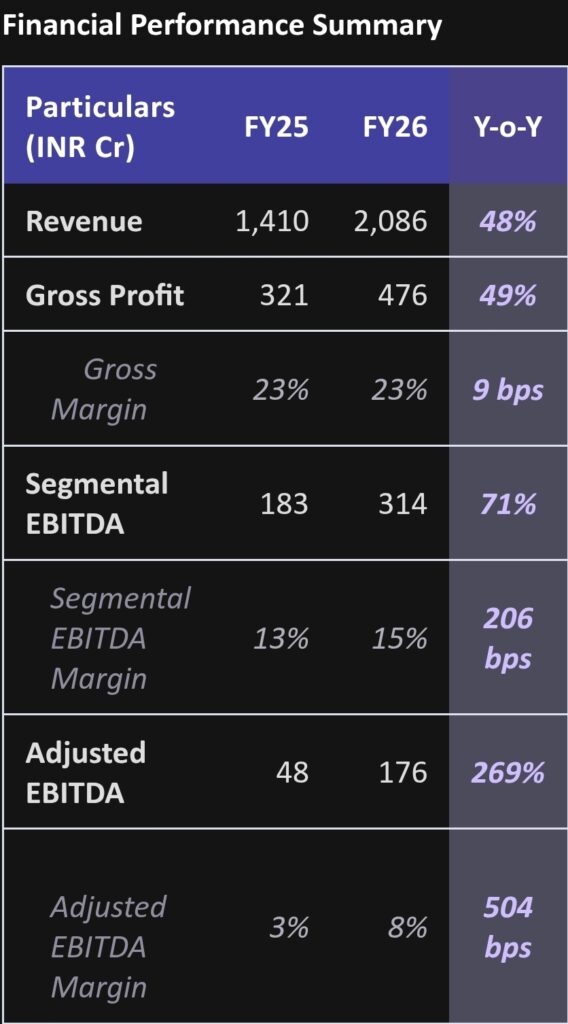
Square Yards FY26 Results show the company achieving INR 2,086 crore revenue and INR 176 crore EBITDA, marking a shift toward platform-led, integrated real estate experiences. This matters as it signals the rise of ecosystem-driven CX models replacing fragmented property transactions.
Square Yards FY26 Results Signal a New Era of Platform-Led Real Estate Growth
The Square Yards FY26 Results mark a defining inflection point in India’s proptech evolution. Reporting INR 2,086 crore in revenue and INR 176 crore in EBITDA, Square Yards has demonstrated that scale and profitability can coexist in a category long plagued by fragmentation and inefficiency.
This becomes critical when real estate platforms historically struggled to move beyond transaction-led revenue. The Square Yards FY26 Results instead highlight a transition toward a multi-layered ecosystem—where customer acquisition, financing, design, and property management operate as a unified engine.
From a CX standpoint, this is not just growth—it is structural transformation.
Square Yards FY26 Results and the Collapse of Fragmented Real Estate Models
For decades, real estate transactions have been defined by disjointed experiences. Buyers interacted with brokers, banks, designers, and property managers in isolation—resulting in friction, delays, and low trust.
The Square Yards FY26 Results demonstrate what happens when this fragmentation is eliminated. By integrating discovery, mortgage, interiors, and rentals into a single platform, Square Yards is redefining how value is created and captured.
At a structural level, this signals a shift from:
- Transaction-centric engagement
- To lifecycle-centric ownership
The deeper implication is that customer journey control is now the primary competitive advantage.
This is where the shift occurs: platforms that unify services will outperform those that specialize in isolated functions.
From Marketplace to Ecosystem Controller
Strategically, Square Yards is no longer operating as a marketplace—it is evolving into an ecosystem controller.
“ We are at an interesting trisection of scale, growth and profitability. And with network flywheel effects and leverage playing out across the ecosystem, this is the best operational phase we have ever been in.”
— Tanuj Shori, Founder and CEO, Square Yards
This statement is revealing.
It highlights three simultaneous realities:
- Scale is no longer diluting margins
- Cross-sell is amplifying revenue per customer
- Network effects are compounding growth
Operationally, this translates into a model where:
- Property transactions drive mortgage demand
- Mortgage customers convert into interior design users
- Managed properties generate recurring rental income
The deeper implication is the emergence of flywheel economics, where each service reinforces the next.
Competition is No Longer Vertical—It’s Horizontal
The competitive landscape is undergoing a fundamental reconfiguration.
Traditional players operate in silos:
- Listing platforms focus on discovery
- Banks dominate financing
- Interior firms handle post-purchase services
Square Yards disrupts this structure by integrating all layers.
This becomes critical when customer expectations demand continuity across the journey. A fragmented competitor cannot match the seamlessness of a unified platform.
Strategically, this indicates a shift from:
- Vertical excellence
- To horizontal integration
And in this new paradigm, breadth of capability becomes more valuable than depth in isolation.
Technology as the Invisible Engine Behind Scale
At a system level, the success of the Square Yards FY26 Results is underpinned by a tightly orchestrated technology stack.
The platform integrates:
- Property discovery engines
- Mortgage distribution systems via Urban Money
- Interior design workflows
- Rental and property management infrastructure
What makes this powerful is not the individual components—but their orchestration.
Data flows seamlessly across systems, enabling:
- Predictive cross-selling
- Faster loan approvals
- Personalized property recommendations
Additionally, the use of AI and VR technologies enhances customer confidence by improving visualization and decision-making.
Operationally, this reduces friction and increases conversion efficiency—two critical levers in high-value transactions like real estate.
CX is No Longer a Layer—It’s the Operating Model
From a CX standpoint, Square Yards has embedded experience into its core operating architecture.
Customer Impact:
- End-to-end journey ownership
- Reduced cognitive load
- Faster and more transparent transactions
Business Impact:
- Higher lifetime value per customer
- Improved EBITDA margins through operating leverage
- Reduced customer acquisition cost over time
System Impact:
- Unified data ecosystem
- Scalable service delivery
- Continuous feedback loops
This is where the transformation becomes evident: CX is not an interface—it is the infrastructure.
Maturity Signals and the Next Phase of Evolution
Square Yards has reached an advanced stage of CX maturity, characterized by ecosystem integration and cross-functional orchestration.
However, the next phase will depend on:
- AI-driven hyper-personalization
- Automated decisioning across services
- Expansion into adjacent home ownership services
The gap lies in scaling personalization without increasing operational complexity.
The trigger for this next evolution will be deeper AI integration across the stack.
Decision Intelligence: What Leaders Should Learn
The Square Yards FY26 Results offer a clear strategic blueprint for industry leaders.
Build vs Buy vs Partner:
- Build: High control, high investment
- Buy: Faster capability acquisition, integration challenges
- Partner: Flexible and scalable, but dependent on ecosystem alignment
Risk Factors:
- Execution complexity across multiple verticals
- Capital allocation across integrated services
- Maintaining customer trust at scale
Implementation Reality:
High complexity, but high defensibility once executed.
The key takeaway: integration is expensive—but fragmentation is costlier.
Industry Implications: Talent, Competition, and Ecosystem Shifts
The implications extend beyond Square Yards.
Talent:
Demand will rise for hybrid roles combining CX, fintech, and proptech expertise.
Competition:
Expect consolidation as platforms attempt to build or acquire missing capabilities.
Ecosystem:
Partnerships between developers, lenders, and service providers will intensify.
This becomes critical as no single player can dominate without ecosystem alignment.
The Future: Flywheel Economics Will Define Winners
The most important signal from the Square Yards FY26 Results is the validation of flywheel economics in real estate.
Each layer of the platform strengthens the other:
- Transactions feed financing
- Financing drives interiors
- Interiors lead to property management
This interconnected model creates compounding value over time.
Final Takeaway
The Square Yards FY26 Results are not just a financial milestone—they are proof that platform-led, CX-driven ecosystems can scale profitably in real estate.
The deeper implication is unmistakable:
The future of real estate belongs to platforms that control the entire customer journey—not just parts of it.
The post Square Yards FY26 Results: Revenue Hits INR 2,086 Cr, EBITDA Surges appeared first on CX Quest.


You May Also Like

Crypto sector reassured as the CLARITY Act fails to pass, Perkins says

MONIE Trades At $0.006597 As Infiblue World Burns 80 Million Tokens In Deflationary Move