A quiet regulatory document can sometimes carry more weight than a loud market rally. That idea comes into focus after a new filing connected to AAVE appeared atA quiet regulatory document can sometimes carry more weight than a loud market rally. That idea comes into focus after a new filing connected to AAVE appeared at

Will SEC Approve the First DeFi ETF? AAVE Filing Sparks Big Question

2026/02/17 15:30
3 min read

A quiet regulatory document can sometimes carry more weight than a loud market rally. That idea comes into focus after a new filing connected to AAVE appeared at the United States Securities and Exchange Commission. The paperwork points to a possible path that could move decentralized finance closer to traditional investment access.

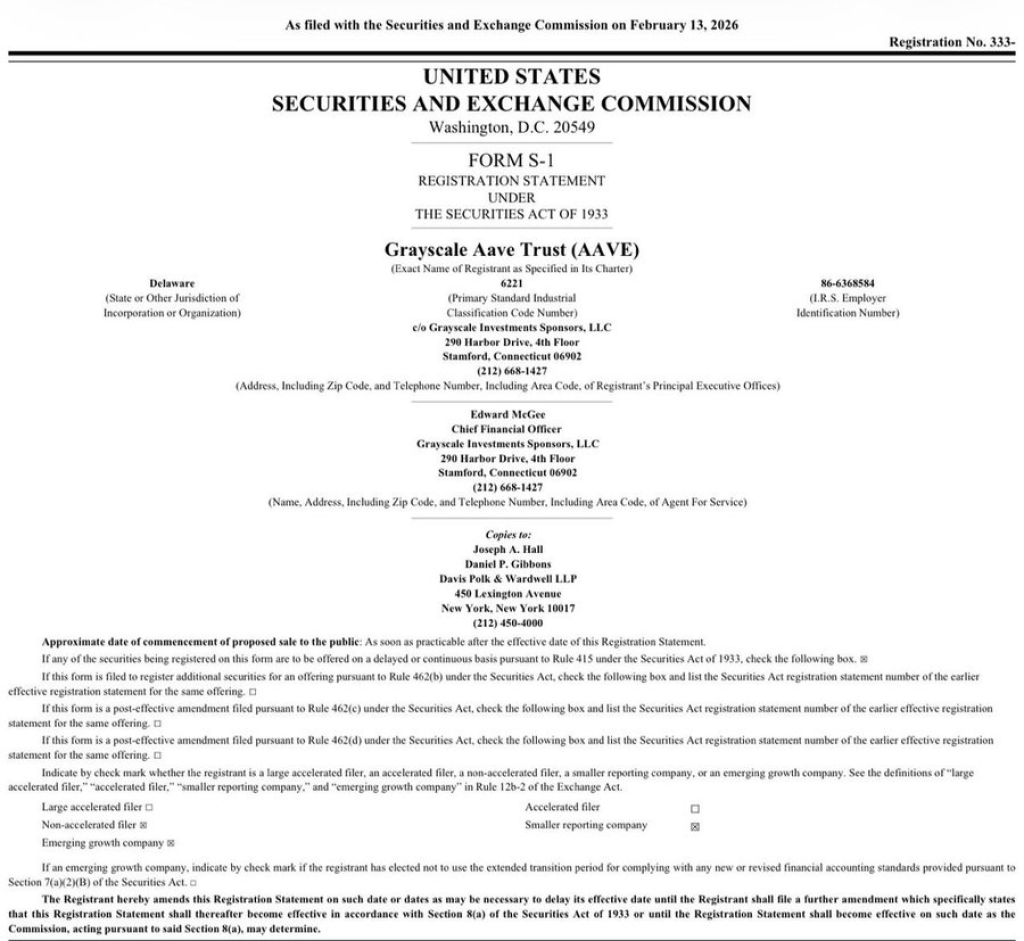
Crypto Patel noted the development in a post that framed the moment as a serious step toward a DeFi exchange-traded fund. The post notes that Grayscale submitted an S-1 registration tied to an Aave trust.

That type of filing usually marks the early stage of a product meant for public market exposure, which explains why the conversation around AAVE has started to focus on regulation instead of short term price action.
@CryptoPatel / X

SEC Filing Shows Formal Structure Behind Potential AAVE Investment Product

Details inside the document reveal that the proposed vehicle is named the Grayscale Aave Trust. The registration statement sits under the Securities Act of 1933, which governs how securities reach public investors in the United States. Grayscale Investments Sponsors appears as the listed sponsor, with corporate addresses and executive oversight clearly outlined.

Such structure matters because it shows preparation for institutional compliance rather than experimental token exposure. Traditional filings require disclosure, governance clarity, and operational transparency. Each requirement creates a bridge between decentralized assets like AAVE and regulated financial markets.

Crypto Patel connects this step to a wider pattern that includes similar ETF ambitions across the altcoin sector. Expansion beyond Bitcoin and Ethereum would mark a meaningful change in how regulators view decentralized finance infrastructure. Access through brokerage accounts could introduce AAVE to investors who never interact with on chain lending protocols.

Regulatory Approval Remains Uncertain Despite Growing DeFi Interest

Regulatory progress rarely follows a straight timeline. SEC review can stretch across months, and approval depends on market surveillance, custody standards, and investor protection rules. AAVE must satisfy those conditions before any product reaches trading desks.

Crypto Patel frames the moment as an open question rather than a guaranteed outcome. The post asks whether the SEC will allow a DeFi focused ETF during the current cycle. That question captures the tension between innovation and oversight that defines the digital asset market today.

Read Also: Kaspa Crosses 600 Million Transactions: One of Crypto’s Most Underrated Growth Stories

Aave already holds a strong position inside decentralized lending, which gives the filing practical relevance beyond speculation. Institutional packaging could expand visibility, yet final approval still depends on regulatory comfort with DeFi mechanics. That balance will shape how quickly decentralized finance enters mainstream portfolios.

Subscribe to our YouTube channel for daily crypto updates, market insights, and expert analysis.

The post Will SEC Approve the First DeFi ETF? AAVE Filing Sparks Big Question appeared first on CaptainAltcoin.

Market Opportunity
AaveToken Logo
AaveToken Price(AAVE)
$124.63
$124.63$124.63
+0.65%
USD
AaveToken (AAVE) Live Price Chart
Disclaimer: The articles reposted on this site are sourced from public platforms and are provided for informational purposes only. They do not necessarily reflect the views of MEXC. All rights remain with the original authors. If you believe any content infringes on third-party rights, please contact [email protected] for removal. MEXC makes no guarantees regarding the accuracy, completeness, or timeliness of the content and is not responsible for any actions taken based on the information provided. The content does not constitute financial, legal, or other professional advice, nor should it be considered a recommendation or endorsement by MEXC.

You May Also Like

SEC Clears the Way for Spot Crypto ETFs with New Generic Rules

SEC Clears the Way for Spot Crypto ETFs with New Generic Rules

The post SEC Clears the Way for Spot Crypto ETFs with New Generic Rules appeared first on Coinpedia Fintech News The U.S. SEC has approved new listing standards that simplify the process for launching spot crypto ETFs under the ’33 Act. Cryptocurrencies with listed futures on Coinbase, currently about 12 to 15 coins, will now qualify automatically, removing the need for separate case-by-case approvals. This change streamlines regulatory procedures, cutting delays and hurdles, while opening …
Share
CoinPedia2025/09/18 14:35
Raydium’s 200% volume spike tests RAY’s breakout strength – Here’s why

Raydium’s 200% volume spike tests RAY’s breakout strength – Here’s why

The post Raydium’s 200% volume spike tests RAY’s breakout strength – Here’s why appeared on BitcoinEthereumNews.com. RAY surged over 11% in 24 hours to $0.69 as
Share
BitcoinEthereumNews2026/02/17 18:10
Bitcoin devs cheer block reconstruction stats, ignore security budget concerns

Bitcoin devs cheer block reconstruction stats, ignore security budget concerns

The post Bitcoin devs cheer block reconstruction stats, ignore security budget concerns appeared on BitcoinEthereumNews.com. This morning, Bitcoin Core developers celebrated improved block reconstruction statistics for node operators while conveniently ignoring the reason for these statistics — the downward trend in fees for Bitcoin’s security budget. Reacting with heart emojis and thumbs up to a green chart showing over 80% “successful compact block reconstructions without any requested transactions,” they conveniently omitted red trend lines of the fees that Bitcoin users pay for mining security which powered those green statistics. Block reconstructions occur when a node requests additional information about transactions within a compact block. Although compact blocks allow nodes to quickly relay valid bundles of transactions across the internet, the more frequently that nodes can reconstruct without extra, cumbersome transaction requests from their peers is a positive trend. Because so many nodes switched over in August to relay transactions bidding 0.1 sat/vB across their mempools, nodes now have to request less transaction data to reconstruct blocks containing sub-1 sat/vB transactions. After nodes switched over in August to accept and relay pending transactions bidding less than 1 sat/vB, disparate mempools became harmonized as most nodes had a better view of which transactions would likely join upcoming blocks. As a result, block reconstruction times improved, as nodes needed less information about these sub-1 sat/vB transactions. In July, several miners admitted that user demand for Bitcoin blockspace had persisted at such a low that they were willing to accept transaction fees of just 0.1 satoshi per virtual byte — 90% lower than their prior 1 sat/vB minimum. With so many blocks partially empty, they succumbed to the temptation to accept at least something — even 1 billionth of one bitcoin (BTC) — rather than $0 to fill up some of the excess blockspace. Read more: Bitcoin’s transaction fees have fallen to a multi-year low Green stats for block reconstruction after transaction fees crash After…
Share
BitcoinEthereumNews2025/09/18 04:07