

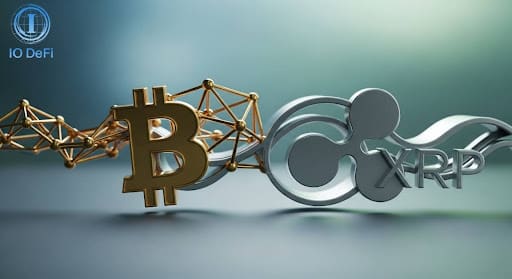
More Bitcoin and XRP Holders Are Testing Structured Models Instead of Waiting for the Next Cycle
For years, the dominant mindset among Bitcoin and XRP investors was simple: buy, hold, and wait for the next major market cycle.
That approach worked well during periods of rapid expansion. But as markets have matured, and consolidation phases have grown longer, a different behavior is beginning to surface. Rather than waiting indefinitely for price momentum to return, some investors are experimenting with structured participation models that allow capital to remain active during quieter market conditions.
This change is not being driven by hype or short-term speculation. It reflects a practical response to how the market now behaves.
 IO DeF
When Holding Stops Feeling Passive and Starts Feeling Costly
Extended periods of sideways price action have a subtle effect on investor psychology. While holding assets still feels “safe,” it also creates a sense that capital is underutilized.
For investors who have already experienced multiple cycles, the challenge is no longer volatility—it is inactivity.
As regulatory developments slow momentum and liquidity becomes more selective, many holders are reassessing whether waiting alone is still a complete strategy. This has opened the door to participation frameworks that focus less on prediction and more on process.
Small Allocations, Clear Rules
One notable aspect of this shift is how cautiously it is happening.
Rather than redeploying large portions of their portfolios, many investors are starting with limited allocations. The goal is not to chase returns, but to understand how structured systems operate in real conditions.
These models typically follow a straightforward logic: assets are allocated for a defined period, the system operates autonomously according to preset rules, and outcomes are determined by the structure itself rather than daily market movements.
This approach appeals to investors who value clarity and discipline over constant engagement.
Why Structured Participation Is Gaining Attention
Platforms offering structured digital asset participation are designed to remove several common friction points in crypto investing: emotional decision-making, frequent monitoring, and reactionary trading.
Instead of responding to every market fluctuation, participants enter predefined structures and allow the system to run its course. For long-term Bitcoin and XRP holders, this provides an alternative way to remain engaged without abandoning a broader holding strategy.
IO DeFi has emerged as one of the platforms operating in this space, focusing on fixed participation frameworks rather than discretionary trading tools. Users select structures based on duration and scale, after which the process runs independently until completion.
A Practical Middle Ground
What is drawing attention is not the promise of extraordinary outcomes, but the practicality of the model.
Structured participation sits between two extremes: doing nothing and trading constantly. For investors who are comfortable holding digital assets but want to explore more active use without increasing complexity, this middle ground feels increasingly relevant.
Access to these structures is available through IO DeFi’s official registration portal, where participants can review available options and onboard via a streamlined email-based process.
Review available participation structures here:
https://iodefi.com/xml/index.html#/register
A Quiet Behavioral Shift
This trend is not loud, and it is not driven by marketing headlines. It is visible in behavior rather than commentary.
As more Bitcoin and XRP holders test structured participation models alongside traditional holding strategies, the definition of what it means to “own” digital assets continues to evolve. In a market where patience alone no longer feels sufficient, process-driven participation is becoming part of how investors stay engaged—without relying on predictions about the next cycle.
You May Also Like
Why Bitcoin Dominance Is Not Always a Reliable Market Signal
Hadron Labs Launches Bitcoin Summer on Neutron, Offering 5–10% BTC Yield
