Rolland is the CEO and co-founder of UXLINK, a Web3 infrastructure project focused on solving the mass adoption challenge through real social graphs and relationshipRolland is the CEO and co-founder of UXLINK, a Web3 infrastructure project focused on solving the mass adoption challenge through real social graphs and relationship

The Hidden Layer of Web3 Infrastructure: Insights from UXLINK CEO Rolland

Rolland is the CEO and co-founder of UXLINK, a Web3 infrastructure project focused on solving the mass adoption challenge through real social graphs and relationship-based user acquisition. Under his leadership, UXLINK has facilitated the migration of tens of millions of Web2 users into Web3 ecosystems, working behind the scenes as foundational infrastructure for gaming, DeFi, and social applications across multiple blockchain networks.

  1. How can decentralized applications (dApps) leverage familiar Web2 social dynamics—specifically group chats and community management—to onboard the next billion users into the Web3 ecosystem? 

I think the key is to meet users where they already are and make the transition feel seamless rather than disruptive. Web2 platforms like Telegram, WhatsApp, X,  Discord have mastered frictionless group chats, shared media, roles, and community moderation. UXLINK replicates and extends these dynamics on-chain by allowing users to import or mirror their existing Web2 groups into decentralized environments without requiring them to abandon familiar interfaces.

Users can create or join on-chain groups using the same invite links and chat flows they already know, while gradually introducing Web3 elements like shared wallets, on-chain reputation, and assetized relationships. This “familiar first, crypto later” approach lowers the psychological and technical barriers. By starting with social utility (such as discovering friends, joining interest-based groups) and only later revealing economic utility (like earning from relationships or group governance), we turn passive Web2 users into active Web3 participants. This is how we believe the next billion users will enter web3—not through speculative trading, but through social connections that they already value.

  1. What are the key architectural and performance challenges that necessitate building a dedicated Layer 2 solution specifically optimized for high-volume, real-time social networking and community applications?

    General-purpose L2s optimize for financial throughput, not social graph synchronization. Social interactions generate massive volumes of small, frequent, interdependent state changes:user reactions, reputation updates, and graph traversals (e.g., “friends of friends”).

The main challenges are:


* High-frequency, low-value interactions

* Real-time state updates

* Massive concurrency at group level

* Extremely low latency

* Bursty traffic patterns: Because viral events can spike activity 100x in minutes, requiring elastic scaling.

A dedicated, social-optimized L2 is built specifically for social workloads. It uses custom execution layers for social graph operations and parallel state updates for group actions. It also applies data availability designs tailored to social data. This delivers truly real-time, planet-scale social experiences that general-purpose L2s simply can’t match.

  1. How critical is the transition of non-transferable, real-world social relationships into verifiable, on-chain, assetized social identities for building truly resilient and trustworthy social applications?
    This transition is absolutely foundational. Current social platforms suffer from fake accounts, bot networks, and disposable identities because relationships have no cost or verifiability. By turning real-world social connections into non-transferable, on-chain assets we embed social cost and social credibility directly into Web3. This enables stronger resilience, deeper trust, and lasting identity continuity. These are capabilities that purely financial mechanisms can never achieve.
  1. In a decentralized group environment, what are the primary security and governance hurdles associated with managing and utilizing shared, on-chain community assets for the collective benefit of the group members?

The core challenge is aligning collective ownership with accountable execution.

The main hurdles would be:

* Permission abuse

* Governance capture

* Low-participation voting

* Privacy vs transparency: Because balancing on-chain auditability with member privacy is something we have to deal with very often. 

We address this through group-native account abstraction(with OAOG protocols), role-based permissions, social recovery, and execution thresholds tied to user reputation—not just token weight. We believe, governance must reflect social consensus, not capital dominance.

  1. When bootstrapping a new decentralized social ecosystem, what are the most effective token distribution models and incentive designs to reward collective action and ensure genuine, long-term, and sustainable community activity?

    The most effective models prioritize contribution quality over raw volume.
    We use the Link-to-Earn model. Where value is first earned collectively(based on acquaintance), then distributed based on contribution quality. This discourages farming and encourages coordination, continuity, and long-term participation.
    Pure individual mining or trading rewards attract mercenaries.The social graph adds peer accountability, and organic growth. Combined with non-transferable reputation assets, this filters for genuine users who build rather than extract, creating flywheels of sustainable activity.
  1. The UXLINK Protocol Stack is defined as a modular L2 infrastructure. How does the technical architecture of this stack specifically address the scalability and latency needs of group social interactions better than a general-purpose L2?

The UXLINK Protocol Stack is modular by design, with dedicated layers for social execution, group accounts, RWS identity, and unified gas and settlement. By separating social logic from financial settlement and optimizing execution specifically for group interactions, we significantly reduce state contention and latency. This architecture makes real-time, on-chain social interactions practical and scalable—an area where general-purpose L2s typically fall short.

  1. UXLINK converts social relationships into the on-chain asset UXLinkage / RWS. What security and anti-sybil mechanisms are used to verify the authenticity and “real-world” value of this asset to prevent farming or bot activity?

Here we use a multi-layered approach:

* Proof-of-humanity signals (phone verification, Web2 account binding)

* Social proof scoring (meaning, links from high-reputation users weigh more)
* Time-based relationship persistence

* Rate limiting and cost. The system might ask a user in certain circumstances, to pay a small gas or points whenever there is suspicion.
* AI + community flagging for anomalous patterns.

* Progressive unlocking (new links gain value slowly as interaction history builds up)

This ensures Link-to-Earn/RWS represents genuine real-world relationships rather than farmed connections, maintaining the asset’s integrity and value.

  1. The UXUY points are distributed via a Link-to-Earn (L-to-E) mechanism. What objective and quantifiable metrics does UXLINK use to assess the “quality” or “contribution” of a user, to ensure fair and sustainable incentive distribution?

At UXLINK, UXUY and Link-to-Earn are driven by objective, quantifiable signals instead of hype: we score users on measurable contributions such as the quality and consistency of their interactions, retention over time, verified network growth they bring in, real economic value generated on-chain (including usage of products like Fuji Pay, or Social club cards), and constructive participation in governance or community work. These signals are normalized, weighted, and combined into a transparent quality score that determines each user’s share of rewards per epoch. And this goes along  with strong anti-Sybil checks, rate limits, and vesting to prevent abuse. The goal is simple: reward real and sustained value to the network, not short-term farming.

  1. UXLINK has built a comprehensive group infrastructure. What is the immediate monetization strategy for the group layer and the overall UXLINK ecosystem, beyond basic token incentives, in the next 12 months?

In the next 12 months, UXLINK’s priority is not to monetize groups directly, but to scale real usage and economic activity across the network. We’re focused on driving value through PayFi use-cases like Fuji Pay, developer adoption via the UXLINK protocol stack, and deeper integration of social identity with on-chain payments and apps. Revenue and sustainability will primarily come from growth services provided by UXLINK to other Web3 projects, and from ecosystem growth, rather than extracting value from users or communities. We believe that once large-scale social and payment activity is established, sustainable monetization will naturally follow without compromising user experience or growth.

  1. With the emphasis on Real World Social (RWS), what is the long-term vision for linking a user’s in-real-life identity and reputation to their on-chain UXLINK identity in a privacy-preserving and secure manner?

    The vision is a world where your real-world reputation becomes portable digital capital without sacrificing privacy. We will achieve this through Zero-knowledge proofs for selective disclosure. For instance: prove you have X real friends or Y reputation without revealing who.

Users will control exactly what reputation data is shared with which applications

—enabling trust-minimized lending, hiring, dating, and collaboration based on real human history, while keeping sensitive details private. This bridges the offline and online self into a unified, user-owned digital identity.This way, UXLINK is positioned to remain a key player in crypto mass adoption and industry growth.

And lastly, 

Web3 won’t scale through better speculation. It will scale through better social coordination. That’s what UXLINK is building

Market Opportunity
Solayer Logo
Solayer Price(LAYER)
$0.1739
$0.1739$0.1739
+2.23%
USD
Solayer (LAYER) Live Price Chart
Disclaimer: The articles reposted on this site are sourced from public platforms and are provided for informational purposes only. They do not necessarily reflect the views of MEXC. All rights remain with the original authors. If you believe any content infringes on third-party rights, please contact [email protected] for removal. MEXC makes no guarantees regarding the accuracy, completeness, or timeliness of the content and is not responsible for any actions taken based on the information provided. The content does not constitute financial, legal, or other professional advice, nor should it be considered a recommendation or endorsement by MEXC.

You May Also Like

Here’s How Consumers May Benefit From Lower Interest Rates

Here’s How Consumers May Benefit From Lower Interest Rates

The post Here’s How Consumers May Benefit From Lower Interest Rates appeared on BitcoinEthereumNews.com. Topline The Federal Reserve on Wednesday opted to ease interest rates for the first time in months, leading the way for potentially lower mortgage rates, bond yields and a likely boost to cryptocurrency over the coming weeks. Average long-term mortgage rates dropped to their lowest levels in months ahead of the central bank’s policy shift. Copyright{2018} The Associated Press. All rights reserved. Key Facts The central bank’s policymaking panel voted this week to lower interest rates, which have sat between 4.25% and 4.5% since December, to a new range of 4% and 4.25%. How Will Lower Interest Rates Impact Mortgage Rates? Mortgage rates tend to fall before and during a period of interest rate cuts: The average 30-year fixed-rate mortgage dropped to 6.35% from 6.5% last week, the lowest level since October 2024, mortgage buyer Freddie Mac reported. Borrowing costs on 15-year fixed-rate mortgages also dropped to 5.5% from 5.6% as they neared the year-ago rate of 5.27%. When the Federal Reserve lowered the funds rate to between 0% and 0.25% during the pandemic, 30-year mortgage rates hit record lows between 2.7% and 3% by the end of 2020, according to data published by Freddie Mac. Consumers who refinanced their mortgages in 2020 saved about $5.3 billion annually as rates dropped, according to the Consumer Financial Protection Bureau. Similarly, mortgage rates spiked around 7% as interest rates were hiked in 2022 and 2023, though mortgage rates appeared to react within weeks of the Fed opting to cut or raise rates. How Do Treasury Bonds Respond To Lower Interest Rates? Long-term Treasury yields are more directly influenced by interest rates, as lower rates tend to result in lower yields. When the Fed pushed rates to near zero during the pandemic, 10-year Treasury yields fell to an all-time low of 0.5%. As…
Share
BitcoinEthereumNews2025/09/18 05:59
Two new wallets withdrew 26,241 ZEC from Binance within 12 hours, worth $13.5 million.
Two new wallets withdrew 26,241 ZEC from Binance within 12 hours, worth $13.5 million.

PANews reported on December 28 that, according to Lookonchain monitoring, two newly created wallets withdrew 26,241 ZEC (US$13.5 million) from Binance in the past
Share
PANews2025/12/28 09:13
Crucial ETH Unstaking Period: Vitalik Buterin’s Unwavering Defense for Network Security

Crucial ETH Unstaking Period: Vitalik Buterin’s Unwavering Defense for Network Security

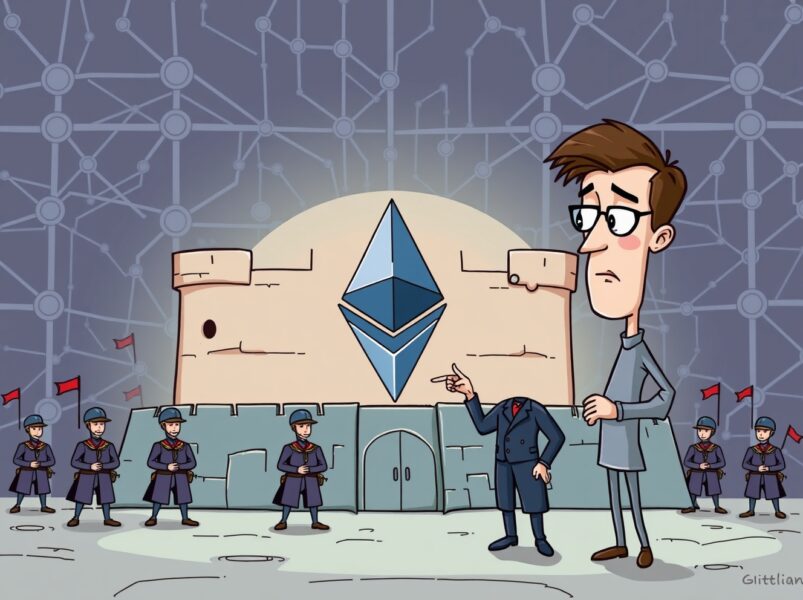
BitcoinWorld Crucial ETH Unstaking Period: Vitalik Buterin’s Unwavering Defense for Network Security Ever wondered why withdrawing your staked Ethereum (ETH) isn’t an instant process? It’s a question that often sparks debate within the crypto community. Ethereum founder Vitalik Buterin recently stepped forward to defend the network’s approximately 45-day ETH unstaking period, asserting its crucial role in safeguarding the network’s integrity. This lengthy waiting time, while sometimes seen as an inconvenience, is a deliberate design choice with profound implications for security. Why is the ETH Unstaking Period a Vital Security Measure? Vitalik Buterin’s defense comes amidst comparisons to other networks, like Solana, which boast significantly shorter unstaking times. He drew a compelling parallel to military operations, explaining that an army cannot function effectively if its soldiers can simply abandon their posts at a moment’s notice. Similarly, a blockchain network requires a stable and committed validator set to maintain its security. The current ETH unstaking period isn’t merely an arbitrary delay. It acts as a critical buffer, providing the network with sufficient time to detect and respond to potential malicious activities. If validators could instantly exit, it would open doors for sophisticated attacks, jeopardizing the entire system. Currently, Ethereum boasts over one million active validators, collectively staking approximately 35.6 million ETH, representing about 30% of the total supply. This massive commitment underpins the network’s robust security model, and the unstaking period helps preserve this stability. Network Security: Ethereum’s Paramount Concern A shorter ETH unstaking period might seem appealing for liquidity, but it introduces significant risks. Imagine a scenario where a large number of validators, potentially colluding, could quickly withdraw their stake after committing a malicious act. Without a substantial delay, the network would have limited time to penalize them or mitigate the damage. This “exit queue” mechanism is designed to prevent sudden validator exodus, which could lead to: Reduced decentralization: A rapid drop in active validators could concentrate power among fewer participants. Increased vulnerability to attacks: A smaller, less stable validator set is easier to compromise. Network instability: Frequent and unpredictable changes in validator numbers can lead to performance issues and consensus failures. Therefore, the extended period is not a bug; it’s a feature. It’s a calculated trade-off between immediate liquidity for stakers and the foundational security of the entire Ethereum ecosystem. Ethereum vs. Solana: Different Approaches to Unstaking When discussing the ETH unstaking period, many point to networks like Solana, which offers a much quicker two-day unstaking process. While this might seem like an advantage for stakers seeking rapid access to their funds, it reflects fundamental differences in network architecture and security philosophies. Solana’s design prioritizes speed and immediate liquidity, often relying on different consensus mechanisms and validator economics to manage security risks. Ethereum, on the other hand, with its proof-of-stake evolution from proof-of-work, has adopted a more cautious approach to ensure its transition and long-term stability are uncompromised. Each network makes design choices based on its unique goals and threat models. Ethereum’s substantial value and its role as a foundational layer for countless dApps necessitate an extremely robust security posture, making the current unstaking duration a deliberate and necessary component. What Does the ETH Unstaking Period Mean for Stakers? For individuals and institutions staking ETH, understanding the ETH unstaking period is crucial for managing expectations and investment strategies. It means that while staking offers attractive rewards, it also comes with a commitment to the network’s long-term health. Here are key considerations for stakers: Liquidity Planning: Stakers should view their staked ETH as a longer-term commitment, not immediately liquid capital. Risk Management: The delay inherently reduces the ability to react quickly to market volatility with staked assets. Network Contribution: By participating, stakers contribute directly to the security and decentralization of Ethereum, reinforcing its value proposition. While the current waiting period may not be “optimal” in every sense, as Buterin acknowledged, simply shortening it without addressing the underlying security implications would be a dangerous gamble for the network’s reliability. In conclusion, Vitalik Buterin’s defense of the lengthy ETH unstaking period underscores a fundamental principle: network security cannot be compromised for the sake of convenience. It is a vital mechanism that protects Ethereum’s integrity, ensuring its stability and trustworthiness as a leading blockchain platform. This deliberate design choice, while requiring patience from stakers, ultimately fortifies the entire ecosystem against potential threats, paving the way for a more secure and reliable decentralized future. Frequently Asked Questions (FAQs) Q1: What is the main reason for Ethereum’s long unstaking period? A1: The primary reason is network security. A lengthy ETH unstaking period prevents malicious actors from quickly withdrawing their stake after an attack, giving the network time to detect and penalize them, thus maintaining stability and integrity. Q2: How long is the current ETH unstaking period? A2: The current ETH unstaking period is approximately 45 days. This duration can fluctuate based on network conditions and the number of validators in the exit queue. Q3: How does Ethereum’s unstaking period compare to other blockchains? A3: Ethereum’s unstaking period is notably longer than some other networks, such as Solana, which has a two-day period. This difference reflects varying network architectures and security priorities. Q4: Does the unstaking period affect ETH stakers? A4: Yes, it means stakers need to plan their liquidity carefully, as their staked ETH is not immediately accessible. It encourages a longer-term commitment to the network, aligning staker interests with Ethereum’s stability. Q5: Could the ETH unstaking period be shortened in the future? A5: While Vitalik Buterin acknowledged the current period might not be “optimal,” any significant shortening would likely require extensive research and network upgrades to ensure security isn’t compromised. For now, the focus remains on maintaining robust network defenses. Found this article insightful? Share it with your friends and fellow crypto enthusiasts on social media to spread awareness about the critical role of the ETH unstaking period in Ethereum’s security! To learn more about the latest Ethereum trends, explore our article on key developments shaping Ethereum’s institutional adoption. This post Crucial ETH Unstaking Period: Vitalik Buterin’s Unwavering Defense for Network Security first appeared on BitcoinWorld.
Share
Coinstats2025/09/18 15:30