Tron shows steady selling pressure with falling TVL and shrinking futures interest among traders. Technical readings signal sellers’ control, with price below major averages and momentum fading further. Tron (TRX) traded at $0.2830 on Tuesday, extending its pressure after a 5% decline on Monday. Market data shows the token is approaching a key support level [...]]]>Tron shows steady selling pressure with falling TVL and shrinking futures interest among traders. Technical readings signal sellers’ control, with price below major averages and momentum fading further. Tron (TRX) traded at $0.2830 on Tuesday, extending its pressure after a 5% decline on Monday. Market data shows the token is approaching a key support level [...]]]>

TRX Faces Breakdown Risk — Tron Price Pressured by Falling Demand and Outflows

For feedback or concerns regarding this content, please contact us at [email protected]
  • Tron shows steady selling pressure with falling TVL and shrinking futures interest among traders.
  • Technical readings signal sellers’ control, with price below major averages and momentum fading further.

Tron (TRX) traded at $0.2830 on Tuesday, extending its pressure after a 5% decline on Monday. Market data shows the token is approaching a key support level near $0.2764. On-chain and derivatives metrics indicate weakening demand and declining investor confidence.

According to DeFiLlama, Tron’s Total Value Locked fell by about 6.32% over the past 24 hours, dropping below the 5 billion dollar mark to around 4.8 billion. The decline suggests ongoing withdrawals from the DeFi ecosystem and points to waning engagement among network participants.

Open interest in TRX futures also dropped by 4.48% over the past 24 hours, sliding to around $291 million. The fall suggests a cutback in leveraged positions as traders reduce risk exposure. This reduction signals a sharp decline in speculation and participation within the derivatives market.

If the decline in derivatives and on-chain activity continues, the market’s value could drop further. Short-term conditions show strong bearish momentum, confirmed by technical indicators that signal weakening strength.

Indicators Point Toward Continued Weakness

Technical analysis shows the current price is trading below the 200-day Exponential Moving Average (EMA) at $0.3029. The 50-day EMA has also crossed below the 100-day EMA, a formation known as a death cross. This usually points to ongoing bearish pressure, which suggests that short-term sellers still have the upper hand.

On the daily chart, momentum indicators are showing signs of pressure. The Relative Strength Index (RSI) is at 26, clearly reflecting an oversold level with a downward direction. This setup points to heavy selling and weak recovery attempts.

The MACD indicator has dropped below its signal line, marking the third time since early October. This repeated crossover points to growing sell pressure. At the moment, sellers appear to have stronger control over market direction.

Chaikin Money Flow (CMF) is currently below the zero line at -0.09, showing steady outflow and weak buying pressure. Parabolic SAR dots appearing above the candles also indicate a downward trend and low investor confidence.
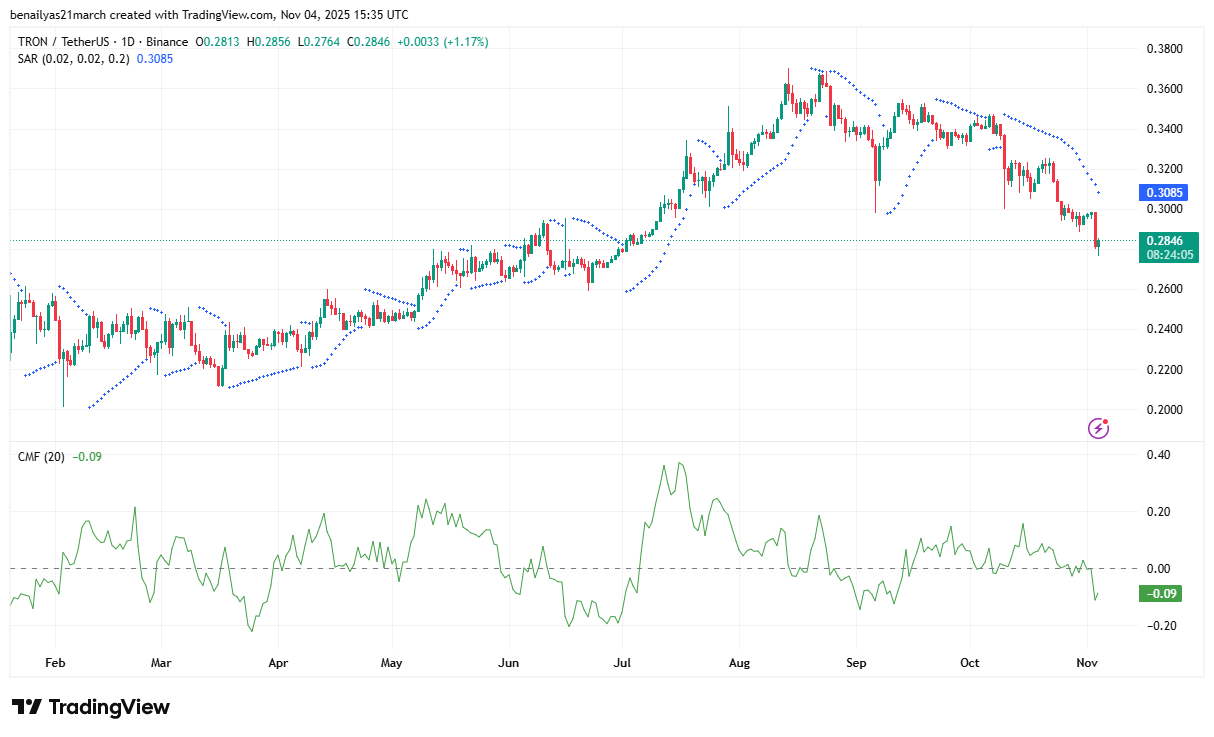
Tron price analysisSource: TradingView

Tron Near Key Levels That Could Shift Trend

If the current downward pressure breaks below the $0.2764 support, traders may look toward $0.2632 and $0.2397 as the next targets. These levels match the lows from May 31 and April 18.  A drop below these levels could trigger a deeper decline and strengthen the selling trend further.

If Tron shows a short-term bounce from $0.2764, resistance could appear near $0.2967. The 200-day EMA sits around $0.3029. These levels may cap the upside unless stronger buying pressure steps in. Bulls need clear volume support to push past these barriers and confirm a sustained recovery.

]]>
Disclaimer: The articles reposted on this site are sourced from public platforms and are provided for informational purposes only. They do not necessarily reflect the views of MEXC. All rights remain with the original authors. If you believe any content infringes on third-party rights, please contact [email protected] for removal. MEXC makes no guarantees regarding the accuracy, completeness, or timeliness of the content and is not responsible for any actions taken based on the information provided. The content does not constitute financial, legal, or other professional advice, nor should it be considered a recommendation or endorsement by MEXC.

You May Also Like

Cashing In On University Patents Means Giving Up On Our Innovation Future

Cashing In On University Patents Means Giving Up On Our Innovation Future

The post Cashing In On University Patents Means Giving Up On Our Innovation Future appeared on BitcoinEthereumNews.com. “It’s a raid on American innovation that would deliver pennies to the Treasury while kneecapping the very engine of our economic and medical progress,” writes Pipes. Getty Images Washington is addicted to taxing success. Now, Commerce Secretary Howard Lutnick is floating a plan to skim half the patent earnings from inventions developed at universities with federal funding. It’s being sold as a way to shore up programs like Social Security. In reality, it’s a raid on American innovation that would deliver pennies to the Treasury while kneecapping the very engine of our economic and medical progress. Yes, taxpayer dollars support early-stage research. But the real payoff comes later—in the jobs created, cures discovered, and industries launched when universities and private industry turn those discoveries into real products. By comparison, the sums at stake in patent licensing are trivial. Universities collectively earn only about $3.6 billion annually in patent income—less than the federal government spends on Social Security in a single day. Even confiscating half would barely register against a $6 trillion federal budget. And yet the damage from such a policy would be anything but trivial. The true return on taxpayer investment isn’t in licensing checks sent to Washington, but in the downstream economic activity that federally supported research unleashes. Thanks to the bipartisan Bayh-Dole Act of 1980, universities and private industry have powerful incentives to translate early-stage discoveries into real-world products. Before Bayh-Dole, the government hoarded patents from federally funded research, and fewer than 5% were ever licensed. Once universities could own and license their own inventions, innovation exploded. The result has been one of the best returns on investment in government history. Since 1996, university research has added nearly $2 trillion to U.S. industrial output, supported 6.5 million jobs, and launched more than 19,000 startups. Those companies pay…
Share
BitcoinEthereumNews2025/09/18 03:26
Subaru Motors Finance Reviews 2026

Subaru Motors Finance Reviews 2026

If you’re at a Subaru dealership, your heart is set on the perfect Outback or Forester. The salesperson asks, “Would you like to finance it today?” That’s where
Share
Fintechzoom2026/03/08 10:55
Shiba Inu Price Prediction: Dubai Cracks Down on KuCoin as Pepeto Outpaces DOGE and SHIB With $7.4M Raised

Shiba Inu Price Prediction: Dubai Cracks Down on KuCoin as Pepeto Outpaces DOGE and SHIB With $7.4M Raised

SHIB trades near cycle lows, but Pepeto is outpacing every Shiba Inu price prediction with $7.4M raised and a full exchange ecosystem approaching launch as Dubai
Share
Techbullion2026/03/08 10:54