Impersonation Scams 2026: How to Spot Them and Stay Safe
Keep your money safe, learn how to spot impersonation scams 
As scam tactics continue to evolve, impersonation scams remain one of the more common forms of fraud. By posing as familiar organisations and using official-looking documents, branding, or personal information, scammers may attempt to gain trust and pressure individuals into disclosing sensitive information or making payments.
This guide explains how impersonation scams typically work, common warning signs to look out for, and how to stay protected.
 Table of Contents:
- What Is an Impersonation Scam?
- How These Scams Work
- Common Tactics to Look Out For
- What YouTrip Will Never Do
- How to Protect Yourself
- What to Do If You’ve Already Responded
- FAQ
- Official YouTrip Platforms
What Is an Impersonation Scam?
An impersonation scam happens when a fraudster pretends to represent a trusted organisation, such as a bank, government agency, courier service, or fintech company, to gain your trust and pressure you into sharing personal information or transferring money.
Scammers may use a combination of:
- Fake policy or reference numbers (e.g. “YOU123456”) to appear legitimate
- Spoofed local phone numbers, including numbers with a “+65” prefix
- Personal details such as your name, NRIC, or date of birth, to appear credible
- Fake WhatsApp business profiles displaying familiar branding
- Fabricated contracts, chatbot messages, or video calls involving impersonators
These tactics are designed to make the interaction appear genuine and encourage you to act before verifying the situation.
How These Scams Typically Work
While scam scripts may vary, impersonation scams often follow a similar pattern:
Step 1: Initial Call
You may receive an unsolicited call from someone claiming to represent a trusted organisation. The caller may:
- Claim that an insurance plan or service was recently purchased
- Mention an upcoming charge or deduction
- Provide a policy or reference number to appear legitimate
The goal is often to create urgency and encourage immediate action.
Step 2: Transfer to “Customer Service”
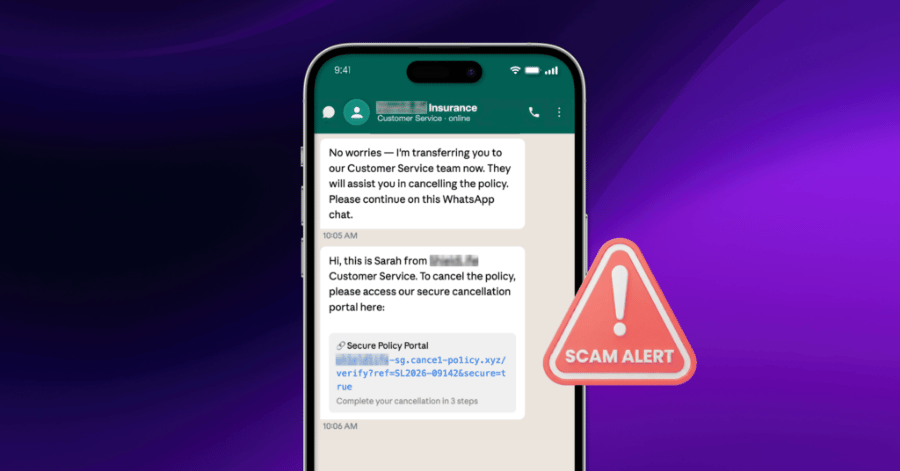
You may then be “transferred” to another individual claiming to be customer service. At this stage, you may be:
- Asked to continue the conversation on WhatsApp
- Given a WhatsApp number displaying company branding
- Instructed to “cancel” the policy or service through a chatbot or automated system
Step 3: Fake System Interactions
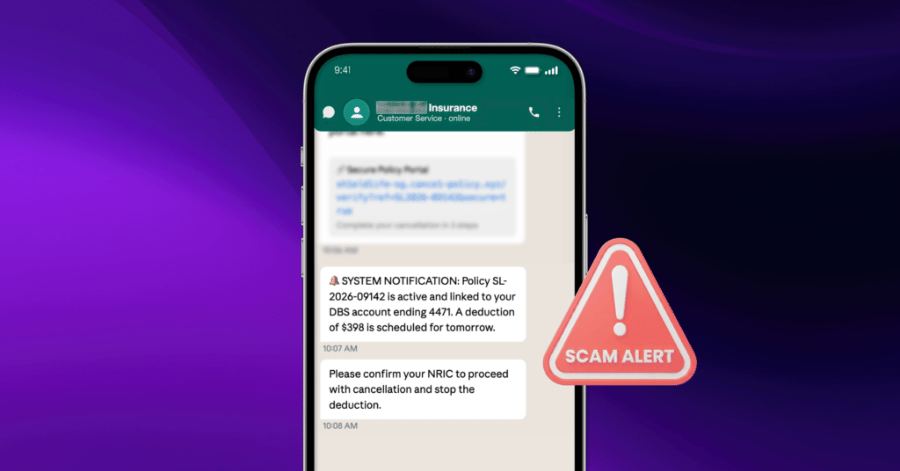
Scammers may send:
- Fake contracts or policy documents
- Fabricated “system notifications”
- Screenshots of supposedly linked bank accounts
- Warnings about pending deductions or auto-debits
These materials are designed to reinforce the legitimacy of the scam.
Step 4: Escalation to “Authorities”
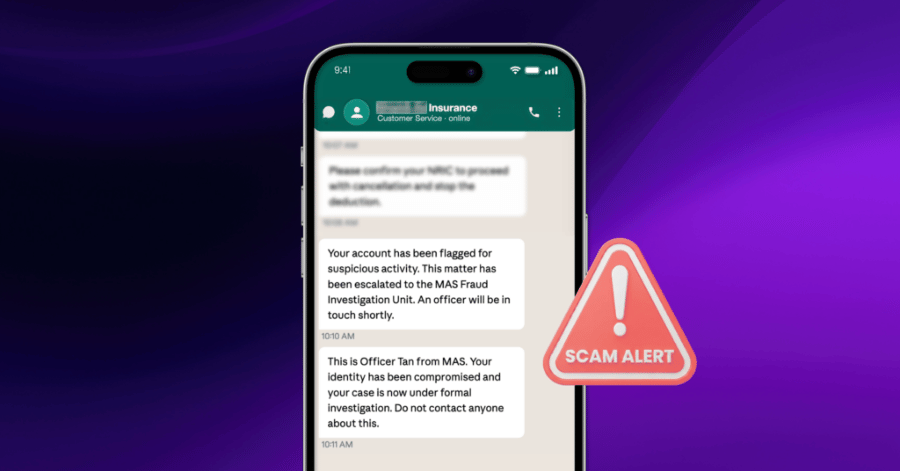
If you push back or express doubt, scammers may escalate by impersonating public authorities. You may be told:
- Your identity has been compromised
- Your account is linked to suspicious activity
- The matter has been escalated for investigation
In some cases, you may be directed to video calls with impersonators using uniforms, logos, or official-looking backgrounds.
 Remember: Real government agencies don’t ask for payment this way.
The Singapore Police Force, MAS, IRAS, ICA, and any legitimate government agency communicate through official letters, Singpass-linked notifications, and government portals.
They will never make unsolicited calls demanding immediate payment, instruct you to transfer money to personal accounts or “safety accounts,” request payment in cryptocurrency or gift cards, ask for your OTP or banking credentials, or threaten you with arrest unless you pay over the phone.
If something doesn’t fit that pattern, treat it as a scam and verify directly through the agency’s official website.
Step 5: Pressure and Manipulation
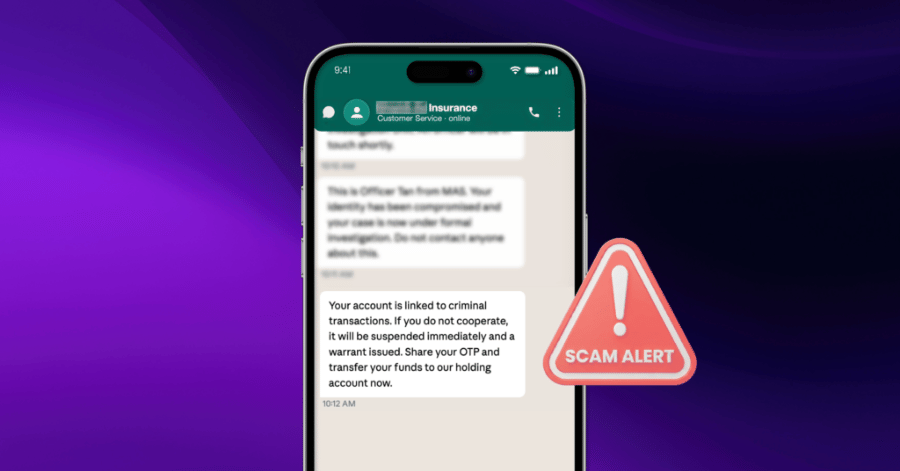
Scammers may then apply pressure by:
- Accusing you of criminal activity
- Threatening account suspension or deductions
- Instructing you not to discuss the matter with anyone
- Requesting OTPs, banking details, or fund transfers
Creating urgency and isolation is a common social engineering tactic.
Common Tactics Scammers Use
Impersonation scams often combine multiple tactics to appear credible.
1. Use of Personal Information
Scammers may already know your full name, NRIC (full or partial), and date of birth. This information may come from previous data leaks and can make a scam feel convincing.
2. Authority Impersonation
Scammers may pretend to be:
- Customer service officers
- Financial institutions
- Government or regulatory officers (e.g. the Singapore Police Force, MAS, IRAS, ICA)
They may use official-sounding names, fake titles, logos, uniforms, or professional video backgrounds. No matter how official the caller sounds, a genuine government officer will never request money, transfers, or OTPs over the phone.
3. Multi-Step Social Engineering
Rather than asking for money immediately, scammers may gradually build trust through:
- Multiple phone transfers
- Fake chatbots
- Contracts or “system notifications”
- Escalation to authority figures
4. Fear, Urgency, and Isolation
Examples include:
- “You will be charged within one hour.”
- “A monthly deduction has been scheduled.”
- “Your identity is linked to suspicious activity.”
- “Please do not discuss this with anyone.”
Urgency is commonly used to discourage verification.
 Here’s how to protect yourself from card fraud
What YouTrip Will Never Do
To help you identify fraudulent communications, please note that YouTrip will never:
- Call you to request payment for insurance, subscriptions, or other services
- Ask you to continue customer support conversations on WhatsApp
- Ask for your password, OTP, PIN, or full card details
- Threaten account suspension, legal action, or criminal investigation over unsolicited calls
- Transfer your call to MAS, the police, or other authorities
Important clarifications:
- YouTrip will never call to request any form of payment, including insurance payments. Wallet top-ups can only be initiated by you directly within the app.
- The only travel insurance offered by YouTrip is available exclusively within the YouTrip app.
- Our official customer support email is [email protected], and our dedicated fraud reporting email is [email protected].
YouTrip also runs additional safeguards in the background, including a Kill Switch you can trigger to immediately freeze your account, and a 12-hour cooling-off period whenever your account is logged in on a new device.
Find out more about how else we’re safeguarding your transactions here
How to Protect Yourself
If you receive a suspicious call or message claiming to be from YouTrip:
- End the call immediately
- Do not continue the conversation on WhatsApp
- Do not share personal information, banking details, passwords, or OTPs
- Hang up if the caller claims to be a government official or police officer asking for money
- Verify your account activity directly in the YouTrip app
- Contact us only through official support channels
- Speak to someone you trust if you feel pressured or uncertain
Download the ScamShield App on Google Play or the App Store to detect scam SMSes and phone calls. You may also contact ScamShield at 1799 or report suspicious activity through police channels at police.gov.sg.
Stay alert: Learn how to protect yourself from e-commerce & phishing scams here
What to Do If You’ve Already Responded
If you have shared personal information, banking details, or OTPs:
- Email [email protected] with the details so we can help secure your account
- Please immediately suspend your YouTrip account. You can activate the Kill Switch by calling +65 6904 9334
- Make a local police report here if your account was being used fraudulently
For other non-fraud and scam enquiries, please continue to contact us at [email protected]
For any other Fraud-&-Scam-related FAQs click here
FAQs
Don’t engage. Don’t click any links, reply, or share information. Forward suspicious emails to [email protected] and end the call. If you’ve already responded, follow the steps in ‘What to Do If You’ve Already Responded’ above.
No. YouTrip will never call or SMS you to request an OTP, password, PIN, or full card details. Any OTPs you receive are meant solely for your own use within the YouTrip app and should never be shared with anyone, including someone claiming to be from YouTrip.
If you’re asked to share these details over a call or chat, end the conversation and report it to [email protected].
Check the sender domain against our list of official email addresses below. YouTrip SMSes always come from the sender ID “YouTrip” and never include links unless you’ve requested them. If anything looks off, email [email protected] before clicking or responding.
Email [email protected] immediately, freeze your YouTrip card in the app, contact your bank if you’ve shared banking details, and lodge a police report at police.gov.sg.
Government agencies such as the Singapore Police Force, MAS, IRAS, and ICA communicate through official letters, Singpass-linked notifications, and government portals. They do not make unsolicited calls demanding immediate payment, ask you to transfer funds to personal or “safety” accounts, or request your OTPs and banking credentials over the phone.
If you receive a call that pressures you to act in any of these ways, hang up and report it to ScamShield at 1799.
If In Doubt, Verify Through Official Channels
Scammers may use convincing scripts, branding, and personal information to appear legitimate. If something feels unusual, pause and verify through official YouTrip channels before taking any action.
When in doubt, hang up, verify, and stay alert.
Official YouTrip Platforms
YouTrip exclusively operates on the following platforms listed below. Any other platforms claiming to be YouTrip are engaging in impersonation and are to be reported immediately.
Email addresses:
- [email protected]
- [email protected]
- [email protected]
- [email protected]
- [email protected]
- [email protected]
Hotline:
- +65 6904 9334
Social Platforms:
- Instagram @youtripsg
- TikTok @youtripsg
- X (formerly Twitter) @YouTripSG
- Facebook YouTripSG
Telegram SG Travel+Lifestyle Hacks (@youtripsg), YouTrip Squad (@youtripsquad)


The post Impersonation Scams 2026: How to Spot Them and Stay Safe appeared first on YouTrip Singapore.


You May Also Like

Q2 Market Insights: Bitcoin regains dominance in risk-averse environment, ETFs remain critical to market structure

Pi Network Node Update 24.1.0 Appears as Protocol 23 Deployment Expands