

Gold keeps winning the battle with economists
By Aaron Brown
GOLD is trading near $5,000 an ounce. And yet, in the middle of the US and Israeli war on Iran and as foreign central banks sell Treasuries to defend their currencies and bond yields rise instead of fall, the precious metal has barely budged even as the world’s monetary authorities — the very institutions built to make gold obsolete — buy it at the fastest pace in a generation.
This is not supposed to be happening. The economics profession declared gold a “barbarous relic” a century ago and has spent most of the time since trying to make that verdict stick. It keeps losing.
The opening shot was fired by John Maynard Keynes in 1924. The gold standard, he wrote, was a primitive monetary technology that enlightened modern economies had outgrown. The future belonged to managed currencies, run by expert institutions. His view largely prevailed at Bretton Woods in 1944, where gold was kept as a nominal anchor — convertible to dollars at $35 an ounce — but effectively demoted to figurehead status.
Round one to the economists. Gold was caged.
Or was it?
On Aug. 15, 1971, President Richard Nixon announced that the dollar would no longer be convertible to gold. Economists mostly cheered. Milton Friedman had long argued that floating exchange rates managed by disciplined central banks were superior to the gold standard’s rigidities. The profession was nearly unanimous: Gold was a historical curiosity. You couldn’t run a modern economy tethered to something you dug out of the ground.
Gold’s revenge was swift and embarrassing. Within nine years it had risen from $35 to $850 an ounce — a gain of more than 2,300%. The 1970s, which were supposed to demonstrate the superiority of managed currencies, produced instead stagflation and a dollar that lost more than half its purchasing power. Investors who held cash lost 87% of their real wealth. Those who held the barbarous relic quadrupled theirs.
Round two to gold.
Federal Reserve Chairman Paul Volcker came out swinging in 1979 and soon raised interest rates to 20%, crushing inflation and restoring the credibility of managed money. Gold collapsed — from $850 in 1980 to $255 by 1999, an 85% real loss over two decades. European central banks, in the ultimate act of institutional contempt, began actively selling their reserves. The Bank of England sold 395 tons between 1999 and 2002, at almost the exact bottom — a transaction that became known in the British press as “Brown’s Bottom” after Chancellor Gordon Brown, who ordered it.
Round three to the economists, decisively.
Then came 2008 and the global financial crisis. Lehman Brothers Holdings, Inc. collapsed, governments deployed trillions of dollars in emergency stimulus, and real interest rates turned negative. Gold remembered its lines. From $800 at the depths of the crisis, it climbed to $1,921 by 2011. The economists’ institutions were visibly struggling. Gold, which has no management, no board of directors, and no leverage, sat there looking smug.
But the most consequential round in the modern era had nothing to do with inflation. It was about something more fundamental: whether dollar-denominated assets are truly safe.
On Feb. 26, 2022, two days after Russia invaded Ukraine, the US and its allies froze $300 billion of Russian central bank reserves held in Western institutions. Every non-aligned central bank got the message. Assets held in dollars, euros, or pounds could be confiscated. There was precisely one major reserve asset that could not be frozen by SWIFT, seized by court order, or inflated away by someone else’s monetary policy. It cannot be hacked and it doesn’t require trusting any institution or government.
Which explains why central banks bought a record 1,080 tons of gold in 2022, the most since the gold standard era, and have maintained that pace since. The buyers were China, India, Turkey, Poland, Singapore — countries that watched the Russian sanctions and drew their own conclusions.
For the first time since 1996, global central banks now hold more gold in aggregate than US government bonds. That milestone arrived quietly, with little fanfare, but it represents a structural shift in how sovereign institutions think about reserves.
This is what separates the current gold rally from previous ones. Earlier bull markets were driven by retail investors and inflation fears. This one is being driven by sovereign institutions making a deliberate, long-term strategic choice. It is not inflation hedging. It is geopolitical insurance. And it is a vote of no confidence in the system Keynes and his successors built.*
Which brings us back to the Iran war, and to gold near $5,000.
The conventional haven trade in every previous crisis since the financial crisis — the global COVID-19 pandemic, Russia’s war on Ukraine, the European debt crisis — was into US Treasuries. Yields fell, the dollar strengthened, and the system worked as designed. In the Iran war, foreign central banks have sold $82 billion in Treasuries in five weeks. Yields have climbed. The petrodollar recycling loop — Gulf oil revenues flowing back into US government debt — has seized up as the Strait of Hormuz closes. And gold has held near record highs throughout.
The pattern is now legible. Gold doesn’t perform best when inflation is high. It performs best when trust in monetary institutions is low — when the world’s central banks look at their reserve assets and quietly conclude they would prefer something no government can confiscate. That condition predates the Iran war and will survive it.
Keynes was right that gold’s monetary role is a convention, not a law of nature. What he underestimated is how hard it is to replace a convention that combines liquidity, neutrality, durability, and freedom from political risk — especially when the institution maintaining the alternative is also the world’s largest debtor, the issuer of its own reserve currency, and the aggressor in a major war.
Gold has been making this argument for 5,000 years. The economists have been rebutting it for about 300. The current score, on points, favors the metal.
BLOOMBERG OPINION
*Gold’s argument for the monetary throne has acquired an unlikely understudy. Bitcoin was invented in 2008 and its founding logic mirrors gold’s exactly: a fixed supply, immune to debasement, beyond the reach of any government.


You May Also Like
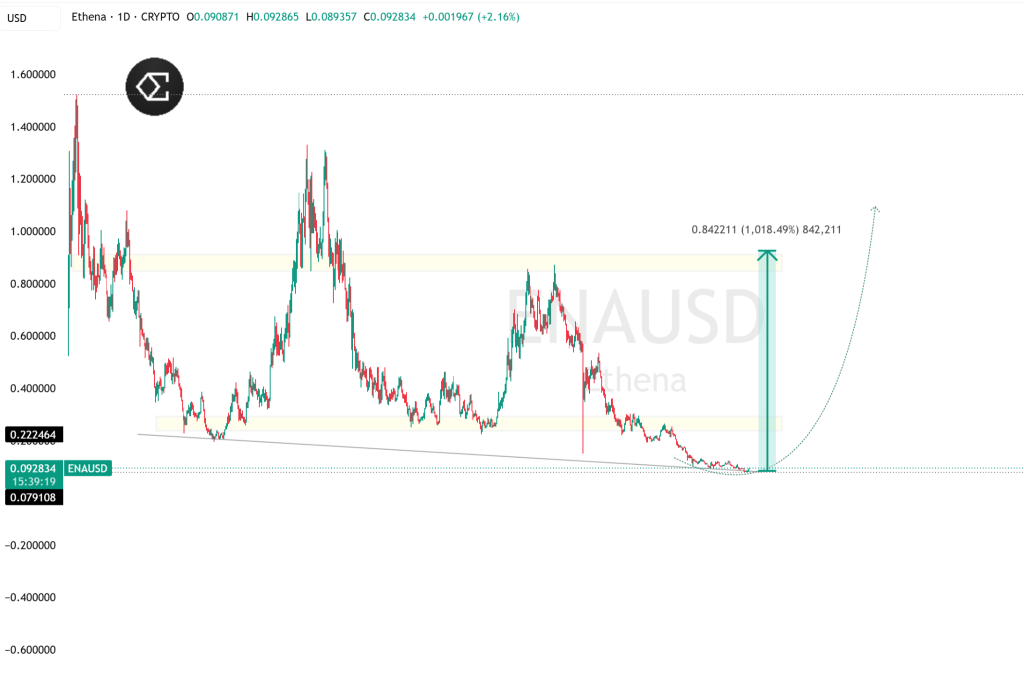
Ethena ($ENA) Volume Explodes – Here’s What Could Happen Next

Crypto Update: BTC Breaks $71K as Pepeto Presale Fills Faster




