Reinforcement Learning: A Paradigm Shift in Decentralized AI Networks
The real opportunity for reinforcement learning × Web3 lies not in replicating a decentralized version of OpenAI, but in rewriting "intelligent production relations".
Written by: 0xjacobzhao
This independent research report was supported by IOSG Ventures. The research and writing process was inspired by Sam Lehman's (Pantera Capital) report on reinforcement learning. We thank Ben Fielding (Gensyn.ai), Gao Yuan (Gradient), Samuel Dare & Erfan Miahi (Covenant AI), Shashank Yadav (Fraction AI), and Chao Wang for their valuable suggestions. While striving for objectivity and accuracy, some viewpoints involve subjective judgment and may contain biases; we ask for the reader's understanding.
Artificial intelligence is moving from statistical learning, primarily focused on "pattern fitting," to a capability system centered on "structured reasoning," with the importance of post-training rapidly increasing. The emergence of DeepSeek-R1 marks a paradigm shift in reinforcement learning in the era of large models, leading to an industry consensus: pre-training forms the foundation for building general-purpose models, and reinforcement learning is no longer just a value alignment tool, but has been proven to systematically improve the quality of reasoning chains and complex decision-making capabilities, gradually evolving into a technological path for continuously improving intelligence.
Meanwhile, Web3 is reshaping the production relations of AI through decentralized computing networks and cryptographic incentive systems. The structural requirements of reinforcement learning for rollout sampling, reward signals, and verifiable training are naturally aligned with the computing power collaboration, incentive allocation, and verifiable execution of blockchain. This report will systematically dissect AI training paradigms and the principles of reinforcement learning technology, demonstrating the structural advantages of reinforcement learning × Web3, and analyzing projects such as Prime Intellect, Gensyn, Nous Research, Gradient, Grail, and Fraction AI.
I. Three Stages of AI Training: Pre-training, Instruction Fine-tuning, and Post-training Alignment
The entire training lifecycle of modern large language models (LLMs) is typically divided into three core stages: pre-training, supervised fine-tuning (SFT), and post-training/RL. These three stages respectively fulfill the functions of "building a world model," "injecting task capabilities," and "shaping reasoning and values." Their computational structure, data requirements, and validation difficulty determine the degree of decentralized matching.
Pre-training, which builds the linguistic statistical structure and cross-modal world model of the model through large-scale self-supervised learning, is the foundation of LLM capabilities. This stage requires training on trillions of corpora in a globally synchronous manner, relying on homogeneous clusters of thousands to tens of thousands of H100 images, accounting for 80-95% of the cost, and is extremely sensitive to bandwidth and data copyright. Therefore, it must be completed in a highly centralized environment.
Supervised fine-tuning is used to inject task capabilities and instruction formats. It involves small amounts of data and accounts for approximately 5-15% of the cost. Fine-tuning can be performed using full-parameter training or parametrically efficient fine-tuning (PEFT) methods, among which LoRA, Q-LoRA, and Adapter are the mainstream methods in the industry. However, gradient synchronization is still required, which limits its decentralized potential.
Post-training consists of multiple iterative sub-stages that determine the model's reasoning ability, values, and safety boundaries. Methods include reinforcement learning systems (RLHF, RLAIF, GRPO), preference optimization methods without RL (DPO), and process reward models (PRM). This stage has relatively low data volume and cost (5–10%), mainly focusing on Rollout and policy updates. It naturally supports asynchronous and distributed execution; nodes do not need to hold full weights. Combined with verifiable computation and on-chain incentives, it can form an open, decentralized training network, making it the most suitable training stage for Web3.
II. A Panoramic View of Reinforcement Learning Technology: Architecture, Framework, and Applications 2.1 System Architecture and Core Components of Reinforcement Learning
Reinforcement Learning (RL) drives a model to autonomously improve its decision-making ability through "environment interaction—reward feedback—policy update." Its core structure can be viewed as a feedback loop consisting of state, action, reward, and policy. A complete RL system typically includes three components: Policy (policy network), Rollout (experience sampling), and Learner (policy updater). The policy interacts with the environment to generate a trajectory, and the Learner updates the policy based on reward signals, thus forming a continuous iterative and optimizing learning process.
Policy network: Generates actions from the environment state and is the core of the system's decision-making. During training, centralized backpropagation is required to maintain consistency; during inference, it can be distributed to different nodes for parallel execution.
Rollout: Nodes interact with the environment according to the policy, generating trajectories such as state, action, and reward. This process is highly parallel, requires very little communication, and is insensitive to hardware differences, making it the most suitable component for scaling in a decentralized environment.
The learner aggregates all Rollout trajectories and performs policy gradient updates. It is the module with the highest requirements for computing power and bandwidth, so it is usually deployed in a centralized or lightly centralized manner to ensure convergence stability.
2.2 Reinforcement Learning Stage Framework (RLHF → RLAIF → PRM → GRPO)
Reinforcement learning can generally be divided into five stages, and the overall process is as follows:
Data generation phase (Policy Exploration): Given input cues, the policy model πθ generates multiple candidate inference chains or complete trajectories, providing a sample basis for subsequent preference evaluation and reward modeling, and determining the breadth of policy exploration.
Preference Feedback Phase (RLHF / RLAIF):
RLHF (Reinforcement Learning from Human Feedback) uses multiple candidate answers, human preference annotation, training a reward model (RM), and PPO optimization strategy to make the model output more consistent with human values. It is a key step in the transition from GPT-3.5 to GPT-4.
RLAIF (Reinforcement Learning from AI Feedback) replaces manual annotation with AI Judge or constitutional rules, automating preference acquisition, significantly reducing costs and possessing scalability. It has become the mainstream alignment paradigm for companies such as Anthropic, OpenAI, and DeepSeek.
Reward Modeling Phase: Preference-based reward models learn to map outputs to rewards. RM teaches the model "what is the correct answer," while PRM teaches the model "how to reason correctly."
Reward Model (RM) is used to evaluate the quality of the final answer, scoring only the output:
The Process Reward Model (PRM) no longer only evaluates the final answer, but scores each step of reasoning, each token, and each logical segment. It is also a key technology of OpenAI o1 and DeepSeek-R1, and essentially teaches the model how to think.
Reward Verification Phase (RLVR): Introducing "verifiable constraints" during the generation and use of reward signals to ensure that rewards come from reproducible rules, facts, or consensus as much as possible, thereby reducing reward hacking and bias risks, and improving auditability and scalability in open environments.
Policy optimization involves updating the policy parameters θ under the guidance of signals from the reward model to obtain a policy πθ′ with stronger reasoning ability, higher security, and more stable behavior patterns. Mainstream optimization methods include:
PPO (Proximal Policy Optimization): A traditional optimizer in RLHF, known for its stability, but often faces limitations such as slow convergence and insufficient stability in complex inference tasks.
Group Relative Policy Optimization (GRPO) is a core innovation of DeepSeek-R1. It estimates expected value by modeling the advantage distribution within candidate answer groups, rather than simply ranking them. This method preserves reward magnitude information, is more suitable for inference chain optimization, and has a more stable training process. It is considered an important reinforcement learning optimization framework for deep inference scenarios after PPO.
DPO (Direct Preference Optimization): A post-training method that is not a reinforcement learning method. It does not generate trajectories or build reward models, but directly optimizes preference pairs. It is low-cost and stable, and is therefore widely used for alignment in open-source models such as Llama and Gemma, but does not improve inference ability.
New Policy Deployment Phase: The optimized model exhibits enhanced System-2 Reasoning capabilities, behaviors more aligned with human or AI preferences, a lower rate of hallucinations, and higher security. Through continuous iteration, the model learns preferences, optimizes processes, and improves decision-making quality, forming a closed loop.
2.3 Five Major Categories of Industrial Applications of Reinforcement Learning
Reinforcement learning has evolved from early game-theoretic intelligence into a core framework for autonomous decision-making across industries. Its application scenarios can be categorized into five major types based on technological maturity and industrial implementation, and each has driven key breakthroughs in its respective direction.
Game and Strategy Systems: This was the earliest area of RL to be validated. In environments with "perfect information + explicit rewards" such as AlphaGo, AlphaZero, AlphaStar, and OpenAI Five, RL demonstrated decision-making intelligence that could rival or even surpass human experts, laying the foundation for modern RL algorithms.
Robotics and Embodied AI: RL enables robots to learn manipulation, motion control, and cross-modal tasks (such as RT-2 and RT-X) through continuous control, dynamic modeling, and environmental interaction. It is rapidly moving towards industrialization and is a key technology route for the real-world application of robots.
Digital Reasoning (LLM System-2): RL + PRM drives large models from "language imitation" to "structured reasoning". Representative achievements include DeepSeek-R1, OpenAI o1/o3, Anthropic Claude and AlphaGeometry. Its essence is to optimize rewards at the reasoning chain level, rather than just evaluating the final answer.
Scientific Discovery and Mathematical Optimization (RL): RL seeks optimal structures or strategies in unlabeled, complex rewards and huge search spaces, and has achieved fundamental breakthroughs such as AlphaTensor, AlphaDev, and Fusion RL, demonstrating an exploration capability that surpasses human intuition.
Economic Decision-making & Trading: RL is used for strategy optimization, high-dimensional risk control, and adaptive trading system generation. Compared with traditional quantitative models, it can learn continuously in uncertain environments and is an important component of intelligent finance.
III. The Natural Match Between Reinforcement Learning and Web3
The high degree of compatibility between reinforcement learning (RL) and Web3 stems from the fact that both are essentially "incentive-driven systems." RL relies on reward signals to optimize strategies, while blockchain relies on economic incentives to coordinate participant behavior, making them naturally consistent at the mechanism level. The core requirements of RL—large-scale heterogeneous rollout, reward distribution, and authenticity verification—are precisely where the structural advantages of Web3 lie.
Decoupling inference and training: The training process of reinforcement learning can be clearly divided into two stages:
Rollout (exploratory sampling): The model generates large amounts of data based on the current policy, a computationally intensive but communication-sparse task. It does not require frequent communication between nodes and is suitable for parallel generation on globally distributed consumer-grade GPUs.
Update (parameter update): Updates model weights based on collected data, requiring a high-bandwidth centralized node to complete.
"Inference-training decoupling" is a natural fit for decentralized heterogeneous computing power structures: Rollout can be outsourced to open networks and settled according to contribution through a token mechanism, while model updates remain centralized to ensure stability.
Verifiability: ZK and Proof-of-Learning provide a means to verify whether nodes are actually performing reasoning, solving the honesty problem in open networks. In deterministic tasks such as coding and mathematical reasoning, verifiers only need to check the answer to confirm the workload, significantly improving the credibility of decentralized RL systems.
The incentive layer is based on a token-based feedback production mechanism: Web3's token mechanism can directly reward RLHF/RLAIF preference feedback contributors, enabling preference data generation to have a transparent, settleable, and permissionless incentive structure; staking and slashing further constrain feedback quality, forming a more efficient and aligned feedback market than traditional crowdsourcing.
The potential of Multi-Agent Reinforcement Learning (MARL): Blockchain is inherently a public, transparent, and continuously evolving multi-agent environment. Accounts, contracts, and agents constantly adjust their strategies under incentive-driven conditions, giving it a natural potential to build large-scale MARL testbeds. Although still in its early stages, its characteristics of public state, verifiable execution, and programmable incentives provide a fundamental advantage for the future development of MARL.
IV. Analysis of Classic Web3 + Reinforcement Learning Projects
Based on the above theoretical framework, we will briefly analyze the most representative projects in the current ecosystem:
Prime Intellect: An asynchronous reinforcement learning paradigm
Prime Intellect is dedicated to building a global open computing market, lowering the barriers to training, promoting collaborative decentralized training, and developing a complete open-source superintelligence technology stack. Its ecosystem includes: Prime Compute (a unified cloud/distributed computing environment), the INTELLECT model family (10B–100B+), the Environments Hub (an open reinforcement learning environment center), and the large-scale synthetic data engine (SYNTHETIC-1/2).
The Prime Intellect core infrastructure component, the prime-rl framework, is designed for asynchronous distributed environments and is highly relevant to reinforcement learning. Other components include the OpenDiLoCo communication protocol to overcome bandwidth bottlenecks and the TopLoc verification mechanism to ensure computational integrity.
Overview of Prime Intellect core infrastructure components
Technical foundation: prime-rl asynchronous reinforcement learning framework
prime-rl is the core training engine of Prime Intellect, designed specifically for large-scale asynchronous decentralized environments. It achieves high-throughput inference and stable updates through complete decoupling of Actor and Learner. Rollout Workers and Learners are no longer synchronously blocked; nodes can join or leave at any time, simply continuously pulling the latest strategy and uploading the generated data.
Actor (Rollout Workers): Responsible for model inference and data generation. Prime Intellect innovatively integrates the vLLM inference engine on the Actor side. vLLM's PagedAttention technology and Continuous Batching capability enable Actors to generate inference trajectories with extremely high throughput.
Learner (Trainer): Responsible for policy optimization. The Learner asynchronously pulls data from the shared Experience Buffer for gradient updates, without waiting for all Actors to complete the current batch.
Orchestrator: Responsible for scheduling model weights and data flow.
The key innovations of prime-rl:
True Asynchrony: prime-rl abandons the synchronous paradigm of traditional PPO, does not wait for slow nodes and does not require batch alignment, enabling any number and performance of GPUs to access at any time, laying the foundation for the feasibility of decentralized RL.
Deep integration of FSDP2 and MoE: Through FSDP2 parameter slicing and MoE sparse activation, prime-rl enables efficient training of billions of models in a distributed environment. Actors only run active experts, significantly reducing GPU memory and inference costs.
GRPO+ (Group Relative Policy Optimization): GRPO eliminates the Critic network, significantly reducing computational and memory overhead, and is naturally adapted to asynchronous environments. Prime-RL's GRPO+ further ensures reliable convergence under high latency conditions through a stabilization mechanism.
The INTELLECT model family: a marker of maturity in decentralized RL technology.
INTELLECT-1 (10B, October 2024) is the first to demonstrate that OpenDiLoCo can be trained efficiently in heterogeneous networks spanning three continents (communication ratio <2%, computing power utilization 98%), breaking the physical understanding of cross-regional training;
INTELLECT-2 (32B, April 2025) is the first Permissionless RL model, which verifies the stable convergence capability of prime-rl and GRPO+ in multi-step delay and asynchronous environments, and realizes decentralized RL with global open computing power participation;
INTELLECT-3 (106B MoE, November 2025) employs a sparse architecture that activates only 12B parameters. It is trained on a 512×H200 and achieves flagship-level inference performance (AIME 90.8%, GPQA 74.4%, MMLU-Pro 81.9%, etc.). Its overall performance is close to or even surpasses that of centralized closed-source models that are much larger than themselves.
Prime Intellect also built several supporting infrastructure components: OpenDiLoCo reduces cross-regional training communication by hundreds of times through temporal sparse communication and quantization weight differences, enabling INTELLECT-1 to maintain 98% utilization across three continents; TopLoc + Verifiers form a decentralized trusted execution layer to activate fingerprint and sandbox verification to ensure the authenticity of inference and reward data; the SYNTHETIC data engine produces large-scale, high-quality inference chains and enables the 671B model to run efficiently on consumer-grade GPU clusters through pipelined parallelism. These components provide a crucial engineering foundation for data generation, verification, and inference throughput in decentralized RL. The INTELLECT series demonstrates that this technology stack can produce mature, world-class models, marking the transition of decentralized training systems from the conceptual stage to the practical application stage.
Gensyn: The core stack of reinforcement learning, Swarm and SAPO
Gensyn's goal is to aggregate idle computing power globally into an open, trustless, and infinitely scalable AI training infrastructure. Its core includes a standardized execution layer across devices, a peer-to-peer coordination network, and a trustless task verification system, automatically allocating tasks and rewards through smart contracts. Leveraging the characteristics of reinforcement learning, Gensyn introduces core mechanisms such as RL Swarm, SAPO, and SkipPipe to decouple the generation, evaluation, and update stages, utilizing a "swarm" of heterogeneous GPUs globally to achieve collective evolution. Ultimately, it delivers not just computing power, but verifiable intelligence.
Reinforcement Learning Applications of the Gensyn Stack
RL Swarm: A decentralized collaborative reinforcement learning engine
RL Swarm demonstrates a completely new collaborative model. It's no longer a simple task distribution system, but rather a decentralized "generate-evaluate-update" loop that simulates human social learning, analogous to a collaborative learning process, with an infinite loop:
Solvers (Executors): Responsible for local model inference and Rollout generation, working seamlessly across heterogeneous nodes. Gensyn integrates a high-throughput inference engine (such as CodeZero) locally, outputting the complete trajectory rather than just the answer.
Proposers: Dynamically generate tasks (mathematical problems, coding problems, etc.), supporting task diversity and adaptive difficulty similar to Curriculum Learning.
Evaluators: Use frozen "judge models" or rules to evaluate local rollouts and generate local reward signals. The evaluation process is auditable, reducing opportunities for malicious behavior.
Together, these three elements form a P2P RL organizational structure, enabling large-scale collaborative learning without centralized scheduling.
SAPO: A Policy Optimization Algorithm for Decentralized Reconstruction: SAPO (Swarm Sampling Policy Optimization) centers on "sharing Rollout and filtering gradient-less signal samples, rather than sharing gradients." Through large-scale decentralized Rollout sampling, and treating received Rollouts as locally generated, it maintains stable convergence in environments with no centralized coordination and significant differences in node latency. Compared to PPO, which relies on Critic networks and has high computational costs, or GRPO, which is based on intra-group advantage estimation, SAPO enables consumer-grade GPUs to effectively participate in large-scale reinforcement learning optimization with extremely low bandwidth.
Through RL Swarm and SAPO, Gensyn demonstrates that reinforcement learning (especially post-training RLVR) is naturally suited to decentralized architectures—because it relies more on large-scale, diverse rollouts than on high-frequency parameter synchronization. Combined with the validation frameworks of PoL and Verde, Gensyn provides an alternative path for training trillion-parameter models that no longer depends on a single tech giant: a self-evolving superintelligent network composed of millions of heterogeneous GPUs worldwide.
Nous Research: Atropos, a Validation-Based Reinforcement Learning Environment
Nous Research is building a decentralized, self-evolving cognitive infrastructure. Its core components—Hermes, Atropos, DisTrO, Psyche, and World Sim—are organized into a continuously evolving, closed-loop intelligent system. Unlike the traditional linear process of "pre-training—post-training—inference," Nous employs reinforcement learning techniques such as DPO, GRPO, and rejection sampling to unify data generation, verification, learning, and inference into a continuous feedback loop, creating a continuously self-improving closed-loop AI ecosystem.
Nous Research Component Overview 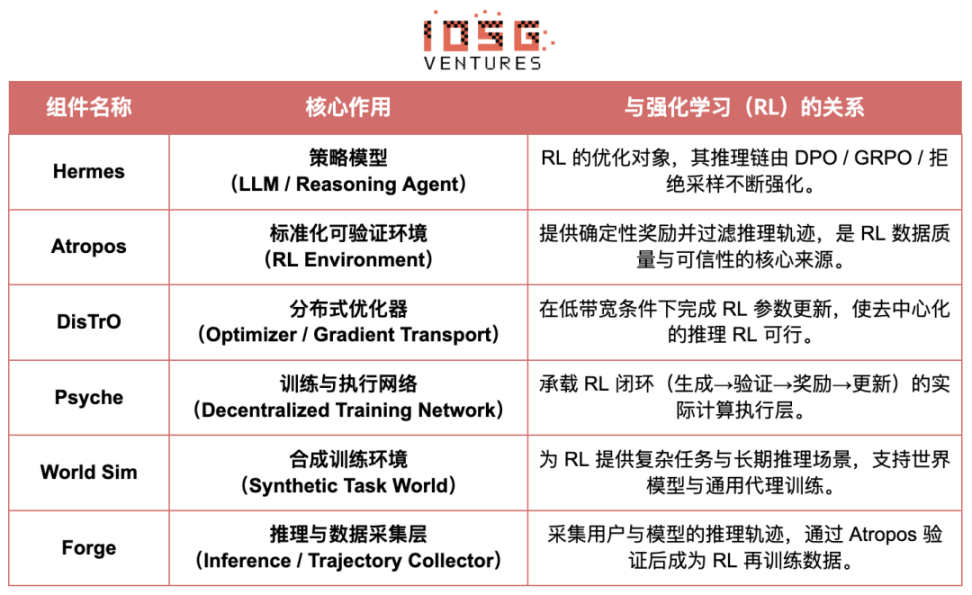
Model layer: Hermes and the evolution of reasoning ability
The Hermes series is Nous Research's primary user-facing model interface, and its evolution clearly demonstrates the industry's migration path from traditional SFT/DPO alignment to Reasoning Reinforcement Learning (RL):
Hermes 1–3: Instruction Alignment and Early Agent Capability: Hermes 1–3 relied on low-cost DPOs for robust instruction alignment, while Hermes 3 leveraged synthetic data and the newly introduced Atropos verification mechanism.
Hermes 4 / DeepHermes: It incorporates System-2-style slow thinking into weights through thought chains, improves mathematical and code performance with test-time scaling, and relies on "rejection sampling + Atropos verification" to build high-purity inference data.
DeepHermes further adopts GRPO to replace PPO, which is difficult to distribute and deploy, enabling inference RL to run on the Psyche decentralized GPU network, laying the engineering foundation for the scalability of open source inference RL.
Atropos: A verifiable reward-driven reinforcement learning environment
Atropos is the true linchpin of the Nous RL system. It encapsulates hints, tool calls, code execution, and multi-turn interactions into a standardized RL environment, directly verifying output correctness and providing deterministic reward signals, replacing expensive and non-scalable human annotation. More importantly, in the decentralized training network Psyche, Atropos acts as a "referee," verifying whether nodes are genuinely improving their policies, supporting auditable proof-of-learning, and fundamentally solving the reward reliability problem in distributed RL.
DisTrO and Psyche: Optimizer Layers for Decentralized Reinforcement Learning
Traditional RLF (RLHF/RLAIF) training relies on centralized, high-bandwidth clusters, which is a core barrier that open-source systems cannot replicate. DisTrO reduces the communication cost of RL by several orders of magnitude through momentum decoupling and gradient compression, enabling training to run on internet bandwidth. Psyche deploys this training mechanism on an on-chain network, allowing nodes to complete inference, verification, reward evaluation, and weight updates locally, forming a complete RL closed loop.
In the Nous architecture, Atropos validates the thought chain; DisTrO compresses training communication; Psyche runs the RL loop; WorldSim provides a complex environment; Forge collects real inference data; and Hermes writes all the learning into the weights. Reinforcement learning is not just a training phase, but the core protocol in the Nous architecture that connects data, environment, model, and infrastructure, making Hermes a living system that can continuously improve itself on open-source computing networks.
Gradient Network: Echo, a reinforcement learning architecture
Gradient Network's core vision is to reshape the AI computing paradigm through an "Open Intelligence Stack." Gradient's technology stack consists of a set of core protocols that can evolve independently yet collaborate heterogeneously. Its architecture, from underlying communication to upper-layer intelligent collaboration, includes: Parallax (distributed inference), Echo (decentralized RL training), Lattica (P2P network), SEDM / Massgen / Symphony / CUAHarm (memory, collaboration, and security), VeriLLM (trusted verification), and Mirage (high-fidelity simulation), collectively forming a continuously evolving decentralized intelligent infrastructure.
Echo — Reinforcement Learning Training Architecture
Echo is Gradient's reinforcement learning framework. Its core design philosophy is to decouple the training, inference, and data (reward) paths in reinforcement learning, enabling Rollout generation, policy optimization, and reward evaluation to scale and be scheduled independently in heterogeneous environments. It operates collaboratively in a heterogeneous network composed of inference and training nodes, maintaining training stability in a wide-area heterogeneous environment with a lightweight synchronization mechanism. This effectively alleviates the SPMD failures and GPU utilization bottlenecks caused by mixed inference and training in traditional DeepSpeed RLHF/VERL.
Echo employs a dual-group architecture for inference and training to maximize computational power utilization. The two groups operate independently and do not block each other.
Maximizing sampling throughput: The Inference Swarm, composed of consumer-grade GPUs and edge devices, uses Parallax to build high-throughput samplers in a pipeline-parallel fashion, focusing on trajectory generation;
Maximizing gradient computation power: The Training Swarm, consisting of consumer-grade GPU networks that can run on centralized clusters or in multiple locations around the world, is responsible for gradient updates, parameter synchronization, and LoRA fine-tuning, focusing on the learning process.
To maintain consistency between policy and data, Echo provides two lightweight synchronization protocols: sequential and asynchronous, to achieve bidirectional consistency management of policy weights and trajectories.
Sequential Pull Mode | Precision Priority: The training side forces the inference node to refresh the model version before pulling a new trajectory, thereby ensuring trajectory freshness, which is suitable for tasks that are highly sensitive to policy staleness;
Asynchronous Push-Pull Mode | Efficiency First: The inference side continuously generates trajectory with version labels, the training side consumes it according to its own rhythm, and the coordinator monitors version deviation and triggers weight refresh to maximize device utilization.
At its core, Echo is built on Parallax (heterogeneous inference in low-bandwidth environments) and lightweight distributed training components (such as VERL), relying on LoRA to reduce the cost of cross-node synchronization, enabling reinforcement learning to run stably on heterogeneous networks around the world.
Grail: Reinforcement Learning in the Bittensor Ecosystem
Bittensor constructs a massive, sparse, non-stationary reward function network through its unique Yuma consensus mechanism.
Covenant AI within the Bittensor ecosystem has built a vertically integrated pipeline from pre-training to post-RL training using SN3 Templar, SN39 Basilica, and SN81 Grail. SN3 Templar handles the pre-training of the base model, SN39 Basilica provides a distributed computing marketplace, and SN81 Grail serves as a "verifiable inference layer" for post-RL training, carrying the core processes of RLHF/RLAIF and completing closed-loop optimization from the base model to the alignment strategy.
GRAIL aims to cryptographically prove the authenticity of each reinforcement learning rollout and its binding to the model's identity, ensuring that RLHF can be securely executed in a trustless environment. The protocol establishes a trust chain through a three-layer mechanism:
Deterministic challenge generation: Using drand random beacons and block hashes to generate unpredictable but reproducible challenge tasks (such as SAT, GSM8K), eliminating pre-computation cheating;
By using PRF index sampling and sketch commitments, validators can sample token-level logprob and inference chains at extremely low cost to confirm that the rollout is indeed generated by the declaration model;
Model identity binding: The inference process is bound to the structured signature of the model weight fingerprint and token distribution, ensuring that model replacement or result replay will be immediately recognized. This provides a foundation of authenticity for the inference rollout in RL.
Based on this mechanism, the Grail subnet implements a GRPO-style verifiable post-training process: miners generate multiple inference paths for the same problem, verifiers score based on correctness, inference chain quality, and SAT satisfaction, and write the normalized results on-chain as TAO weights. Public experiments show that this framework has improved the MATH accuracy of Qwen2.5-1.5B from 12.7% to 47.6%, proving that it can both prevent cheating and significantly enhance model capabilities. In Covenant AI's training stack, Grail is the trust and execution cornerstone of decentralized RLVR/RLAIF, and it has not yet been officially launched on the mainnet.
Fraction AI: Competition-Based Reinforcement Learning (RLFC)
Fraction AI's architecture is explicitly built around Reinforcement Learning from Competition (RLFC) and gamified data annotation, replacing the static rewards and manual annotations of traditional RLFC with an open, dynamic competitive environment. Agents compete against each other in different Spaces, and their relative rankings, together with the AI judge's scores, constitute real-time rewards, transforming the alignment process into a continuously online multi-agent game system.
The core differences between traditional RLHF and Fraction AI's RLFC:
The core value of RLFC lies in the fact that rewards no longer come from a single model, but from constantly evolving opponents and evaluators, preventing the reward model from being exploited and preventing the ecosystem from getting trapped in local optima through strategy diversity. The structure of Spaces determines the nature of the game (zero-sum or positive-sum), driving the emergence of complex behaviors in adversarial and cooperative interactions.
In terms of system architecture, Friction AI breaks down the training process into four key components:
Agents: Lightweight policy units based on open-source LLM, extended with differential weights via QLoRA, and updated at low cost;
Spaces: Isolated mission domain environments where agents pay to enter and receive rewards based on wins and losses;
AI Judges: An instant reward layer built with RLAIF, providing scalable, decentralized evaluation;
Proof-of-Learning: Binds policy updates to specific competitive results, ensuring that the training process is verifiable and prevents cheating.
The essence of Fraction AI is to build a human-machine collaborative evolutionary engine. The user, as the "meta-optimizer" at the policy layer, guides the exploration direction through prompt engineering and hyperparameter configuration; while the agent automatically generates massive amounts of high-quality preference pairs in micro-level competition. This model enables data annotation to achieve a business closed loop through "trustless fine-tuning".
Comparison of Reinforcement Learning Web3 Project Architectures
V. Summary and Outlook: Pathways and Opportunities for Reinforcement Learning × Web3
Based on the deconstructive analysis of the aforementioned cutting-edge projects, we observed that although the entry points (algorithms, engineering, or markets) of each team differ, when reinforcement learning (RL) is combined with Web3, their underlying architectural logic converges into a highly consistent "decoupling-verification-incentive" paradigm. This is not merely a technical coincidence, but rather an inevitable result of decentralized networks adapting to the unique properties of reinforcement learning.
General architectural features of reinforcement learning: addressing core physical constraints and trust issues.
Decoupling of Rollouts & Learning – Default Computation Topology
Sparse, parallelizable Rollout is outsourced to consumer-grade GPUs worldwide, and high-bandwidth parameter updates are concentrated on a small number of training nodes, as seen in Prime Intellect's asynchronous Actor-Learner and Gradient Echo's dual-cluster architecture.
Verification-Driven Trust – Infrastructure Development
In permissionless networks, computational authenticity must be enforced through mathematical and mechanistic design, representing cryptographic verification methods such as Gensyn's PoL, Prime Intellect's TOPLOC, and Grail.
Tokenized Incentive Loop – Market Self-Regulation
The computing power supply, data generation, verification and ranking, and reward distribution form a closed loop. By driving participation through rewards and suppressing cheating through slashes, the network can remain stable and continue to evolve in an open environment.
Differentiated technology paths: different "breakthrough points" under a consistent architecture
Despite the convergence of architectures, each project has chosen different technological moats based on its own characteristics:
Nous Research, a group focused on algorithmic breakthroughs, attempts to address the fundamental contradiction (bandwidth bottleneck) in distributed training from a mathematical perspective. Their DisTrO optimizer aims to compress gradient communication by thousands of times, with the goal of enabling large model training to run even on home broadband – a "dimensionality reduction attack" against physical limitations.
Systems Engineering Approach (Prime Intellect, Gensyn, Gradient): Focuses on building next-generation "AI runtime systems". Prime Intellect's ShardCast and Gradient's Parallax are designed to squeeze the highest heterogeneous cluster efficiency under existing network conditions through extreme engineering techniques.
Market-based game theory (Bittensor, Fraction AI): Focuses on the design of reward functions. By designing sophisticated scoring mechanisms, it guides miners to spontaneously find optimal strategies, thereby accelerating the emergence of intelligence.
Strengths, Challenges and Endgame Outlook
In the paradigm of combining reinforcement learning with Web3, the system-level advantages are first reflected in the rewriting of cost and governance structures.
Cost Reshaping: Post-training in RL has an unlimited demand for rollout sampling, while Web3 can mobilize global long-tail computing power at extremely low cost, a cost advantage that centralized cloud vendors cannot match.
Sovereign Alignment: Breaking the monopoly of large companies on AI values (alignment), the community can vote with tokens to decide "what is a good answer" for the model, thus democratizing AI governance.
At the same time, this system also faces two major structural constraints.
Bandwidth Wall: Despite innovations such as DisTrO, physical latency still limits the full training of ultra-large parameter models (70B+), and Web3 AI is currently more limited to fine-tuning and inference.
Goodhard's Law (Reward Hacking): In highly incentivized networks, miners are prone to "overfitting" the reward rules (score farming) rather than improving actual intelligence. Designing a robust reward function to prevent cheating is a perpetual game.
Malicious Byzantine worker attacks: These attacks disrupt model convergence by actively manipulating and poisoning the training signal. The core strategy is not about continuously designing anti-cheating reward functions, but rather about building adversarially robust mechanisms.
The combination of reinforcement learning and Web3 essentially rewrites the mechanism of "how intelligence is produced, aligned, and its value distributed." Its evolution can be summarized in three complementary directions:
Decentralized push training network: From computing power mining machines to policy networks, outsourcing parallel and verifiable Rollout to global long-tail GPUs, focusing on the verifiable inference market in the short term, and evolving into a reinforcement learning subnetwork for task clustering in the medium term;
Assetizing Preferences and Rewards: From Labeling Labor to Data Equity. This involves assetizing preferences and rewards, transforming high-quality feedback and the Reward Model into governable and distributable data assets, upgrading "labeling labor" to "data equity."
The "small but beautiful" evolution in vertical fields: In vertical scenarios where results are verifiable and benefits are quantifiable, small but powerful dedicated RL Agents are being developed, such as DeFi strategy execution and code generation, which directly link strategy improvement with value capture and are expected to outperform general closed-source models.
Overall, the real opportunity for reinforcement learning × Web3 lies not in replicating a decentralized version of OpenAI, but in rewriting the "intelligent production relations": making training execution an open computing power market, making rewards and preferences governable on-chain assets, and redistributing the value brought by intelligence no longer concentrated on the platform, but among trainers, aligners, and users.
Disclaimer: This article was written with the assistance of AI tools ChatGPT-5 and Gemini 3. The author has made every effort to proofread and ensure the information is truthful and accurate, but omissions are still inevitable. We apologize for any inconvenience. It is particularly important to note that the cryptocurrency market often experiences a discrepancy between project fundamentals and secondary market price performance. The content of this article is for informational and academic/research exchange purposes only and does not constitute any investment advice, nor should it be considered a recommendation to buy or sell any token.
You May Also Like

Tokyo’s Metaplanet Launches Miami Subsidiary to Amplify Bitcoin Income

“Oversold” Solana Mirroring Previous Bottoms