The post Breakout Faces First Real Test As Momentum Pushes Into Resistance appeared on BitcoinEthereumNews.com. ZEC broke out of its short-term descending channelThe post Breakout Faces First Real Test As Momentum Pushes Into Resistance appeared on BitcoinEthereumNews.com. ZEC broke out of its short-term descending channel

Breakout Faces First Real Test As Momentum Pushes Into Resistance

  • ZEC broke out of its short-term descending channel and flipped Supertrend, shifting near-term structure in favor of buyers.
  • Price is testing heavy resistance near $460–$480, where prior rallies have failed and EMA pressure remains active.
  • Rising shielded supply and network upgrades support long-term conviction, but momentum must hold above $420 to avoid a false breakout.

Zcash price today trades near $452, extending its recent recovery after breaking out of a short-term descending channel. The move places buyers back in control near a critical resistance zone, but follow-through now matters.

Breakout From Descending Channel Resets Short-Term Structure

On the 2-hour chart, ZEC has cleanly exited the descending channel that guided price lower through early December. That break coincided with a Supertrend flip near $418, which marked the first structural signal that sellers were losing control. Since then, price has built higher lows and accelerated toward the $450–$460 zone.

RSI on the same timeframe has pushed toward 70, reflecting strong upside momentum rather than exhaustion. This matters. During the prior downtrend, RSI consistently failed below 60. The current regime shift suggests buyers are willing to chase strength, not fade it.

Still, this is the first real test. Breakouts that fail near resistance often retrace quickly. Buyers now need to defend the $430–$420 region to preserve the new structure.

Daily Chart Shows Compression Into EMA Resistance

Zooming out to the daily chart, ZEC remains below a heavy EMA cluster despite the rally. The 20-day EMA sits near $423, with the 50-day around $416. Above that, the 100-day EMA near $346 and the 200-day near $245 define the broader bullish slope that emerged during the November expansion.

Price is currently pressing into the upper Bollinger Band near $480. This band has capped advances since the late-November peak. Previous attempts into this zone triggered sharp pullbacks, which means buyers cannot rely on momentum alone.

The pattern resembles a tightening triangle resolution rather than a clean trend reversal. The market has shifted from liquidation to compression. Direction will be decided by how ZEC behaves near $460–$480.

Shielded Supply Growth Adds A Structural Undercurrent

Beyond price, on-chain structure continues to diverge from sentiment. Shielded ZEC supply has climbed to record highs, now representing roughly 29% of circulating supply. This reflects steady migration into shielded addresses, even during periods of price underperformance.

While critics frame this as capital being locked away, the data tells a different story. Shielded balances rising during volatile phases often signal long-term conviction rather than speculative churn. Historically, sustained increases in shielded supply have preceded periods of tighter liquid supply.

This backdrop does not guarantee upside, but it reduces downside reflexivity. When fewer coins remain readily available, sell pressure tends to thin during corrections.

Zebra 3.1.0 Strengthens Network Foundations

Fundamentally, Zcash has also seen meaningful infrastructure progress. The release of Zebra 3.1.0 marks another step in the transition toward a modern Rust-based node stack.

The update improves Docker support across ARM64 and AMD64 architectures, resolving long-standing compatibility friction for Apple Silicon and cloud deployments. Automatic multi-architecture image selection simplifies node operations and lowers operational errors.

Zebra 3.1.0 also introduces a mempool dust filter, blocking transactions with negligible outputs. This reduces spam pressure and lowers resource strain for operators. RPC improvements further enhance data access, allowing developers and monitoring tools to query large datasets more efficiently.

These changes do not drive short-term prices, but they matter for durability. Strong infrastructure tends to show up in price later, not immediately.

Regulatory Tone Shifts Improve Risk Perception

Sentiment has also benefited from improving regulatory optics. The U.S. SEC Privacy Roundtable on December 15 marked a notable shift, acknowledging privacy as a legitimate financial feature rather than a default red flag.

For Zcash, this matters directly. Shielded transactions sit at the core of the protocol’s value proposition. Reduced delisting risk and clearer regulatory framing have eased one of the market’s biggest overhangs.

Institutional interest has followed. Cypherpunk Technologies’ $68 million ZEC treasury acquisition reinforces the idea that professional investors are willing to hold ZEC outright, not just trade it.

Still, caution remains warranted. Some market participants, including Raoul Pal, have flagged the recent rally as potential capital rotation rather than a confirmed structural breakout. That distinction will be resolved by relative performance over the coming weeks.

Outlook: Will Zcash Go Up?

ZEC is at an inflection point.

  • Bullish case: A daily close above $480, followed by acceptance above $500, would confirm a clean breakout and open the path toward the $600–$650 region. Holding above $430 during pullbacks keeps momentum intact.
  • Bearish case: Failure to clear $480, followed by a drop back below $420, would signal a false breakout and shift focus toward $390–$370 support.

Disclaimer: The information presented in this article is for informational and educational purposes only. The article does not constitute financial advice or advice of any kind. Coin Edition is not responsible for any losses incurred as a result of the utilization of content, products, or services mentioned. Readers are advised to exercise caution before taking any action related to the company.

Source: https://coinedition.com/zcash-price-prediction-breakout-faces-real-test-as-momentum-pushes-into-resistance/

Market Opportunity
RealLink Logo
RealLink Price(REAL)
$0,07443
$0,07443$0,07443
+0,30%
USD
RealLink (REAL) Live Price Chart
Disclaimer: The articles reposted on this site are sourced from public platforms and are provided for informational purposes only. They do not necessarily reflect the views of MEXC. All rights remain with the original authors. If you believe any content infringes on third-party rights, please contact [email protected] for removal. MEXC makes no guarantees regarding the accuracy, completeness, or timeliness of the content and is not responsible for any actions taken based on the information provided. The content does not constitute financial, legal, or other professional advice, nor should it be considered a recommendation or endorsement by MEXC.

You May Also Like

The Role of Blockchain in Building Safer Web3 Gaming Ecosystems

The Role of Blockchain in Building Safer Web3 Gaming Ecosystems

The gaming industry is in the midst of a historic shift, driven by the rise of Web3. Unlike traditional games, where developers and publishers control assets and dictate in-game economies, Web3 gaming empowers players with ownership and influence. Built on blockchain technology, these ecosystems are decentralized by design, enabling true digital asset ownership, transparent economies, and a future where players help shape the games they play. However, as Web3 gaming grows, security becomes a focal point. The range of security concerns, from hacking to asset theft to vulnerabilities in smart contracts, is a significant issue that will undermine or erode trust in this ecosystem, limiting or stopping adoption. Blockchain technology could be used to create security processes around secure, transparent, and fair Web3 gaming ecosystems. We will explore how security is increasing within gaming ecosystems, which challenges are being overcome, and what the future of security looks like. Why is Security Important in Web3 Gaming? Web3 gaming differs from traditional gaming in that players engage with both the game and assets with real value attached. Players own in-game assets that exist as tokens or NFTs (Non-Fungible Tokens), and can trade and sell them. These game assets usually represent significant financial value, meaning security failure could represent real monetary loss. In essence, without security, the promises of owning “something” in Web3, decentralized economies within games, and all that comes with the term “fair” gameplay can easily be eroded by fraud, hacking, and exploitation. This is precisely why the uniqueness of blockchain should be emphasized in securing Web3 gaming. How Blockchain Ensures Security in Web3 Gaming?
  1. Immutable Ownership of Assets Blockchain records can be manipulated by anyone. If a player owns a sword, skin, or plot of land as an NFT, it is verifiably in their ownership, and it cannot be altered or deleted by the developer or even hacked. This has created a proven track record of ownership, providing control back to the players, unlike any centralised gaming platform where assets can be revoked.
  2. Decentralized Infrastructure Blockchain networks also have a distributed architecture where game data is stored in a worldwide network of nodes, making them much less susceptible to centralised points of failure and attacks. This decentralised approach makes it exponentially more difficult to hijack systems or even shut off the game’s economy.
  3. Secure Transactions with Cryptography Whether a player buys an NFT or trades their in-game tokens for other items or tokens, the transactions are enforced by cryptographic algorithms, ensuring secure, verifiable, and irreversible transactions and eliminating the risks of double-spending or fraudulent trades.
  4. Smart Contract Automation Smart contracts automate the enforcement of game rules and players’ economic exchanges for the developer, eliminating the need for intermediaries or middlemen, and trust for the developer. For example, if a player completes a quest that promises a reward, the smart contract will execute and distribute what was promised.
  5. Anti-Cheating and Fair Gameplay The naturally transparent nature of blockchain makes it extremely simple for anyone to examine a specific instance of gameplay and verify the economic outcomes from that play. Furthermore, multi-player games that enforce smart contracts on things like loot sharing or win sharing can automate and measure trustlessness and avoid cheating, manipulations, and fraud by developers.
  6. Cross-Platform Security Many Web3 games feature asset interoperability across platforms. This interoperability is made viable by blockchain, which guarantees ownership is maintained whenever assets transition from one game or marketplace to another, thereby offering protection to players who rely on transfers for security against fraud. Key Security Dangers in Web3 Gaming Although blockchain provides sound first principles of security, the Web3 gaming ecosystem is susceptible to threats. Some of the most serious threats include:
Smart Contract Vulnerabilities: Smart contracts that are poorly written or lack auditing will leave openings for exploitation and thereby result in asset loss. Phishing Attacks: Unintentionally exposing or revealing private keys or signing transactions that are not possible to reverse, under the assumption they were genuine transaction requests. Bridge Hacks: Cross-chain bridges, which allow players to move their assets between their respective blockchains, continually face hacks, requiring vigilance from players and developers. Scams and Rug Pulls: Rug pulls occur when a game project raises money and leaves, leaving player assets worthless. Regulatory Ambiguity: Global regulations remain unclear; risks exist for players and developers alike. While blockchain alone won’t resolve every issue, it remediates the responsibility of the first principles, more so when joined by processes such as auditing, education, and the right governance, which can improve their contribution to the security landscapes in game ecosystems. Real Life Examples of Blockchain Security in Web3 Gaming Axie Infinity (Ronin Hack): The Axie Infinity game and several projects suffered one of the biggest hacks thus far on its Ronin bridge; however, it demonstrated the effectiveness of multi-sig security and the effective utilization of decentralization. The industry benefited through learning and reflection, thus, as projects have implemented changes to reduce the risks of future hacks or misappropriation. Immutable X: This Ethereum scaling solution aims to ensure secure NFT transactions for gaming, allowing players to trade an asset without the burden of exorbitant fees and fears of being a victim of fraud. Enjin: Enjin is providing a trusted infrastructure for Web3 games, offering secure NFT creation and transfer while reiterating that ownership and an asset securely belong to the player. These examples indubitably illustrate that despite challenges to overcome, blockchain remains the foundational layer on which to build more secure Web3 gaming environments. Benefits of Blockchain Security for Players and Developers For Players: Confidence in true ownership of assets Transparency in in-game economies Protection against nefarious trades/scams For Developers: More trust between players and the platform Less reliance on centralized infrastructure Ability to attract wealth and players based on provable fairness By incorporating blockchain security within the mechanics of game design, developers can create and enforce resilient ecosystems where players feel reassured in investing time, money, and ownership within virtual worlds. The Future of Secure Web3 Gaming Ecosystems As the wisdom of blockchain technology and industry knowledge improves, the future for secure Web3 gaming looks bright. New growing trends include: Zero-Knowledge Proofs (ZKPs): A new wave of protocols that enable private transactions and secure smart contracts while managing user privacy with an element of transparency. Decentralized Identity Solutions (DID): Helping players control their identities and decrease account theft risks. AI-Enhanced Security: Identifying irregularities in user interactions by sampling pattern anomalies to avert hacks and fraud by time-stamping critical events. Interoperable Security Standards: Allowing secured and seamless asset transfers across blockchains and games. With these innovations, blockchain will not only secure gaming assets but also enhance the overall trust and longevity of Web3 gaming ecosystems. Conclusion Blockchain is more than a buzzword in Web3; it is the only way to host security, fairness, and transparency. With blockchain, players confirm immutable ownership of digital assets, there is a decentralized infrastructure, and finally, it supports smart contracts to automate code that protects players and developers from the challenges of digital economies. The threats, vulnerabilities, and scams that come from smart contracts still persist, but the industry is maturing with better security practices, cross-chain solutions, and increased formal cryptographic tools. In the coming years, blockchain will remain the base to digital economies and drive Web3 gaming environments that allow players to safely own, trade, and enjoy their digital experiences free from fraud and exploitation. While blockchain and gaming alone entertain, we will usher in an era of secure digital worlds where trust complements innovation. The Role of Blockchain in Building Safer Web3 Gaming Ecosystems was originally published in Coinmonks on Medium, where people are continuing the conversation by highlighting and responding to this story
Share
Medium2025/09/18 14:40
Will XRP Price Increase In September 2025?

Will XRP Price Increase In September 2025?

Ripple XRP is a cryptocurrency that primarily focuses on building a decentralised payments network to facilitate low-cost and cross-border transactions. It’s a native digital currency of the Ripple network, which works as a blockchain called the XRP Ledger (XRPL). It utilised a shared, distributed ledger to track account balances and transactions. What Do XRP Charts Reveal? […]
Share
Tronweekly2025/09/18 00:00
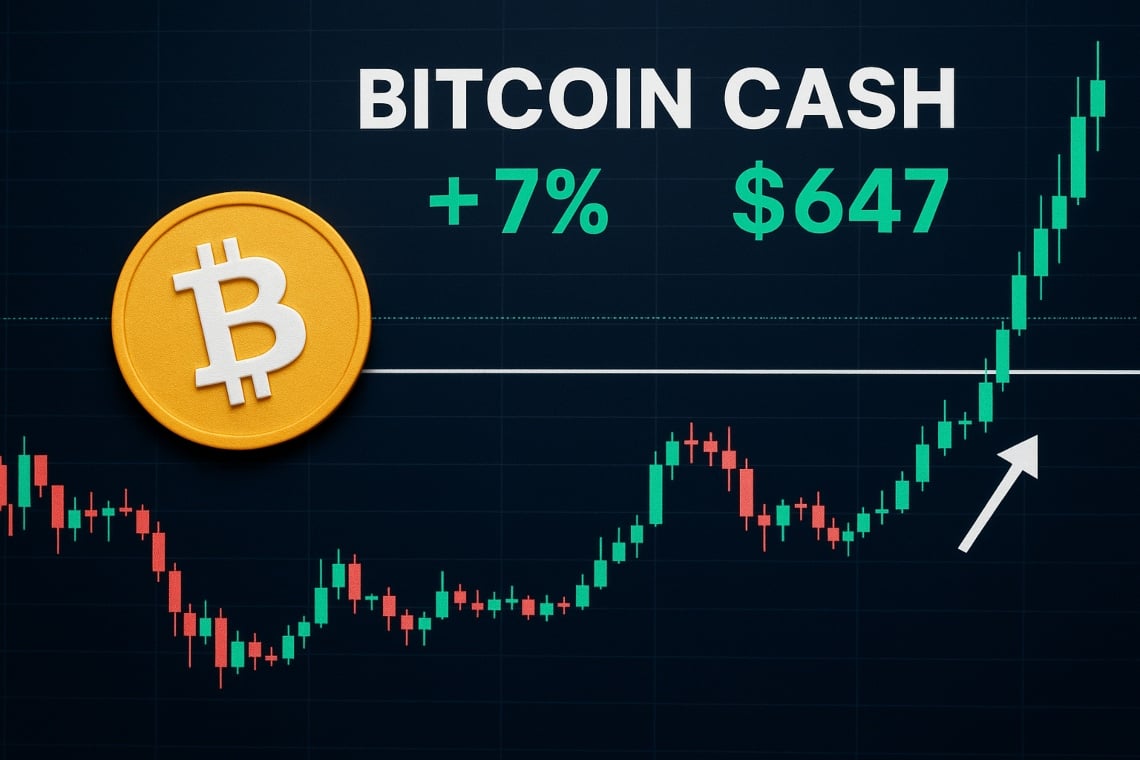
Bitcoin Cash: price +7% at $647, breakout and key levels (09/18/2025)

Bitcoin Cash: price +7% at $647, breakout and key levels (09/18/2025)

Bitcoin Cash gains 7% and reaches $647, hitting highs not seen since last April: the movement fits into a risk-on climate.
Share
The Cryptonomist2025/09/18 21:47