

BNB Chain’s AWS Integration Proves Crypto Is Ready for Enterprise Use
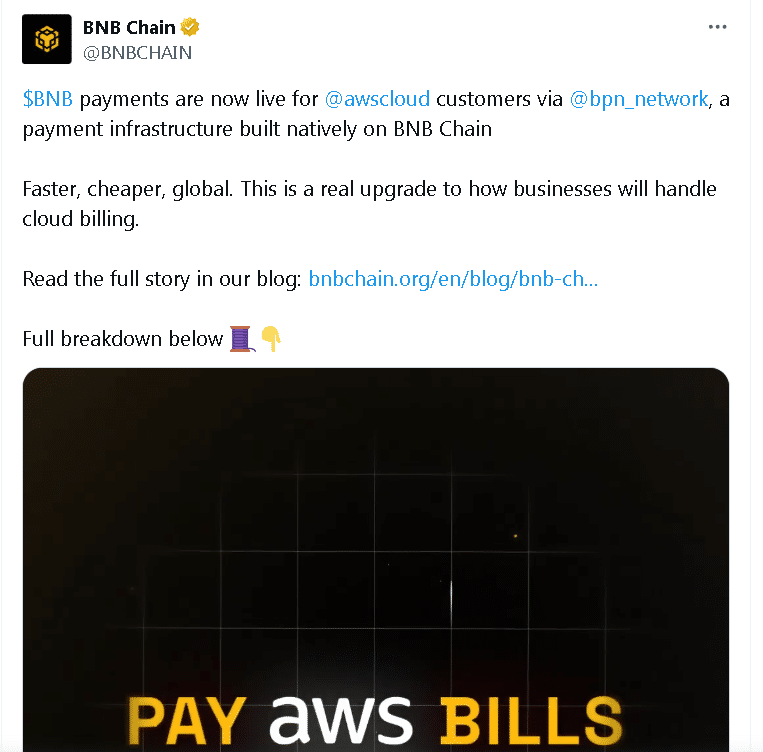
BNB Chain AWS payments have officially gone live through a new on-chain integration that allows Amazon Web Services customers to pay their cloud bills using BNB. This development shows a practical change in how companies manage payments for cloud services.
It moves away from slow and expensive cross-border banking systems and shifts toward real-time settlement on the blockchain. The announcement also reflects a broader effort by blockchain networks to go beyond speculative use cases and become part of core business infrastructure.
What do BNB Chain AWS payments actually mean for enterprises?
In simple terms, the integration lets AWS customers pay for their cloud services using BNB through the Better Payment Network (BPN). BPN is a payment infrastructure built directly on BNB Chain. It allows enterprise and developer AWS accounts to send payments on-chain instead of depending on traditional banking systems.
 BNB Chain’s AWS Integration Proves Crypto Is Ready for Enterprise Use 4
As a result, transactions are settled in real time. This also helps reduce fees and removes delays linked to foreign exchange processes and cross-border transfers. This move positions BNB Chain AWS payments as a practical option for global businesses that operate across multiple countries and jurisdictions.
How does the payment flow work on-chain?
Payments are processed through BPN, which works as a bridge connecting BNB, regulated stablecoins, and traditional financial systems. Once an AWS bill is generated, eligible customers can send the payment through BPN using BNB. The transaction is settled almost instantly on-chain, removing middlemen and eliminating clearing delays.
 BNB Chain’s AWS Integration Proves Crypto Is Ready for Enterprise Use 5
According to BNB Chain, the setup is meant for large-scale business transactions, not everyday retail use. That focus makes BNB Chain AWS payments a better fit for regular cloud invoices and sizable operating expenses faced by enterprises.
Why is this integration being described as enterprise-grade?
For AWS customers, the shift is mainly operational, but its impact is significant. Payments are settled in real time, cutting out long waiting periods. Transaction costs are reduced compared to traditional methods. Billing connects directly with existing enterprise workflows through BPN, while compliance, security, and transparency are built in to meet institutional standards rather than speculative crypto use.
Sarah Song, Head of Business Development at BNB Chain, said the aim is to take BNB beyond simple trading use. She explained that AWS customers gain access to fast and low-cost global payments, while BNB Chain AWS payments help position BNB as a dependable settlement asset for everyday business operations.
What do industry leaders say about the move?
Rica Fu, founder of Better Payment Network, described the integration as clear evidence that crypto can play a real role in enterprise finance. By connecting directly with AWS billing systems, BPN is showing how digital assets can simplify enterprise payments at scale, Fu said.
She added that the system is built to support secure and scalable transaction processing suited to real business needs. Analysts following blockchain infrastructure trends say that BNB Chain AWS payments show a move toward using crypto as basic financial infrastructure rather than as a speculative product.
How does this fit into broader institutional momentum?
The announcement comes at a time when traditional financial institutions are moving faster into on-chain payment systems. Earlier the same day, SoFi launched SoFiUSD, becoming the first U.S. national bank to issue a fully reserved stablecoin on a public blockchain.
JPMorgan has also expanded its tokenized deposit program, placing bank-issued dollars on public blockchains while keeping institutional controls in place. Against this backdrop, BNB Chain AWS payments suggest that blockchain-based settlement is increasingly being used for routine but costly processes such as global billing and B2B payments.
Are BNB Chain AWS payments about adoption rather than hype?
Yes, and that distinction is important. This integration is not connected to trading narratives or price speculation. It focuses on evaluating whether blockchain infrastructure can outperform traditional payment systems in speed, cost, and reliability.
 BNB Chain’s AWS Integration Proves Crypto Is Ready for Enterprise Use 6
By enabling AWS customers to pay cloud bills on-chain, BNB Chain is putting this capability to the test. The move highlights crypto’s potential to serve as core infrastructure for enterprise operations.
Conclusion
The launch of BNB Chain AWS payments is a big step for blockchain in business finance. Payments can now settle in real time. As costs are lower, and companies can pay from anywhere in the world.
This shows that digital assets are starting to be used in regular business operations, not just trading. As more institutions explore on-chain payments, BNB Chain and BPN are emerging as serious players in enterprise financial systems, where getting things done efficiently matters more than hype.
Glossary
AWS: Cloud service offering servers, storage, and databases.
Better Payment Network: BNB Chain system for fast, low-cost crypto payments.
Tokenized Deposit: Digital bank asset on blockchain for instant, transparent payments.
Enterprise-Grade Payment: Secure, reliable payment system for businesses.
On-Chain Payment: Blockchain transaction with instant and clear settlement.
Frequently Asked Questions About BNB Chain AWS Payments
How do BNB Chain AWS payments work?
Payments are sent on-chain through the Better Payment Network. And then are settled almost instantly
Who can use BNB Chain AWS payments?
Enterprise and developer AWS customers who have access to BPN can use BNB to pay their cloud bills.
Are BNB Chain AWS payments only for small transactions?
No, they are designed for large-scale business payments and recurring cloud bills.
How do BNB Chain AWS payments save money?
They reduce transaction fees compared to traditional banking and cross-border payments.
Will BNB Chain AWS payments change global cloud payments?
It could by showing that blockchain can handle fast and low-cost payments for businesses worldwide.
Sources
Cryptotimes
BNBChain
Read More: BNB Chain’s AWS Integration Proves Crypto Is Ready for Enterprise Use">BNB Chain’s AWS Integration Proves Crypto Is Ready for Enterprise Use
You May Also Like

The Channel Factories We’ve Been Waiting For
Let insiders trade – Blockworks
