

Must Read
COUP. Senators raised their hands to vote for the ouster of Senate President Vicente Sotto III, on May 11, 2026.COUP. Senators raised their hands to vote for the ouster of Senate President Vicente Sotto III, on May 11, 2026.
Cayetano’s repeated refusal to convene Senate raises constitutional issue
For feedback or concerns regarding this content, please contact us at [email protected]
MANILA, Philippines – Senate President Alan Peter Cayetano‘s repeated refusal to convene the Senate opens itself up to constitutional issues.
Under the 1987 Constitution, neither the House nor the Senate shall adjourn for more than three days while Congress is in session without the consent of the other.
Play Video 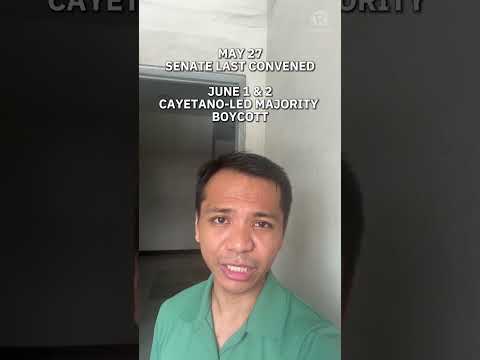
Constitutional lawyer Paolo Tamase believes Cayetano could be violating the Constitution if the Senate fails to meet on Wednesday, June 3, without the House’s consent.
“But whether that is correctible by the other branches, or whether it is strategic to pull in the other branches, is uncertain,” Tamase told Rappler.
“This refusal to hold session is unprecedented though in recent Senate history, so what that will mean for the Senate presidency and its pending business is uncertain. The Constitution has rules and safety valves for emergency situations, but it is written under the assumption that its deliberative bodies — the Senate and the House — will be composed of statesmen. Or that there are at least enough of them to not result in the current impasse,” he added.
Cayetano’s 11-person majority has boycotted the Senate for two consecutive days from Monday, June 1, to Tuesday, June 2, leaving the 11-person minority waiting on the plenary floor. The last time the upper chamber held session was on May 27.
Cayetano has said the boycott is his bloc’s form of protest after authorities arrested Senator Jinggoy Estrada inside Senate premises over his plunder and graft case, even though the arrest itself is legally valid and has precedents. He later insisted that the majority’s absence also ensures that the blue ribbon committee hearing into the flood control scandal under new chair Pia Cayetano will proceed on Thursday, June 4.
The elephant in the room is also that he cannot be ousted as Senate president if he does not convene the Senate. He has not made any indication whether he will do so on Wednesday.
House Deputy Speaker Paolo Ortega and House Senior Seputy Minority Leader Leila de Lima both said they have been reviewing the constitutional provision on the convening of the Senate and the House.
“My take is that if the Senate still does not convene and there is no consent from the House, we can say that the Senate has violated the Constitution because the three-day adjournment has already lapsed,” Ortega told Rappler.
“How can the Senate formally adjourn sine die if it doesn’t convene or hold plenary session today? How about the House of Representatives? Can it do so without a counterpart declaration from the Senate? Sine die adjournment pertains to or is a function of Congress, meaning, both Houses,” De Lima also separately told Rappler.
Senator Kiko Pangilinan earlier said that the Senate minority bloc will “exhaust all legal remedies to address this impasse.”
The legislative calendar sets a June 5 sine die adjournment of Congress, which means the next time they can convene is after the State of the Nation Address, but both chambers usually adjourn on a Wednesday, in this case, June 3.
Earlier on Wednesday, President Ferdinand Marcos Jr. urged the Senate majority to “get back to work” after two consecutive days of absence at plenary sessions, saying crucial proposed measures — especially during the oil crisis — are being compromised. – Rapper.com


Disclaimer: The articles reposted on this site are sourced from public platforms and are provided for informational purposes only. They do not necessarily reflect the views of MEXC. All rights remain with the original authors. If you believe any content infringes on third-party rights, please contact [email protected] for removal. MEXC makes no guarantees regarding the accuracy, completeness, or timeliness of the content and is not responsible for any actions taken based on the information provided. The content does not constitute financial, legal, or other professional advice, nor should it be considered a recommendation or endorsement by MEXC.
You May Also Like
The Senate’s quorum of 12 senators is legal — here’s why
COUP. Senators raised their hands to vote for the ouster of Senate President Vicente Sotto III, on May 11, 2026.
Share
Rappler2026/06/03 21:00

Japanese Tech Giant’s Ambitious Bitcoin Accumulation
The post Japanese Tech Giant’s Ambitious Bitcoin Accumulation appeared on BitcoinEthereumNews.com. Tokyo-based Metaplanet has made a major move in the cryptocurrency
Share
BitcoinEthereumNews2026/04/02 17:47
Nebius Stock Hits Overbought Levels Amid 684% Revenue Surge, Risks Pullback
Nebius Stock Analysis reveals bullish structure but shows short-term pullback pressure and overbought signals. Get the latest momentum insights.
Share
The Cryptonomist2026/06/03 19:31



