

MEXC Review: Fees, Features, Security, Pros, Cons & What You Need to Know in 2026
Most major crypto exchanges serve users from regulated jurisdictions like the US, UK, or Europe. They hold formal financial licenses, which gives traders confidence. In contrast, MEXC takes a different approach.
It operates from the Seychelles and offers deep liquidity, ultra-low fees, and thousands of trading pairs without the overhead of Western regulation. This strategy makes MEXC an attractive option for global traders, but it also means the exchange lacks top-tier oversight, which presents real risks.
Honest Opinion About MEXC
MEXC has built a solid reputation among active traders. After reviewing its features, security measures, and user feedback, I see a clear picture of where this exchange shines and where it falls short.
The positives are strong. MEXC offers 0% maker fees on spot trading and 0.01% taker fees on futures, which is among the cheapest in the industry. The platform lists over 2,700 spot pairs and 800+ futures pairs, giving traders access to coins that other exchanges don’t offer. Security is also a priority — Hacken audits the Proof of Reserves monthly, and as of April 2026, BTC reserves were at 295%, well above user deposits.
The negatives are significant too. MEXC lacks major regulatory licenses. It’s not registered with the SEC, FCA, or other top-tier bodies. User reviews on Trustpilot and Reddit include many complaints about frozen withdrawals and slow customer support. Some of these complaints are legitimate, while others come from users who didn’t complete KYC or violated terms. Overall, MEXC is a great exchange for experienced traders who understand the risks. Beginners should approach with caution.
Executive Summary
MEXC is a Seychelles-based cryptocurrency exchange founded in 2018. It has grown into one of the largest global platforms, serving over 40 million users across more than 170 countries.
The platform offers a wide range of products: spot trading with 2,700+ pairs, futures trading with up to 200x leverage, margin trading, staking (MEXC Earn), a Launchpad for new tokens, P2P fiat onramps, and even crypto-margined stock futures. MEXC also operates DEX+ (a decentralized wallet interface) and mobile apps for iOS and Android.
The biggest draw is cost. MEXC charges 0.00% maker fees and 0.05% taker fees on spot trades. Futures fees are similarly low at 0.00% maker and 0.01% taker in many regions, with discounts available for holding MX tokens or reaching higher VIP tiers. The platform processes roughly $285 billion in annual trading volume (as of April 2026), ranking it among the top 10 exchanges globally. Liquidity is strong in major markets. From a security standpoint, MEXC publishes monthly Hacken-audited Proof of Reserves and maintains a $100 million Guardian Fund plus a futures insurance fund. However, the platform is not available in restricted countries such as the US, UK, Canada, Mainland China, and Singapore. Customer service remains a weak point, with mixed user reviews.
Product Features
MEXC’s product suite caters to both spot traders and high-leverage futures traders, as well as passive investors.
Spot Trading
MEXC offers one of the widest selections of any centralized exchange. There are over 2,700 spot trading pairs and more than 800 futures pairs. The platform uses a standard order-book interface with charting tools from TradingView. The “Convert” tool allows instant, zero-fee crypto swaps without order book slippage.
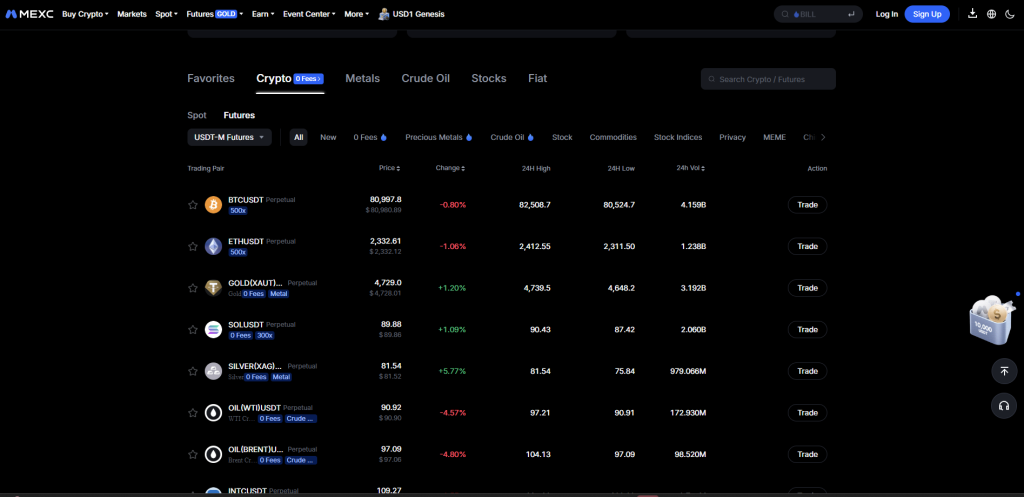
Futures & Margin Trading
Futures contracts are available for hundreds of assets. Traders can access up to 200x leverage on major coins like Bitcoin and Ethereum. MEXC also offers crypto-margined futures on stocks, indices, commodities, and forex — a unique feature not found on most exchanges.
MEXC Earn (Staking & Savings)
The Earn section provides flexible savings, fixed savings, and on-chain staking products. Some promotional APRs reach as high as 600% for select assets. The selection varies by asset and lockup period.
Launchpad & Token Listings
MEXC is known for listing new tokens early. In early 2025 it led major exchanges in total listing events. The Launchpad requires KYC and allows users to acquire new tokens before public listing.
P2P & Fiat Onramps
Users can buy and sell crypto via P2P (escrow) or through third-party providers like MoonPay and Banxa. In late 2025, MEXC added fiat pairs for MXN (Mexico), COP (Colombia), and ARS (Argentina).
Mobile Apps & API
MEXC provides iOS and Android apps with the same features as the web platform. The API suite includes SDKs in five programming languages.
Fee Structure
MEXC’s fee schedule is among the most competitive in crypto.
Spot trading fees are set at:
- Maker: 0.00%
- Taker: 0.05%
This applies to most pairs. Some promotions further reduce taker fees to near zero.
Futures trading fees are region-dependent. The standard rates are:
- Maker: 0.00% in many regions (or 0.01% in others)
- Taker: 0.01% – 0.04% depending on the region and contract
Holders of the MX token receive additional discounts. Users who hold 500 or more MX can get up to 50% off futures trading fees. Additionally, activating the “MX deduction” feature gives a 20% discount on both spot and USDT futures trades, paid with MX tokens.
VIP program offers lower fees for high-volume traders. The base VIP requirements start at 30-day trading volumes of $10 million for spot and $20 million for futures.
Deposit and withdrawal fees: Crypto deposits are free. Withdrawal fees depend on blockchain network conditions (similar to other exchanges). Fiat on/off ramps are handled by third-party partners, and those may have their own fees.
Fee comparison table
| Metric | MEXC | Binance | KuCoin |
|---|---|---|---|
| Spot Maker Fee | 0.00% | 0.10% | 0.10% |
| Spot Taker Fee | 0.05% | 0.10% | 0.10% |
| Futures Maker Fee | 0.00% (region-specific) | 0.02% | ~0.02% |
| Futures Taker Fee | 0.01% (region-specific) | 0.04% | ~0.06% |
| Cryptocurrencies Listed | ~2,700+ spot pairs | ~500 | >1,000 |
| 24h Spot Volume | $1.19B (approx.) | ~$10B | ~$1.98B |
| User Base | 40 million | 280 million | 41 million |
Read also:
- Binance Review – Is Binance Legit?
- KuCoin Review – Is It Legit or a Scam?
Customer Support
MEXC provides 24/7 live chat support in multiple languages through its website and mobile app. The platform also offers email ticketing, a help center with FAQs, and a Telegram community.
User feedback is mixed. Some traders report positive experiences: “The customer support responds quickly and can help. All in all, a very good trading platform.” Others describe slow or unresponsive service, especially during busy periods. This inconsistency is the main drawback of an otherwise strong platform. Before depositing large amounts, new users should test the support system with small issues.
Security & Compliance
MEXC prioritizes security with several layers of protection.
Proof of Reserves (PoR): MEXC partnered with Hacken, a leading blockchain security firm, to conduct monthly PoR audits. The April 2026 audit showed BTC reserves at 295%, ETH at 107.08%, USDT at 126.61%, and USDC at 139.6%. All major assets are over-collateralized. Users can verify their holdings using the Merkle-tree tool.
Insurance Funds: MEXC maintains a $100 million Guardian Fund to protect user assets. It also has a futures insurance fund to cover deficits from extreme market moves.
KYC/AML: The exchange enforces identity verification. Full KYC (passport or national ID) is required to unlock withdrawals and participate in Launchpad events. Users who fail to complete KYC may face withdrawal freezes.
Audits: In addition to PoR, MEXC underwent a full penetration test by Hacken in March–April 2025, which identified and fixed several vulnerabilities.
Regulatory status: MEXC is registered in the Seychelles. It holds no licenses from the SEC (US), FCA (UK), or other top-tier regulators. The exchange does not offer services in restricted countries (see the section below).
The exchange has not suffered a major hack or loss of customer funds. Compliance with sanctions and AML standards is standard.
Reputation
User sentiment on MEXC varies widely. The exchange has responded to complaints and attempted to improve service, but negative feedback persists.
Trustpilot: Reviews are heavily polarized. Many users report frozen withdrawals and slow KYC verification. Others praise the low fees and wide coin selection. MEXC’s official Trustpilot rating is currently disabled due to guideline violations.
Reddit: Discussions on Reddit also show mixed opinions. Some users call MEXC a reliable platform for altcoins, while others accuse it of manipulating prices or freezing accounts without proper explanation.
Positive reviews: Experienced traders often defend MEXC, noting that many complaints come from users who ignored KYC rules or used the exchange from restricted countries. The platform’s uptime and security record are strong.
Negative reviews: A common complaint is accounts being frozen after large deposits, followed by unresponsive customer support. Some of these allegations may be fraudulent, but enough reports exist to consider it a risk.
No known regulatory actions: As of 2026, no major government agency has formally charged MEXC with illegal activity.
Liquidity & Market Depth
MEXC is a top-10 exchange by trading volume. According to CryptoQuant data, MEXC recorded approximately $284.9 billion in total trading volume in 2026 through late April. This places it ahead of Bybit ($242B), Coinbase ($209B), and OKX ($195B) for the same period.
Spot market 24-hour volume averages around $1.19 billion, with tight spreads on major pairs like BTC/USDT and ETH/USDT. Futures trading is even deeper; MEXC claims to be a top-5 global exchange by futures volume.
The large number of listed tokens means some lower-cap pairs may have thinner liquidity. But for the top 200 coins, execution is fast and spreads remain competitive.
Supported Jurisdictions & Restrictions
MEXC serves over 170 countries but does not accept users from the following prohibited jurisdictions:
- North Korea
- Cuba
- Sudan
- Iran
- Mainland China
- Singapore
- United States
- United Kingdom
- Hong Kong
- Canada
- Russian-controlled regions of Ukraine (Crimea, Donetsk, Luhansk, Zaporizhia, Kherson, Sevastopol)
Users in prohibited jurisdictions cannot register, deposit, or trade. The exchange uses IP and document checks to enforce these restrictions.
There is a separate MEXC.US platform for US customers, but that entity is different and has its own terms.
For supported countries, MEXC offers local fiat pairs via P2P and third-party payments (e.g., EUR, MXN, COP, ARS, TRY). KYC requirements vary by region, with stricter verification for EU and Asian users.
Pros and Cons
Pros
- Ultra-low fees: 0.00% maker spot, 0.01% taker futures
- Vast asset selection: 2,700+ spot pairs and 800+ futures pairs
- Deep liquidity: Top-10 global exchange with tight spreads
- Strong security: Monthly PoR audits by Hacken, 295% BTC reserves, insurance funds
- Advanced products: Crypto-margined stock futures, Launchpad, Earn, DEX+
- 24/7 live chat in multiple languages
- Mobile app with full trading features
Cons
- No top-tier regulation (Seychelles registered only)
- Restricted in many major markets (US, UK, Canada, China, Singapore)
- Mixed customer support — slow responses reported by some users
- Negative Trustpilot/Reddit sentiment around account freezes
- Thinner liquidity on obscure altcoins
Onboarding (How to Sign Up with MEXC)
Opening an account on MEXC takes only a few minutes.
- Go to MEXC.io and click “Sign Up”.
- Provide an email address or mobile phone number.
- Create a strong password and complete the CAPTCHA.
- Verify email or phone via a 6-digit code sent to you.
- (Optional) complete KYC to increase withdrawal limits and access launchpad events. Basic KYC requires a government-issued ID (passport or national identity card).
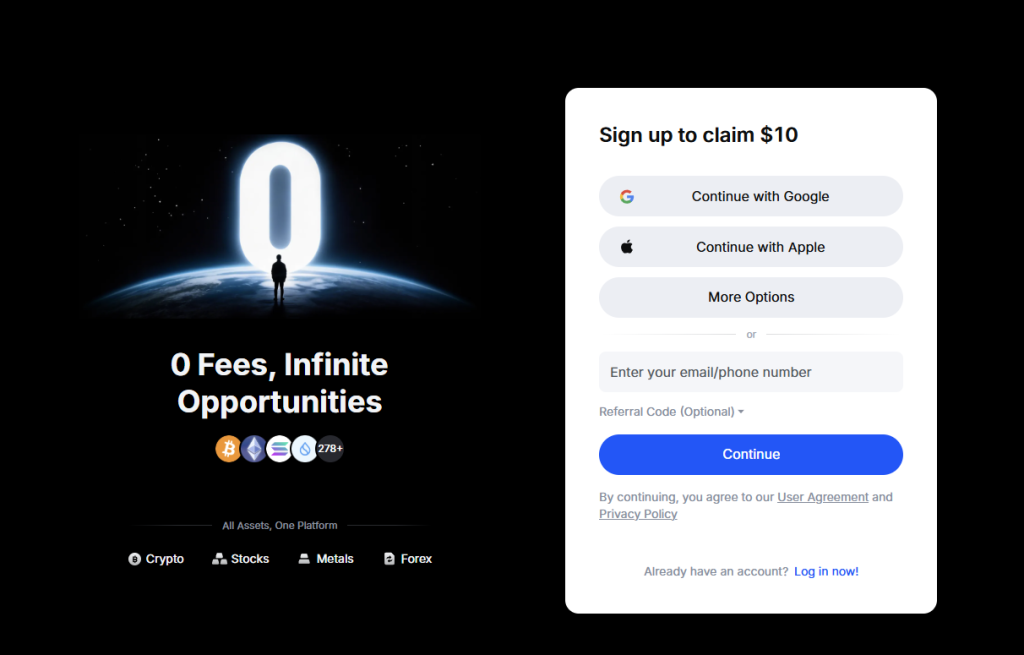
Once registered, you can deposit crypto instantly (no deposit fees). To buy crypto with fiat, use the P2P marketplace or third-party gateways like MoonPay, Banxa, or Finetix. The mobile app supports Google, Apple, MetaMask, and Telegram login options after the first registration.
Conclusion
MEXC is a solid exchange for experienced traders who want low fees, deep liquidity, and access to a massive selection of coins. The platform’s security measures — including monthly PoR audits and insurance funds — are on par with top-tier exchanges. The 0.00% maker fee is among the best in the industry.
However, MEXC is not suitable for everyone. The lack of major regulatory licenses and the restrictions on users from the US, UK, Canada, and China make it inaccessible to a large part of the market. Customer support complaints are frequent enough to warrant caution, especially for large deposits.
If you understand the risks and are comfortable using an offshore exchange, MEXC offers a powerful trading environment. If you prioritize regulation and top-tier support, consider alternatives like Binance or KuCoin.
FAQs

MEXC has strong security: monthly Hacken-audited Proof of Reserves, a $100M Guardian Fund, and no major hacks to date. However, it lacks top-tier regulation.
No. MEXC does not accept users from the United States, UK, Canada, Mainland China, or Singapore.
Spot: 0.00% maker / 0.05% taker. Futures: 0.00% maker / 0.01% taker in many regions. MX token holders get an extra 20% discount.
Yes, for iOS and Android. The app supports all trading features, including spot, futures, and P2P.
MEXC is headquartered in Victoria, Seychelles.
It’s a staking and savings platform offering flexible/fixed savings and on-chain staking with competitive APRs.
No, MEXC is not fully legal in most regulated jurisdictions. The platform operates from the Seychelles and holds no recognized financial license anywhere in the world. Multiple regulators have issued warnings against it, including the Dutch AFM, UK FCA, Canadian OSC, German BaFin, Austrian FMA, Hong Kong SFC, and Dubai’s VARA, all stating MEXC is not authorized to offer crypto services in their regions. In fact, MEXC is explicitly restricted for users in the United States, United Kingdom, Canada, Mainland China, Singapore, and Hong Kong, meaning residents of these countries cannot legally register or trade on the platform.
Yes, MEXC takes security seriously and has a strong track record. The exchange publishes monthly Proof of Reserves audited by Hacken, with the April 2026 report showing BTC reserves at 295% — far above user holdings. MEXC maintains a $100 million Guardian Fund plus a separate futures insurance fund to cover losses. No major hack or loss of customer funds has occurred since its launch in 2018.
The post MEXC Review: Fees, Features, Security, Pros, Cons & What You Need to Know in 2026 appeared first on CaptainAltcoin.


You May Also Like

Fed Governor Calls For Strong Stablecoin Oversight As CLARITY Act’s Final Text Gets Delayed
Startup Battlefield 200 Applications Close May 27: A Final Call for Pre-Series A Founders Seeking VC Access and Global Visibility




