The FTX Recovery Trust has filed a $1.15 billion lawsuit against the Bitcoin mining firm Genesis Digital Assets, alleging fraudulent transfers. The complaint, filed on Monday in U.S. Bankruptcy Court for the District of Delaware, alleges that Sam Bankman-Fried used misappropriated FTX customer funds to purchase Genesis Digital shares at “outrageously inflated prices” through his hedge fund, Alameda Research, between August 2021 and April 2022. Genesis Digital co-founders Rashit Makhat and Marco Krohn received $470 million and $80.9 million, respectively, for their shares in February 2022, according to court documents. The trust contends that only Alameda, and by extension Bankman-Fried, as its 90% owner, benefited from the investments, while FTX customers and creditors suffered losses from the diverted exchange funds.Court Document (Source: Bloomberg Law) Genesis Investment Timeline Reveals Systematic Fund Diversion Court documents reveal that discussions between Bankman-Fried and Genesis Digital began in July 2021, when the Kazakhstan-based mining company was seeking capital to expand its operations into the United States. Bankman-Fried joined Genesis Digital’s board in October 2021, according to Bloomberg, positioning himself to oversee what would become one of Alameda’s largest venture investments. The complaint describes how the FTX founder caused Alameda to purchase multiple tranches of Genesis shares over an eight-month period, with the lawsuit characterizing Genesis as “one of Bankman-Fried’s most reckless investments with commingled and misappropriated funds.“ Between August 2021 and April 2022, Alameda invested $1.15 billion across four distinct funding rounds: $100 million in August 2021, $550 million in January 2022, $250 million in February, and $250 million in April 2022. The trust alleges that FTX insiders regularly caused Alameda to “borrow” billions from the FTX.com exchange to fund “profligate lifestyles and vanity investments” while hiding the source of these funds from investors and creditors. Bankman-Fried resigned from Genesis Digital’s board one day before FTX filed for bankruptcy in November 2022, according to the court filing. Mining Sector Faces Renewed Scrutiny Amid FTX Fallout The Genesis Digital lawsuit is the latest effort by FTX’s bankruptcy estate to recover assets for creditors, with the trust having already distributed $6.2 billion across two previous rounds of payments. The trust completed a $1.2 billion distribution in February, followed by a larger $5 billion payout in May, with an additional $1.6 billion distribution scheduled for September 30, bringing total recoveries to nearly half of the $16.5 billion earmarked for victims. These recovery efforts come as Genesis Digital, which operates over 500 megawatts of mining capacity across 20 data centers on four continents, saw its valuation reach $5.5 billion during an April 2022 fundraising round shortly before cryptocurrency prices collapsed later that year. The mining company was exploring an initial public offering in the United States as recently as July 2024, working with advisors to evaluate a potential listing and planning a pre-IPO funding round amid the crypto industry’s recovery from the 2022 market downturn. However, the FTX lawsuit adds another layer of complexity to Genesis Digital’s corporate structure, which includes an extensive network of U.S. subsidiaries with names like Dog House TX-1, Mother Whale LLC, and White Deer LLC. The complaint alleges that these U.S. subsidiaries operate as “alter egos” of the parent company, potentially exposing the entire corporate structure to clawback claims under both federal bankruptcy law and Delaware state fraudulent transfer statutes. Meanwhile, Bankman-Fried continues to serve his 25-year prison sentence following his conviction on seven felony charges, with oral arguments for his appeal scheduled for November 4, 2025. The lawsuit adds to the complex web of litigation following the $175 million settlement earlier this year with Genesis Global, a subsidiary of Digital Currency Group, as creditors and bankruptcy trustees pursue recovery efforts across multiple jurisdictions and corporate entities tied to the failed exchangeThe FTX Recovery Trust has filed a $1.15 billion lawsuit against the Bitcoin mining firm Genesis Digital Assets, alleging fraudulent transfers. The complaint, filed on Monday in U.S. Bankruptcy Court for the District of Delaware, alleges that Sam Bankman-Fried used misappropriated FTX customer funds to purchase Genesis Digital shares at “outrageously inflated prices” through his hedge fund, Alameda Research, between August 2021 and April 2022. Genesis Digital co-founders Rashit Makhat and Marco Krohn received $470 million and $80.9 million, respectively, for their shares in February 2022, according to court documents. The trust contends that only Alameda, and by extension Bankman-Fried, as its 90% owner, benefited from the investments, while FTX customers and creditors suffered losses from the diverted exchange funds.Court Document (Source: Bloomberg Law) Genesis Investment Timeline Reveals Systematic Fund Diversion Court documents reveal that discussions between Bankman-Fried and Genesis Digital began in July 2021, when the Kazakhstan-based mining company was seeking capital to expand its operations into the United States. Bankman-Fried joined Genesis Digital’s board in October 2021, according to Bloomberg, positioning himself to oversee what would become one of Alameda’s largest venture investments. The complaint describes how the FTX founder caused Alameda to purchase multiple tranches of Genesis shares over an eight-month period, with the lawsuit characterizing Genesis as “one of Bankman-Fried’s most reckless investments with commingled and misappropriated funds.“ Between August 2021 and April 2022, Alameda invested $1.15 billion across four distinct funding rounds: $100 million in August 2021, $550 million in January 2022, $250 million in February, and $250 million in April 2022. The trust alleges that FTX insiders regularly caused Alameda to “borrow” billions from the FTX.com exchange to fund “profligate lifestyles and vanity investments” while hiding the source of these funds from investors and creditors. Bankman-Fried resigned from Genesis Digital’s board one day before FTX filed for bankruptcy in November 2022, according to the court filing. Mining Sector Faces Renewed Scrutiny Amid FTX Fallout The Genesis Digital lawsuit is the latest effort by FTX’s bankruptcy estate to recover assets for creditors, with the trust having already distributed $6.2 billion across two previous rounds of payments. The trust completed a $1.2 billion distribution in February, followed by a larger $5 billion payout in May, with an additional $1.6 billion distribution scheduled for September 30, bringing total recoveries to nearly half of the $16.5 billion earmarked for victims. These recovery efforts come as Genesis Digital, which operates over 500 megawatts of mining capacity across 20 data centers on four continents, saw its valuation reach $5.5 billion during an April 2022 fundraising round shortly before cryptocurrency prices collapsed later that year. The mining company was exploring an initial public offering in the United States as recently as July 2024, working with advisors to evaluate a potential listing and planning a pre-IPO funding round amid the crypto industry’s recovery from the 2022 market downturn. However, the FTX lawsuit adds another layer of complexity to Genesis Digital’s corporate structure, which includes an extensive network of U.S. subsidiaries with names like Dog House TX-1, Mother Whale LLC, and White Deer LLC. The complaint alleges that these U.S. subsidiaries operate as “alter egos” of the parent company, potentially exposing the entire corporate structure to clawback claims under both federal bankruptcy law and Delaware state fraudulent transfer statutes. Meanwhile, Bankman-Fried continues to serve his 25-year prison sentence following his conviction on seven felony charges, with oral arguments for his appeal scheduled for November 4, 2025. The lawsuit adds to the complex web of litigation following the $175 million settlement earlier this year with Genesis Global, a subsidiary of Digital Currency Group, as creditors and bankruptcy trustees pursue recovery efforts across multiple jurisdictions and corporate entities tied to the failed exchange

FTX Trust Sues Genesis Digital for $1.15B Clawback Over Alleged Fraudulent Transfers

The FTX Recovery Trust has filed a $1.15 billion lawsuit against the Bitcoin mining firm Genesis Digital Assets, alleging fraudulent transfers.

The complaint, filed on Monday in U.S. Bankruptcy Court for the District of Delaware, alleges that Sam Bankman-Fried used misappropriated FTX customer funds to purchase Genesis Digital shares at “outrageously inflated prices” through his hedge fund, Alameda Research, between August 2021 and April 2022.

Genesis Digital co-founders Rashit Makhat and Marco Krohn received $470 million and $80.9 million, respectively, for their shares in February 2022, according to court documents.

The trust contends that only Alameda, and by extension Bankman-Fried, as its 90% owner, benefited from the investments, while FTX customers and creditors suffered losses from the diverted exchange funds.
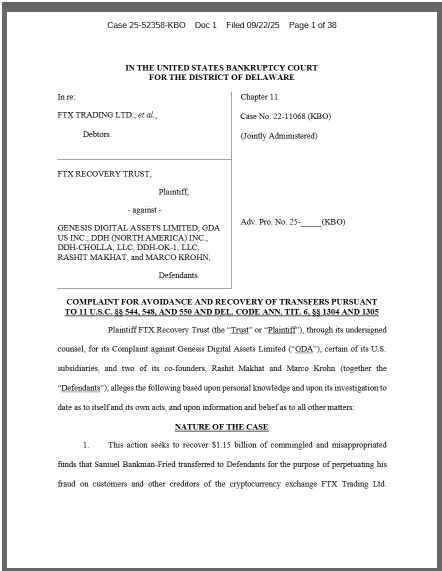
FTX Trust Sues Genesis Digital for $1.15B Clawback Over Alleged Fraudulent TransfersCourt Document (Source: Bloomberg Law)

Genesis Investment Timeline Reveals Systematic Fund Diversion

Court documents reveal that discussions between Bankman-Fried and Genesis Digital began in July 2021, when the Kazakhstan-based mining company was seeking capital to expand its operations into the United States.

Bankman-Fried joined Genesis Digital’s board in October 2021, according to Bloomberg, positioning himself to oversee what would become one of Alameda’s largest venture investments.

The complaint describes how the FTX founder caused Alameda to purchase multiple tranches of Genesis shares over an eight-month period, with the lawsuit characterizing Genesis as “one of Bankman-Fried’s most reckless investments with commingled and misappropriated funds.

Between August 2021 and April 2022, Alameda invested $1.15 billion across four distinct funding rounds: $100 million in August 2021, $550 million in January 2022, $250 million in February, and $250 million in April 2022.

The trust alleges that FTX insiders regularly caused Alameda to “borrow” billions from the FTX.com exchange to fund “profligate lifestyles and vanity investments” while hiding the source of these funds from investors and creditors.

Bankman-Fried resigned from Genesis Digital’s board one day before FTX filed for bankruptcy in November 2022, according to the court filing.

Mining Sector Faces Renewed Scrutiny Amid FTX Fallout

The Genesis Digital lawsuit is the latest effort by FTX’s bankruptcy estate to recover assets for creditors, with the trust having already distributed $6.2 billion across two previous rounds of payments.

The trust completed a $1.2 billion distribution in February, followed by a larger $5 billion payout in May, with an additional $1.6 billion distribution scheduled for September 30, bringing total recoveries to nearly half of the $16.5 billion earmarked for victims.

These recovery efforts come as Genesis Digital, which operates over 500 megawatts of mining capacity across 20 data centers on four continents, saw its valuation reach $5.5 billion during an April 2022 fundraising round shortly before cryptocurrency prices collapsed later that year.

The mining company was exploring an initial public offering in the United States as recently as July 2024, working with advisors to evaluate a potential listing and planning a pre-IPO funding round amid the crypto industry’s recovery from the 2022 market downturn.

However, the FTX lawsuit adds another layer of complexity to Genesis Digital’s corporate structure, which includes an extensive network of U.S. subsidiaries with names like Dog House TX-1, Mother Whale LLC, and White Deer LLC.

The complaint alleges that these U.S. subsidiaries operate as “alter egos” of the parent company, potentially exposing the entire corporate structure to clawback claims under both federal bankruptcy law and Delaware state fraudulent transfer statutes.

Meanwhile, Bankman-Fried continues to serve his 25-year prison sentence following his conviction on seven felony charges, with oral arguments for his appeal scheduled for November 4, 2025.

The lawsuit adds to the complex web of litigation following the $175 million settlement earlier this year with Genesis Global, a subsidiary of Digital Currency Group, as creditors and bankruptcy trustees pursue recovery efforts across multiple jurisdictions and corporate entities tied to the failed exchange.

Market Opportunity
1 Logo
1 Price(1)
$0.007586
$0.007586$0.007586
-0.10%
USD
1 (1) Live Price Chart
Disclaimer: The articles reposted on this site are sourced from public platforms and are provided for informational purposes only. They do not necessarily reflect the views of MEXC. All rights remain with the original authors. If you believe any content infringes on third-party rights, please contact [email protected] for removal. MEXC makes no guarantees regarding the accuracy, completeness, or timeliness of the content and is not responsible for any actions taken based on the information provided. The content does not constitute financial, legal, or other professional advice, nor should it be considered a recommendation or endorsement by MEXC.

You May Also Like

Crypto Market Cap Edges Up 2% as Bitcoin Approaches $118K After Fed Rate Trim

Crypto Market Cap Edges Up 2% as Bitcoin Approaches $118K After Fed Rate Trim

The global crypto market cap rose 2% to $4.2 trillion on Thursday, lifted by Bitcoin’s steady climb toward $118,000 after the Fed delivered its first interest rate cut of the year. Gains were measured, however, as investors weighed the central bank’s cautious tone on future policy moves. Bitcoin last traded 1% higher at $117,426. Ether rose 2.8% to $4,609. XRP also gained, rising 2.9% to $3.10. Fed Chair Jerome Powell described Wednesday’s quarter-point reduction as a risk-management step, stressing that policymakers were in no hurry to speed up the easing cycle. His comments dampened expectations of more aggressive cuts, limiting enthusiasm across risk assets. Traders Anticipated Fed Rate Trim, Leaving Little Room for Surprise Rally The Federal Open Market Committee voted 11-to-1 to lower the benchmark lending rate to a range of 4.00% to 4.25%. The sole dissent came from newly appointed governor Stephen Miran, who pushed for a half-point cut. Traders were largely prepared for the move. Futures markets tracked by the CME FedWatch tool had assigned a 96% probability to a 25 basis point cut, making the decision widely anticipated. That advance positioning meant much of the potential boost was already priced in, creating what analysts described as a “buy the rumour, sell the news” environment. Fed Rate Decision Creates Conditions for Crypto, But Traders Still Hold Back Andrew Forson, president of DeFi Technologies, said lower borrowing costs would eventually steer more money toward digital assets. “A lower cost of capital indicates more capital flows into the digital assets space because the risk hurdle rate for money is lower,” he noted. He added that staking products and blockchain projects could become attractive alternatives to traditional bonds, offering both yield and appreciation. Despite the cut, crypto markets remained calm. Open interest in Bitcoin futures held steady and no major liquidation cascades followed the Fed’s decision. Analysts pointed to Powell’s language and upcoming economic data as the key factors for traders before building larger positions. Powell’s Caution Tempers Immediate Impact of Fed Rate Move on Crypto Markets History also suggests crypto rallies after rate cuts often take time. When the Fed eased in Dec. 2024, Bitcoin briefly surged 5% cent before consolidating, with sustained gains arriving only weeks later. This time, market watchers are bracing for a similar pattern. Powell’s insistence on caution, combined with uncertainty around inflation and growth, has kept short-term volatility muted even as sentiment for risk assets improves. BitMine’s Tom Lee this week predicted that Bitcoin and Ether could deliver “monster gains” in the next three months if the Fed continues on an easing path. His view echoes broader expectations that liquidity-sensitive assets will outperform once the cycle gathers pace. For now, the crypto sector has digested the Fed’s move with restraint. Traders remain focused on signals from the central bank’s October meeting to determine whether Wednesday’s step marks the beginning of a broader policy shift or just a one-off adjustment
Share
CryptoNews2025/09/18 13:14
MoneyGram Taps Stablecoins To Shield Colombians From Peso Weakness

MoneyGram Taps Stablecoins To Shield Colombians From Peso Weakness

According to multiple reports, MoneyGram is rolling out a new mobile app in Colombia that lets users receive, hold and move money using USD-backed stablecoins, specifically USDC. Related Reading: Ethereum Giant The Ether Machine Aims For US Public Debut The service is being positioned as a hybrid: a stored-value USD balance that can be funded, […]
Share
Bitcoinist2025/09/18 20:30
MICA Rules Come into Effect! Another European Country Issues a Very Strong Warning to Crypto Exchanges! Here Are the Details

MICA Rules Come into Effect! Another European Country Issues a Very Strong Warning to Crypto Exchanges! Here Are the Details

The post MICA Rules Come into Effect! Another European Country Issues a Very Strong Warning to Crypto Exchanges! Here Are the Details appeared on BitcoinEthereumNews
Share
BitcoinEthereumNews2025/12/26 15:25