If you trade regularly on MEXC, you've probably come across oil-related derivatives at some point. But for most crypto traders, oil remains a fairly unfamiliar market, because the forces driving its price action are very different from what moves Bitcoin or altcoins.
Beyond the usual fundamental analysis and technical indicators, oil prices are heavily shaped by global supply and demand, production output, inventory levels, OPEC+ decisions, the strength of the U.S. dollar, and especially geopolitical shocks.
A single surprise inventory report, a production cut announcement, or rising tension in a major producing region can send oil prices swinging hard.
This article breaks down the most important factors actually driving oil price moves, so crypto traders can approach this market with more confidence.
Key Takeaways
Oil prices are heavily influenced by supply and demand, OPEC+, inventories, and geopolitics.
The Fed and the U.S. dollar can shift oil's broader trend.
Speculative flows in futures markets can amplify price swings.
Crypto traders shouldn't rely purely on crypto-market intuition when trading oil.
1. The Current Market Backdrop
According to
MEXC data, oil derivatives are currently trading in the $90-$100 range, up roughly 14% since late August. The core driver behind this September 2026 surge isn't a boom in consumption. In fact, the IEA is forecasting that global oil demand will decline in 2026, not rise. The real story is entirely on the supply side, specifically, three chokepoints breaking down at once.
The first is the Strait of Hormuz, the strategic shipping lane through which roughly one-fifth of global oil output must pass. Military conflict involving Iran has caused a sharp drop in tanker traffic through the strait, with preliminary vessel-tracking data showing shipping volumes at roughly a quarter of the average seen just ten days earlier.
The second, and arguably the freshest shock sending oil prices "jumping", is a series of attacks on Saudi Arabia's export infrastructure. Crude loading operations at the strategic Yanbu export terminal on the Red Sea have been suspended, forcing Riyadh to cancel several shipments to European buyers. Yanbu is a critical bypass route that lets Saudi crude avoid Hormuz altogether, and with both routes disrupted simultaneously, the market has started calling this a "double chokepoint" risk.
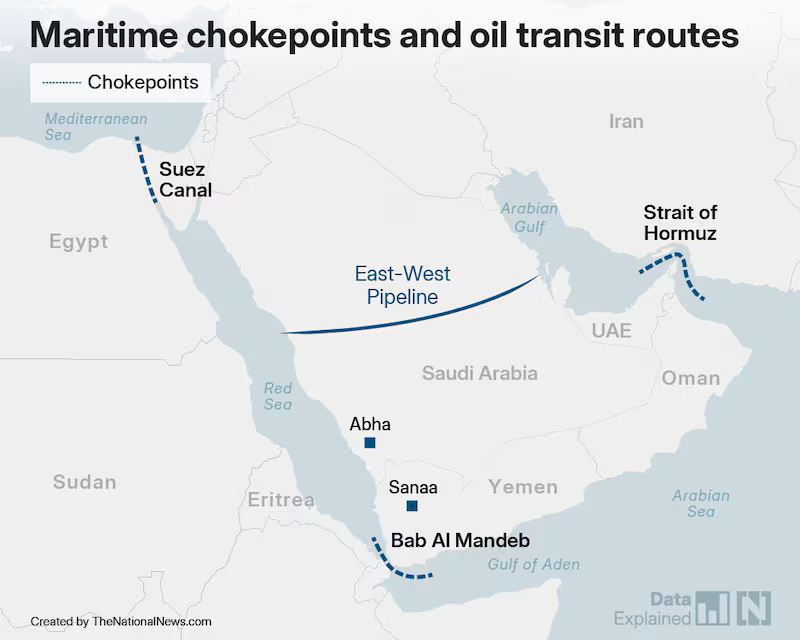
The third is what might be called the OPEC+ paradox: the group keeps announcing higher production quotas on paper, yet actual output keeps falling, because the key exporting nations (Saudi Arabia, Iran, Russia, Kazakhstan) are seeing their exports disrupted by conflict, not by any deliberate policy choice to cut back. When supply drops due to force majeure rather than policy decisions, the market loses its ability to forecast ahead, and a geopolitical risk premium gets baked directly into the price, with some estimates putting that premium as high as $8-$12 per barrel.
The result has been a sharp global inventory drawdown. The IEA recorded observable stockpiles falling by more than 500 million barrels in just six months, and the futures curve has slipped into deep backwardation, meaning spot prices are trading well above future-dated contracts, a classic signal that the market is thirsty for oil right now, not worried about oil later.
2. Why Should Crypto Traders Care About What Drives Oil Prices?
To trade any asset well, you need to understand not just where the price is going, but why it's moving. This is exactly where many crypto traders fall short when they step into oil or traditional forex products. Coming from crypto, most traders default to reading charts for long/short entries while paying little attention to the fundamentals underneath the market.
That approach can work some of the time, but it's not enough for oil. Oil prices are driven heavily by real-world supply and demand, OPEC+ output, inventories, monetary policy, the dollar, and above all, geopolitics. A strong breakout candle sometimes has nothing to do with technical structure at all, it's the market repricing its supply-demand expectations in real time.
More importantly, oil isn't an isolated asset. It functions as a macro variable that can shift risk appetite across the entire financial market, crypto included. That's exactly why a crypto trader who never touches oil directly should still be watching this market closely.
Understanding what drives oil prices doesn't mean abandoning technical analysis, quite the opposite. Fundamentals explain why the market is moving, while technicals help you pinpoint when and where to actually enter a trade. Combine the two, and reading oil's price action becomes far more intuitive than simply staring at candles on a chart.
3. What Actually Moves Oil Prices?
Oil prices aren't set by a single factor, they're the product of interaction between multiple variables: supply and demand, geopolitics, monetary policy, inventories, and speculative capital flows. Some of these can move the price within minutes.
3.1. Oil Supply
In the short term, supply is usually the single most powerful driver of oil prices.
Events like war, sanctions, pipeline outages, or disruptions along strategic shipping routes like the Strait of Hormuz can wipe millions of barrels a day off the market almost instantly.
OPEC+ also plays an outsized role through its production increase or cut decisions. Traders should note that an announced quota doesn't always translate into the actual volume of oil hitting the market.
3.2. Global Oil Demand
On the flip side, oil prices are also heavily shaped by energy consumption demand.
When the economy is growing and manufacturing and transportation are expanding, oil demand typically rises alongside it. Conversely, an economic slowdown or prices that climb too high can trigger demand destruction, forcing businesses and consumers to cut back on energy use.
3.3. Geopolitics
Oil is one of the most geopolitically sensitive commodities in the world.
Conflict in the Middle East, Russia, or along key shipping lanes can generate a geopolitical risk premium, an added price bump reflecting the market's fear that future supply could be disrupted.
This is why oil prices can spike sharply even when the actual physical supply on the market hasn't dropped yet.
3.4. The Fed and the U.S. Dollar
Since oil is primarily priced in USD, moves by the Fed and the dollar carry real weight.
Typically, a stronger dollar puts downward pressure on commodity prices. But during periods of major supply shocks, that correlation can weaken, since the market becomes far more focused on the risk of an actual oil shortage.
3.5. Inventories and Strategic Reserves
Traders should also keep an eye on commercial oil inventories and strategic reserves.
If inventories keep falling, it signals that supply may not be keeping pace with demand. When reserves run low, the market also becomes far more sensitive to any headline about a potential supply disruption.
3.6. Speculative Capital Flows
Finally, there's positioning in the futures market.
Hedge funds, commodity ETFs, and large traders can open or close positions at massive scale, which amplifies oil's price swings well beyond what fundamentals alone would justify.
That means a sharp rally or selloff in oil often isn't purely fundamental, it's also driven by positioning, market psychology, and cascading liquidations.
For crypto traders, this should feel familiar, it has a lot in common with long squeezes and short squeezes on perpetual futures markets.
4. Three Scenarios for Oil Ahead, and What to Watch
Based on everything above, the market is currently pricing in three plausible scenarios for the rest of 2026.
Base case (highest probability): Middle East shipping routes continue operating under a "living with tension" state, supply recovers very slowly, and inventories stay low. Brent trades in the $90-$108 per barrel range through year-end, before gradually cooling off in 2027 if oil flows normalize.
Bullish scenario: If the conflict widens further, Hormuz or the Red Sea route remains blocked, or Saudi oil infrastructure is hit again, prices could spike into the $110-$130 per barrel range, a level not seen in years.
Bearish scenario: If a diplomatic resolution is reached and shipping routes normalize quickly, while China and U.S. economic weakness comes in worse than expected and drags demand down sharply, prices could fall back to the $75-$85 range within just a few weeks.
The most important indicators to watch if you want to "read" this market include: tanker traffic through Hormuz and the Red Sea, actual OPEC+ output compliance versus announced quotas, global commercial inventory levels, the backwardation/contango structure of futures contracts, and of course, Fed policy meetings, since a stronger or weaker dollar feeds back into every USD-denominated asset out there, from oil all the way to Bitcoin.
5. Trade Oil Directly on MEXC, Without Leaving the Crypto Ecosystem
If you're new to oil trading or simply curious about this market, MEXC makes it easy to get exposure without switching platforms. MEXC has rolled out
USOIL (tracking WTI) and
UKOIL (tracking Brent) perpetual contracts right within its TradFi Futures section, alongside gold, silver, and the S&P 500 index, all margined in USDT using the same funding rate and leverage mechanics crypto traders already know well.
The geopolitical tension earlier in 2026 drove a wave of capital into energy and precious metals contracts on MEXC, pushing trading volume in this category up sharply month over month, while the exchange's gold order book depth ranked among the deepest in the industry, a real advantage for reducing slippage during periods of heavy volatility like right now.
Put simply: instead of just guessing how a headline like "oil surges on Middle East tensions" might ripple into BTC, you can now go long or short on that exact variable directly, right inside an interface you already know.
Conclusion
Oil is one of the hardest markets to trade well, because its price is shaped simultaneously by supply and demand, geopolitics, monetary policy, inventories, and speculative capital flows. A single new headline about war, OPEC+, or supply disruptions can flip the market's direction fast.
For crypto traders, the key takeaway is not to rely purely on instincts built for crypto and apply them blindly to oil. This matters even more when trading leveraged products like USOIL or UKOIL, where position sizing and stop-losses need to come first. Big moves can create real opportunities, but they can also wipe out positions fast if risk isn't properly managed.
Understand the market first, find your entry second, that's probably the single most important rule when moving from crypto into oil.
Disclaimer: This content does not constitute investment, tax, legal, financial, or accounting advice. MEXC Blog provides this information for educational purposes only. Always do your own research, understand the risks, and invest responsibly.